


Health officials recommend at least 150 minutes of moderate-intensity exercise each week, a target that can be divided into shorter daily sessions rather than completed in a single block, according to the guidance. Walking, they note, requires little more than a pair of supportive shoes, making it one of the least expensive forms of preventive activity available [1].
Reports published by independent health outlets describe the morning walk as a low-cost intervention that aligns the body's internal clock with the rising sun, and longevity experts point to small, free daily habits rather than drastic lifestyle changes as the most sustainable path to lasting physical and mental improvement [2][3].
Early Light Exposure Linked to Circadian Rhythm Regulation
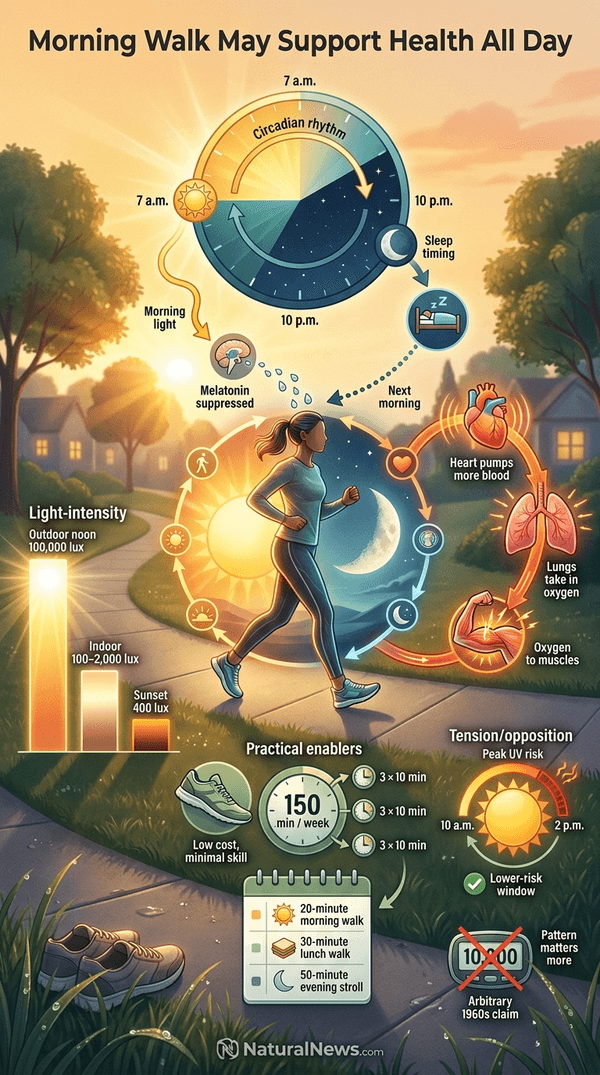
Starting the day outdoors in natural light may help maintain the body's circadian rhythm, according to studies reviewed by independent health publications. Morning sunlight is known to help regulate melatonin production, improving sleep quality and reducing insomnia, depression and anxiety, according to a report published by NaturalNews.com [4]. A separate study found that individuals with greater exposure to bright light during daylight hours showed earlier bedtimes and more consistent sleep schedules, findings that add to a growing body of evidence that daytime light exposure plays a key role in regulating circadian rhythms [5].
Light intensity is measured in lux units. Outdoor light at noon on a clear day can reach roughly 100,000 to 120,000 lux, while indoor environments typically average between 100 and 2,000 lux, according to author Danny Flood in Hack Sleep [6]. The same source notes that the sun at sunset provides roughly 400 lux, illustrating the gap between morning and midday exposure and most indoor settings. Mark Sisson, author of The New Primal Blueprint, writes that increased physical activity outdoors helps sleep and that walking first thing in the morning or around noon provides greater exposure to bright sunlight [7].
In the book Slow Beauty, author Shel Pink describes making first light a daily practice, stepping outside each morning to feel natural light on the skin, and notes that the habit continues in fall and winter months even when the sun rises later [8]. The reports state that early sunlight exposure, particularly before 10 a.m., may improve sleep at night by regulating the circadian rhythm, according to the study summaries reviewed.
Morning Walks Associated With Energy and Alertness
Morning walks have been associated with lower daytime sleepiness and improved alertness during the day, according to research cited by health outlets. The association is described as stemming from early sunlight exposure, which helps support the body's circadian rhythm, the report stated [4]. A study of forest walking among participants with sleep complaints found changes in sleep timing the night after the walk, with median sleep end time delayed approximately 20 minutes compared with the night before, according to the research published in the Journal of Environmental Psychology [9][9].
Separate research published in the journal Behavioral Sleep Medicine found that higher daily step counts were associated with better self-reported sleep quality and earlier sleep timing, and that participants who took more steps reported lower levels of anxiety, depression and stress, according to the report [10]. Health officials said morning walks have been associated with improved alertness, while cautioning that individual results vary.
An earlier study involving twenty healthy men found that dim light exposure during sleep can affect cognition the next day, according to research reviewed by Mercola.com [7]. The same review described how one lux equals the brightness of a surface illuminated by a single candle placed one meter away, and noted that twilight measures about 11 lux. Health officials also note that the first hour of the day sets the tone for immune resilience, with sunlight exposure, gentle movement and hydration listed among the recommended practices [11].
Morning Timing May Reduce Sun Risk; Attention Effects Uncertain
Walking early in the morning can help lower risk from sun exposure because the sun's rays are strongest between 10 a.m. and 2 p.m., according to health agencies. The guidance places morning hours, along with late afternoon and evening, in a lower-risk window for ultraviolet exposure. Reports state that walking before 10 a.m. supports the circadian system while avoiding the period of peak solar intensity [2].
Some studies have found metabolic and cognitive benefits to morning walking, but research is inconsistent on whether those benefits are unique to the time of day, the report stated. One study suggested improvement in selective and sustained attention after exercise regardless of time, according to the study summary. A researcher involved in the work said research is inconsistent on whether attention benefits are unique to morning exercise, according to the report [12].
Widely cited research on step patterns has also challenged the popular 10,000-step benchmark. A comprehensive study tracking more than 33,000 adults for nearly a decade concluded that the pattern of walking matters more than the total step count, according to the findings reported by NaturalNews.com [13]. The report stated that the 10,000-steps-per-day goal is largely arbitrary and originated as a marketing claim for a pedometer in the 1960s. Research shows health benefits with fewer than 10,000 steps, and setting goals that are too difficult can discourage regular walking, the report stated. Ways to add steps include walking to work or the store, taking stairs, parking farther away and walking during breaks, officials said.
Regular Walking Offers Broad Benefits; Guidelines Recommend 150 Minutes Weekly
Regular walking has been associated with cardiopulmonary fitness, reduced heart disease and stroke risk, blood pressure management, improved circulation, reduced bone loss, weight management, immune function, reduced joint pain in older adults, better blood sugar control, improved sleep and mood, slowed mental decline, and improved muscle strength and mobility in older adults, according to health sources [1][12]. The benefits extend to the workplace and the commute: a 20-minute morning walk, a 30-minute lunch walk and a 50-minute evening stroll together meet a 100-minute daily target without requiring a gym membership, according to the guidance [1].
At least 150 minutes of moderate-intensity exercise is recommended weekly, officials said, and moderate intensity varies by person and can be split into two 15-minute or three 10-minute walks. Research on morning routines has also found that simple, sustainable habits can affect blood sugar levels, which naturally rise at dawn as the body releases hormones such as cortisol to promote wakefulness, according to registered nurse Carrie Madormo's updated recommendations reviewed by registered dietitian Karina Tolentino [14].
Authors writing on habit formation describe how routines reinforce themselves over time. In Your Mind Builds Your Body, author Snipes Roger writes that once the mind and body are trained to crave good things, health benefits follow and people begin to instinctively reject things that make them feel bad [15]. Sleep researchers caution against relying on medication rather than natural methods. The Merck Manual Home Health Handbook states that most sleep aids, even at recommended doses, are particularly risky for older people and those with breathing problems and can reduce daytime alertness [16]. Magnesium has been shown to reduce cortisol levels after aerobic exercise, according to Hack Sleep, which advises using supplementation sparingly and only after natural methods have been tried [6].
Conclusion: Morning Walks and All-Day Health
Morning walking may support circadian rhythm, alertness and attention while reducing sun exposure risk, but research on attention timing is inconsistent, studies stated. Health officials recommend 150 minutes of moderate-intensity exercise weekly, adjustable by fitness level and able to be split into shorter sessions [2][1].
Walking is described as a versatile form of exercise whose benefits accrue with regular activity regardless of the exact step count, according to research [13].
References
- NaturalNews.com. "Beyond the stroll: Why adding challenge to your walk builds real strength". NaturalNews.com. July 04, 2026.
- NaturalNews.com. "Morning Walks Linked to Sleep, Energy, and Other Health Benefits, Reports Say". NaturalNews.com. September 10, 2026.
- NaturalNews.com. "Beyond a Simple Stroll: How a Morning Walk Activates Your Body's Natural Healing Systems". NaturalNews.com. February 24, 2026.
- NaturalNews.com. "The science of sleep How small changes can transform your health and well being". NaturalNews.com. February 09, 2026.
- NaturalNews.com. "Bright Daytime Light Exposure Linked to Earlier Bedtimes and Deeper Sleep, Study Finds". NaturalNews.com. July 30, 2026.
- Danny Flood. "Hack Sleep How to Fall Asleep Faster Sleep Better and Sleep Well and Naturally Reverse Sleep Disorders Hacks to Create a New".
- Mercola.com. "Rare Gene Mutation Allows Some People to Thri". Mercola.com. January 05, 2017.
- Shel Pink. "Slow Beauty".
- Emi Morita et al. "A before and after comparison of the effects of forest walking on the sleep of a community-based sample of people with sleep complaints". Journal of Environmental Psychology. 2014.
- NaturalNews.com. "Daily walking linked to improved sleep, mood and stress levels, study finds". NaturalNews.com. July 03, 2026.
- NaturalNews.com. "Winter immunity boost Natural strategies to stay cold free all season". NaturalNews.com. February 04, 2026.
- NaturalNews.com. "Morning walks deliver a powerful prescription for heart health, mental clarity and longevity, research confirms". NaturalNews.com. January 31, 2026.
- NaturalNews.com. "Walk your way to a healthier heart: How you accumulate steps matters more than the total step count". NaturalNews.com. January 03, 2026.
- NaturalNews.com. "Morning routines can tame blood sugar spikes, new guidance shows". NaturalNews.com. August 06, 2026.
- Snipes Roger. "Your mind builds your body unlock your potential with biohacking and strength training".
- Justin L Kaplan, Barbara P Homeier. "The Merck Manual Home Health Handbook".
Explainer Infographic












Please contact us for more information.


