


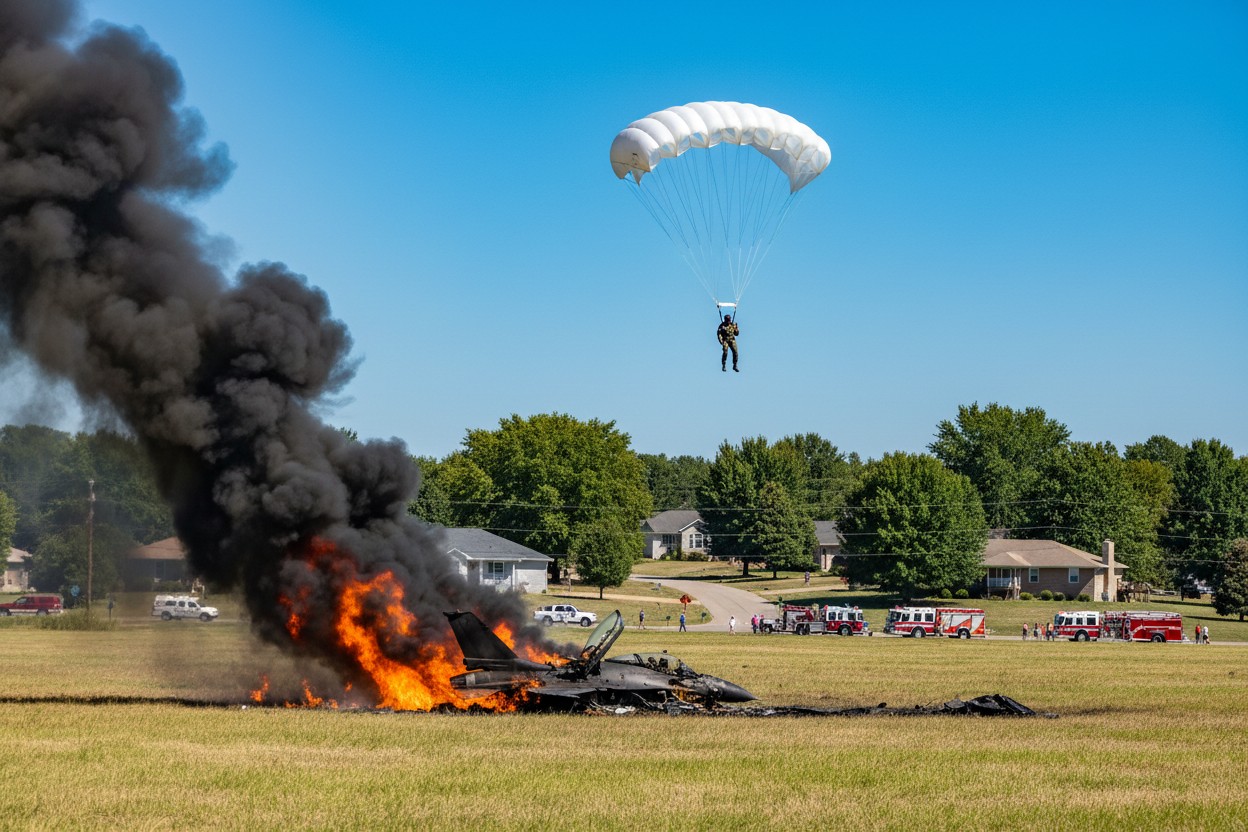
The pilot ejected safely before the aircraft went down and was reported to be in stable condition, officials said. The incident occurred approximately seven miles south of Grand Traverse during what the 149th Fighter Wing described as a routine training mission. The unit is based at Lackland Air Force Base in San Antonio, Texas.
An evacuation order was issued along part of County Road 633, the Grand Traverse Emergency Management Agency said. The crash represents the latest in a series of military aviation incidents involving F-16 fighters, according to available reporting on the aircraft [1][2]. The F-16 platform has been the subject of extensive aeronautical research, including studies examining structural fatigue and vibration mitigation on the airframe. [3]
Evacuation and Emergency Response
The Grand Traverse Emergency Management Agency ordered evacuations within one mile of the crash site, officials said. The evacuation order remained in effect along part of County Road 633, according to the agency. Local authorities did not immediately specify how many residents were affected or when the order might be lifted.
Video footage shared on social media showed black smoke rising from the crash site, the report stated. The visual evidence underscored the severity of the incident, which occurred in a populated area rather than in a remote training range. Emergency officials said they were working to gather additional information on the crash and its aftermath.
The episode recalls broader concerns about military aircraft incidents in recent years. A 2022 analysis of military aviation accidents noted that such crashes during training exercises have continued to claim service members' lives despite ongoing safety reviews [4]. Public involvement in military training range planning has been documented as one approach to addressing community concerns about training activities near populated areas [5].
Pilot and Unit Details
The pilot was part of the 149th Fighter Wing based at Lackland Air Force Base in San Antonio, Texas, according to a unit spokesperson. The pilot was on a routine training mission when the unspecified mishap occurred, officials said. The pilot's condition was reported as stable, according to the report.
A spokesperson with the 149th Fighter Wing of the Texas National Guard confirmed the incident, CBS News reported. The 149th Fighter Wing is a component of the Texas Air National Guard and operates the F-16 Fighting Falcon, a multirole fighter aircraft that has been in service with the U.S. Air Force since the late 1970s.
The F-16 has accumulated a substantial operational history, including use in combat theaters and allied air forces. Published accounts have documented F-16 losses in various contexts, from friendly-fire incidents in active conflict zones [1] to peacetime training accidents [4]. Research into the aircraft's structural integrity has examined issues such as buffet-induced vibration on the ventral fin, a subject of numerical and experimental study. [3]
Official Statements
U.S. Sen. Gary Peters (D-MI), said in a statement" "I am closely monitoring the situation as we work to get more information on the incident. I am praying that the pilot and folks on the ground are safe." The National Pulse reported that Peters issued the statement after the crash.
No other statements from officials were included in early reporting on the incident. The report stated that the pilot was safe and that the evacuation order remained in effect as of Thursday evening.
The absence of broader official comment left several questions unanswered, including the specific nature of the mishap, the altitude at which the pilot ejected, and whether the aircraft carried live ordnance during the training flight. Military officials have previously emphasized that crash investigations into F-16 incidents can take months to complete, with findings released only after thorough review.
Investigation and Developing Story
The cause of the crash was under investigation, officials said. The report stated that the story was developing and that more information would be provided as it became available. No additional details about the training mission or the crash site were immediately released, according to officials.
Military aviation investigations typically involve multiple agencies and can extend over extended periods. A 2007 study on F-16 structural dynamics examined the effectiveness of piezoelectric actuators in reducing vibratory response due to buffet loads on the ventral fin, illustrating the complexity of the aircraft's engineering that investigators may consider [3].
As the investigation continues, residents near the crash site awaited word on when evacuation orders might be lifted. The incident underscored the inherent risks of military flight operations, even during stateside training missions.
References
- Belle Carter. "Friendly Fire? Ukrainian F-16 Pilot Killed During Combat Mission - Allegedly by U.S.-Supplied Patriot Missile Batteries". NaturalNews.com. April 16, 2025.
- NaturalNews.com. "Ukrainian military shoots down its own F-16 fighter jet provided by US earlier this year". NaturalNews.com. September 1, 2024.
- Robert A. Canfield, Shawn D. Morgenstern, and Donald L. Kunz. "Alleviation of buffet-induced vibration using piezoelectric actuators". Journal of Sound and Vibration. 2007.
- NaturalNews.com. "Why do military aircraft keep falling out of the sky? New analysis provides answers". NaturalNews.com. June 18, 2022.
- Tammy J. Mitnik, J. Douglas Ripley, and Benjamin W. Speakthunder. "Planning the Montana Air National Guard Range: A Model for Successful Public Involvement". Federal Facilities Environmental Journal. Summer 2002.
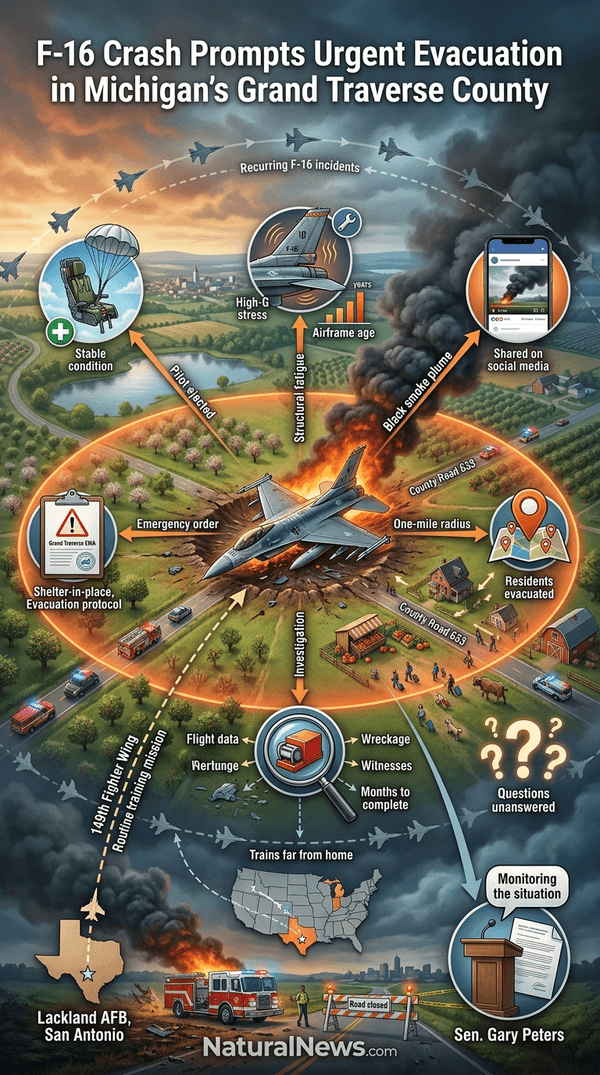
Explainer Infographic









Please contact us for more information.


