


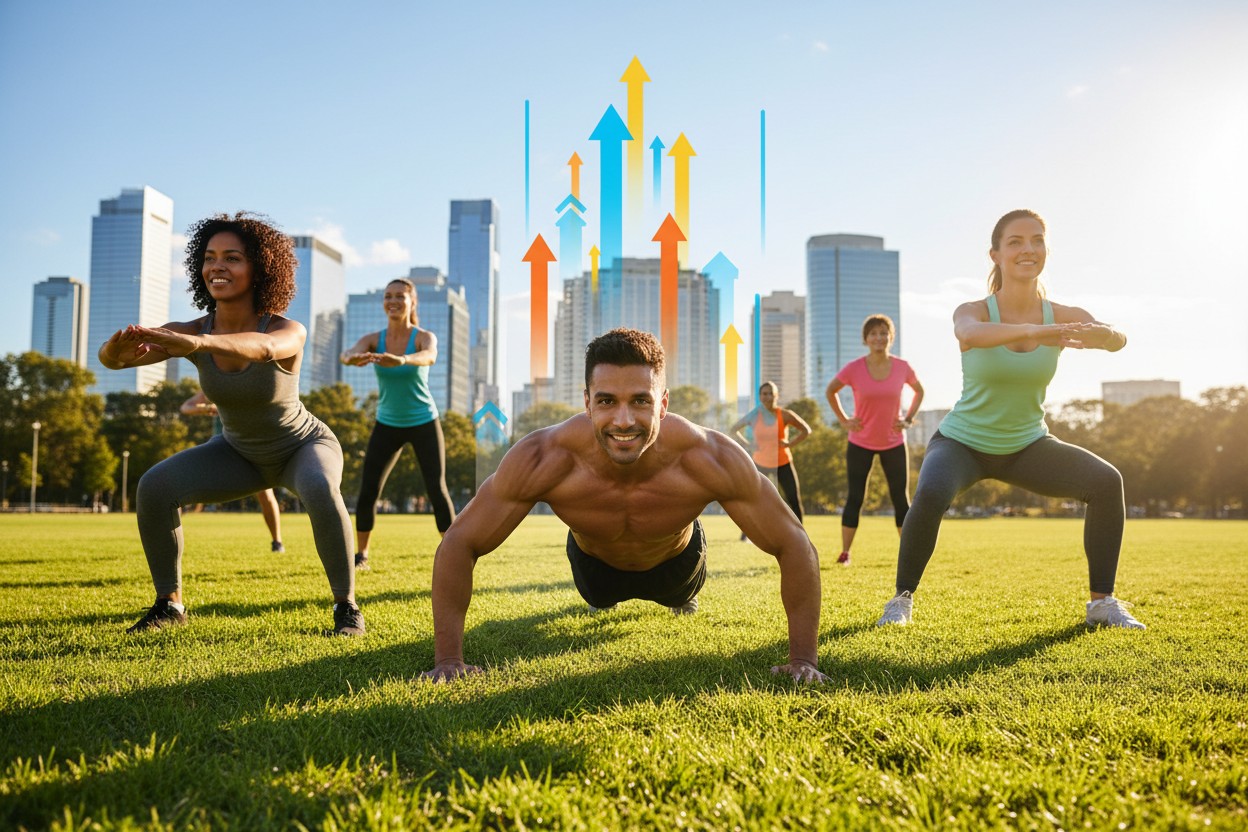
Fitness experts note that bodyweight movements provide sufficient resistance for muscle growth when performed with proper form and progressively increased difficulty. The new guidance recommends that healthy adults train each major muscle group at least twice per week [2]. For individuals seeking equipment-free options, a series of five fundamental exercises can target the chest, back, legs, and glutes, and these movements can be scaled to accommodate different fitness levels [3].
Push-ups and Pull-ups Train Upper Body Muscles
Push-ups primarily engage the chest, anterior shoulders, and triceps, according to exercise physiology resources, while also activating trunk stabilizers. Proper form involves starting in a high plank position with hands slightly wider than shoulder-width apart, lowering the chest under control, and pressing back up to the starting position. Fitness guidelines describe the push-up as a compound movement that works multiple muscle groups simultaneously [4].
Pull-ups target the latissimus dorsi, upper back, and biceps, with standard guidance to grasp an overhead bar and pull the chin toward the bar using controlled motion. For those unable to perform the standard versions, exercise resources recommend regression strategies. Beginners can perform assisted pull-ups with resistance bands or incline push-ups with hands on an elevated surface, according to instructions in bodyweight training manuals [5]. Progression methods include elevating the feet for push-ups or performing slow negatives during pull-ups to increase difficulty as strength improves [5].
Squats and Lunges Strengthen Lower Body
Bodyweight squats work the quadriceps, gluteus maximus, and hamstrings, according to fitness guidelines, with instructions to place feet shoulder-width apart and lower the body as far as comfortable. The squat is classified as a compound movement because it engages the posterior chain muscles, lower back, and calf muscles in a single exercise [4]. Fitness experts have described the squat as a cornerstone for building functional strength and improving balance, with benefits that extend to reducing the risk of falls [6].
Lunges challenge the quadriceps, glutes, and hamstrings while requiring single-leg balance, typically performed by stepping forward and lowering both knees toward the ground. To increase difficulty, individuals can progress to single-leg variations such as split squats or reverse lunges [3]. Exercise experts state that comfortable range of motion varies by individual, and exercises should be performed within pain-free and controllable limits. Progressions in bodyweight training are designed to be gradual, with an emphasis on improving every week rather than forcing immediate advancement [7].
Glute Bridges Activate Posterior Chain Muscles
Glute bridges primarily engage the glutes and hamstrings while also recruiting trunk stabilizers, as noted in exercise references [4]. The movement involves lying on the back with knees bent and feet flat on the floor, lifting the hips to form a straight line from shoulders to knees, holding the position briefly, then lowering with control. This exercise can be performed in a small space without equipment, similar to other at-home leg strengthening routines recommended for older adults [8].
Single-leg bridge variations can increase the challenge for those seeking progressive overload, while reducing the range of motion makes the exercise easier, according to fitness coaches. The principle of gradual progression applies across all bodyweight exercises, with literature noting that focusing on incremental improvement each week is the path to continued gains [7]. Individuals with heavier body weight may need to start with easier variations, and the guidance states that these regressions are appropriate starting points that lead to progress over time [7].
Progressive Overload Key to Muscle Growth
The American College of Sports Medicine recommends training each major muscle group at least twice weekly, but fitness professionals emphasize that muscles require progressive overload to adapt and grow [2]. Progressive overload involves gradually increasing the number of repetitions, reducing rest time between sets, or transitioning to more demanding exercise variations such as elevating the feet during push-ups or adding single-leg movements to bridge exercises. Bodyweight training literature indicates that focusing on the traditional mid-repetition range of 8-12 repetitions is effective for muscle growth, though higher repetitions become useful at more advanced levels [7].
Exercise science literature states that consistency in training frequency and effort is more critical than extreme workout intensity [2]. The updated ACSM guidelines specifically note that all forms of resistance training -- whether using free weights, resistance bands, or bodyweight exercises -- yield results when performed regularly [1]. This finding supports the view that maintaining a simple, consistent routine produces better outcomes than intermittent attempts at perfection [1].
Stop Exercises on Pain or Discomfort
Exercise guidelines state that muscle fatigue is an expected response to resistance training, but sharp or persistent joint pain, dizziness, or other concerning symptoms require stopping the activity. Spoken guidance from health advocates reinforces that individuals bear responsibility for their own well-being and must listen to their bodies during physical activity [9]. Sudden pain is not a normal response to resistance training, and medical evaluation is recommended if symptoms persist.
"If an exercise becomes difficult to control, switch to an easier variation rather than forcing the movement," said a spokesperson for a national fitness organization. This approach aligns with bodyweight training guidance that recommends performing exercises with strict form and controlled tempo rather than pushing through pain [10]. The progressive nature of bodyweight programs is designed to accommodate individual limits, allowing exercisers to master foundational movements before advancing to more difficult variations [5].
References
- Belle Carter. "New strength-training guidelines: Simplicity and consistency trump perfection". NaturalNews.com. March 30, 2026.
- Belle Carter. "New strength training guidelines Simplicity and consistency trump perfection". NaturalNews.com. March 30, 2026.
- Academy Fitness. "FITNESS COLLECTION Bodyweight Training + Hiit Training Fitness Training and Workout Motivation Improve your body".
- Fitness Academy. "FITNESS COLLECTION Bodyweight Training + Hiit Training Fitness Training and Workout Motivation Improve your body shape".
- Arvanitakis Anthony. "How to Build Strong Lean Bodyweight Muscle A Science-based Approach to Gaining Mass without Lifting Weights".
- NaturalNews.com. "Squat variations offer a blueprint for lower-body strength, balance, and injury prevention". August 17, 2026.
- Arvanitakis Anthony-2. "How to Build Strong Lean Bodyweight Muscle A Science-based Approach to Gaining Mass without Lifting Weights".
- NaturalNews.com. "Report: Five At-Home Exercises for Leg Strength in Adults Over 60". August 18, 2026.
- Mike Adams - BrightVideos.com. "Bright Videos News - AI BOTS LAUNCH RELIGIONS". February 04, 2026.
- Dr Mark Sisson. "Primal Blueprint Fitness".
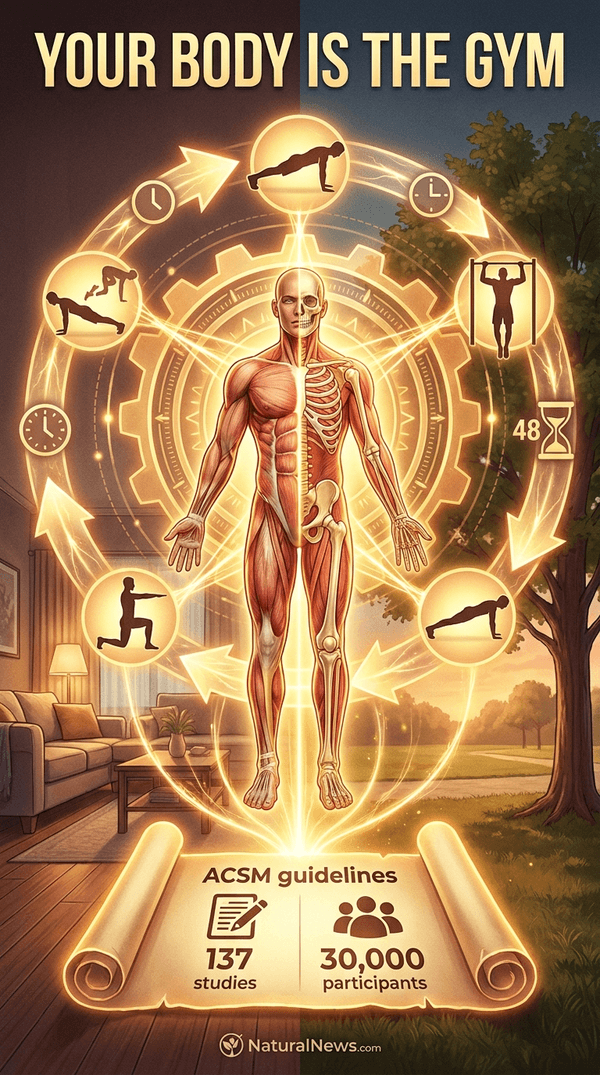
Explainer Infographic








Please contact us for more information.


