


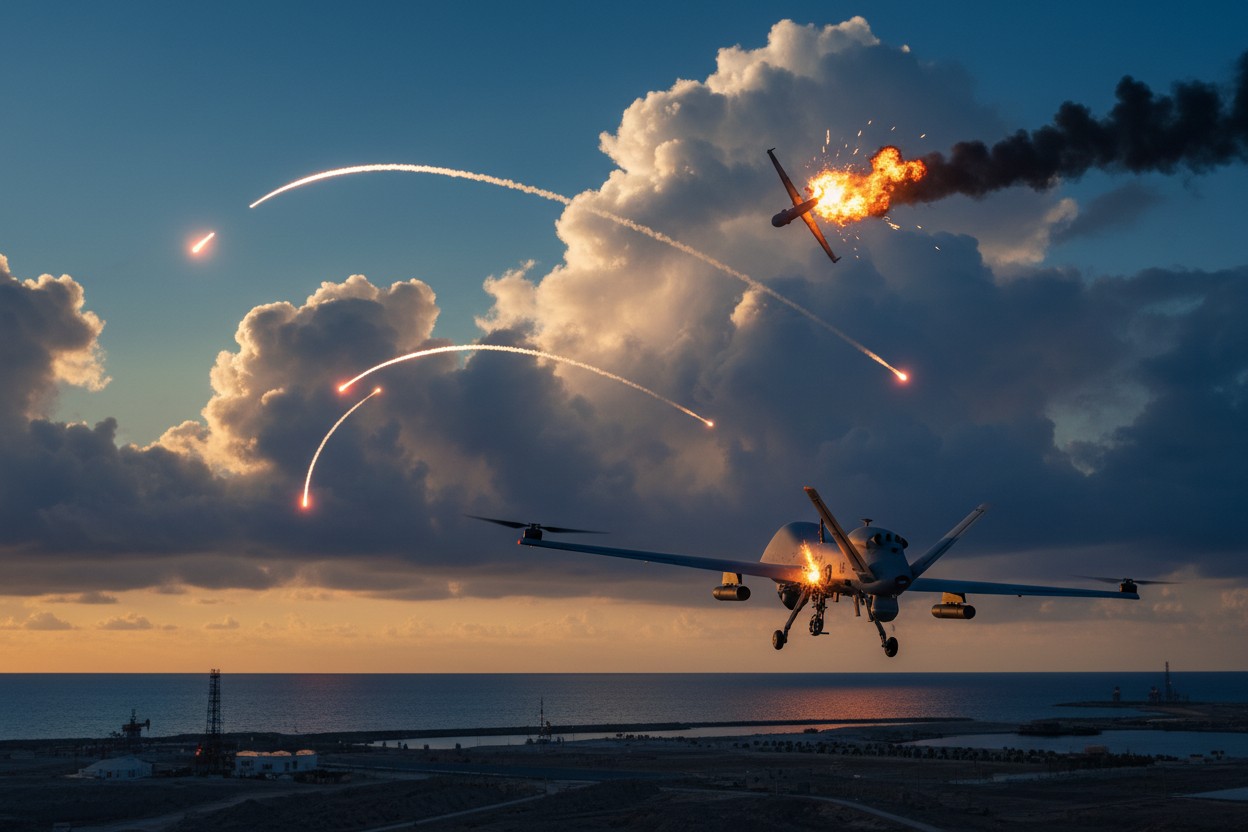
- Iran’s Islamic Revolutionary Guard Corps destroyed a U.S. Saildrone Explorer unmanned surveillance vessel near the Strait of Hormuz on Sept. 10, 2026.
- The IRGC released video showing the burning drone, identified by hull number 5838.
- Incident follows Iran’s capture of a U.S. underwater drone in the same waters two days earlier.
- Brent crude prices surged above $107 per barrel as global energy traffic faces severe disruption.
- The U.S. military has not confirmed the loss, as Tehran warns of targeting any “hostile presence” in the strategic waterway.
Strait of Hormuz: Flashpoint reaches boiling point
Iran’s Islamic Revolutionary Guard Corps destroyed a U.S. Saildrone Explorer reconnaissance vessel at the entrance to the Strait of Hormuz on Thursday, Sept. 10, 2026, releasing video of the unmanned craft burning in the water. The IRGC Navy identified the vessel by hull number 5838 and claimed it was struck while conducting surveillance near the strategic waterway that handles roughly one-fifth of global oil traffic. The attack marks the second major confrontation in 48 hours following Iran’s capture of a U.S. underwater drone, pushing tensions between Washington and Tehran to levels not seen since the 2019 downing of a U.S. drone by Iranian forces.
The roughly seven-meter Saildrone Explorer, a commercial-grade unmanned surface vessel equipped with cameras, sensors and communications systems, was previously deployed with the U.S. Navy’s 5th Fleet Task Force 59 based in Bahrain. That unit was specifically established to integrate unmanned systems and artificial intelligence into regional maritime operations. Iran’s state media described the vessel as an American surveillance drone, though the Pentagon has not confirmed its loss or released an official statement on the incident.
The two-day assault: A coordinated campaign
The destruction of the Saildrone Explorer came just two days after the IRGC captured a U.S. underwater drone at the same location. Tehran released footage showing what appeared to be an Anduril-built Dive-LD autonomous underwater vehicle commissioned by the U.S. military in 2025. The Pentagon acknowledged losing that submersible but characterized it as old, broken, and carrying no sensitive data or classified equipment.
The timing suggests a coordinated Iranian campaign to challenge U.S. surveillance operations along one of the world’s most vital energy corridors. The IRGC explicitly framed its actions as defensive, stating that “the American terrorist and aggressor army” dispatched unmanned vessels “out of fear of approaching and confronting the fighters of Islam.” The warning was unambiguous: “Any hostile presence in this strategic strait will be targeted.”
Chokepoint warfare returns
The Strait of Hormuz has served as a flashpoint for U.S.-Iran tensions for decades. In 1988, the U.S. Navy engaged Iranian naval forces in Operation Praying Mantis, destroying oil platforms and naval vessels after Iran mined international waters. Iran has repeatedly threatened to close the strait in response to sanctions or military pressure.
The current confrontation, however, represents an unprecedented escalation in the use of unmanned systems. Iran’s simultaneous targeting of both surface and subsurface U.S. drones demonstrates a sophisticated anti-access and area-denial strategy explicitly designed to contest American naval dominance in the Persian Gulf. This mirrors broader trends in modern naval warfare, where low-cost drones increasingly challenge expensive warships and surveillance platforms.
Economic shockwaves: Oil above $107
The confrontation has severely disrupted traffic through the Strait of Hormuz, pushing Brent crude oil above $107 per barrel. Beyond the immediate price spike, the disruption threatens global energy security at a time when Iran-aligned Houthi forces are tightening their grip on Bab al-Mandeb, another vital chokepoint linking the Red Sea and the Indian Ocean. Together, these two waterways handle a significant portion of global liquefied natural gas and crude oil shipments.
The U.S. has reportedly destroyed several Iranian oil tankers in response to IRGC ballistic missile attacks on American warships. Iran has reciprocated by striking U.S. vessels and commercial tankers it accuses of violating restrictions in the strait. The cycle of escalation has turned the Persian Gulf into a contested battlespace, with commercial shipping caught in the middle.
Strategic implications: A precedent for drone warfare
The U.S. military’s decision not to confirm the loss of the Saildrone Explorer raises questions about its ability to protect uncrewed assets in contested environments. The Pentagon’s previous characterization of the captured underwater drone as “old and broken” may reflect an attempt to downplay Iranian successes, but it also highlights the vulnerability of unmanned systems operating near hostile shores.
The situation carries echoes of Iran’s 2019 shootdown of a U.S. Navy RQ-4A Global Hawk drone, which brought the two nations to the brink of direct military confrontation. That incident triggered President Trump’s approval of retaliatory strikes, which were called off at the last minute. The current administration faces similar choices: whether to respond militarily to the destruction of U.S. equipment or de-escalate through diplomatic channels.
A crisis without clear exit
The Strait of Hormuz has once again become the crucible of U.S.-Iran confrontation, with unmanned systems now serving as the primary means of provocation and response. Iran’s destruction of the Saildrone Explorer and capture of the underwater drone represent tactical victories for Tehran, but they also risk triggering a broader military escalation that neither side has shown willingness to pursue. The economic consequences are already measurable, with oil prices climbing and global shipping facing mounting risks. Without direct communication channels or mutual restraint, the pattern of attack and response threatens to pull both nations into a conflict that neither can control and few can afford.
Sources for this article include:






Please contact us for more information.


