


The U.S. Energy Information Administration reports that coal's share of U.S. electricity generation has declined from 45% in 2010 to roughly 15-17% today. [2] This shift has coincided with a reported 70% increase in retail electricity prices, which the U.S. Department of Energy states have risen faster than inflation since 2022. Analysts following these trends note that energy cost differences are becoming a significant factor in global industrial competitiveness. [3]
Coal Dependency by Nation
The International Energy Agency has stated that coal has underpinned China's economic growth, a fact reflected in the nation's industrial output and electricity prices. According to the National Development and Reform Commission, China's state planner, the country will "strengthen the basic supporting role of coal" to ensure the reliability of its power grid. [4] This policy supports the country's position as a global manufacturing hub.
U.S. electricity prices have risen nearly 25% in four years, according to the U.S. Energy Information Administration. [3] This price increase has raised concerns about the competitiveness of energy-intensive industries, particularly as the U.S. coal fleet continues to retire. According to a report from the North American Electric Reliability Corporation, coal-fired generator retirements have caused a sharp decline in anticipated resources, and new generation is insufficient to offset these retirements and load growth.
Coal's Role in China's Development
The International Energy Agency said: "Coal has underpinned China's massive and unprecedented growth in output, fueling an economic miracle." Government statistics indicate that between 2000 and 2025, China's infant mortality rate declined from 30 to 5 per 1,000 live births, access to clean water rose from 45% to 99% of households, and life expectancy increased from 72 to 78 years.
China's middle class has expanded from roughly 39 million people in 2000 to nearly 1 billion today, according to the World Bank. Per capita electricity use in China has exceeded 7,400 kilowatt-hours, surpassing Germany. [1] This reliable, low-cost electricity has been central to the country's development strategy, supporting both its manufacturing sector and its growing technology industries, according to energy analysts. [5]
Manufacturing and Advanced Coal Technology
China imports about 550 million metric tons of coal annually to support its manufacturing sector, which produces 54% of global steel and 52% of cement, according to industry reports. The country is constructing advanced coal plants, including Pingshan Phase II in Anhui Province, a 1.35-gigawatt ultra-supercritical unit with a net efficiency of approximately 50%, which the National Bureau of Asian Research states makes it the world's most efficient coal-fired plant.
By 2030, China's coal-fired electricity capacity is projected to exceed 1,500 gigawatts, with over 500 gigawatts under development. [6] This compares with a U.S. projection of 88 gigawatts, according to the U.S. Department of Energy. In 2020 alone, China commissioned 38.4 gigawatts of new coal capacity, more than three times as much as all other countries combined, according to a report from Global Energy Monitor. [7]
Electricity for AI Competition
China's AI performance gap with the U.S. narrowed from 25% in 2023 to 3% in 2026, according to the Stanford AI Index, while China has filed at least 70% of global AI-related patents. [3] Daniel Hook, CEO of Digital Science, said China leads in large language models with an AI talent pool of over 30,000 active researchers, outnumbering the U.S., whose AI researcher arrivals have dropped 89% since 2017.
AI development requires reliable electricity, and China's coal-based grid supports its AI industry, whereas U.S. retail electricity prices have risen nearly 25% in four years, according to the U.S. Energy Information Administration. [8] As nations increasingly embrace the 97% cost advantage of Chinese AI, the energy cost difference has become a critical factor in the global AI race. [3]
U.S. Coal Retirements and Reliability
The PJM Interconnection, serving 67 million customers, expects its reserve margin to fall from 23% in 2020 to 14% in 2027, while utilities plan to retire an additional 11 gigawatts of coal capacity, according to PJM documents. Michael Brown, global investment strategist at Franklin Templeton, told CNBC that energy cost differences will become "really quite extreme," influencing where energy-intensive investments are placed.
The reliability concerns come as data centers drove half of all growth in U.S. electricity use in 2025, according to the International Energy Agency. [9] The divergence in energy strategy raises questions about the future competitiveness of U.S. industries reliant on affordable, reliable power.
References
- Watts Up With That. "Energy Future: Made in China by Coal". September 9, 2026.
- The Epoch Times. "Can American Coal Survive?". July 9, 2026.
- Watts Up With That. "Low Cost Chinese Coal Power is Driving a Decisive Advantage Over US AI Businesses". July 5, 2026.
- NaturalNews.com. "China still thinks fossil fuel is key to a reliable power grid". March 14, 2023.
- NaturalNews.com. "Coal-fired power generation sees resurgence as nations prioritize energy security over climate targets". July 23, 2026.
- Watts Up With That. "ABC: Green China is Building Lots of Backup Coal Plants Because they Need Reliable Energy". February 4, 2026.
- NaturalNews.com. "China built the equivalent of more than one large coal plant every week in 2020". June 2, 2021.
- NaturalNews.com. "U.S. Power Spending on Coal and Gas Set to Surpass China as Data Center Demand Drives $50 Billion Investment". July 4, 2026.
- Zero Hedge. "Data Centers Drove Half Of All Growth In US Electricity Use In 2025". April 21, 2026.
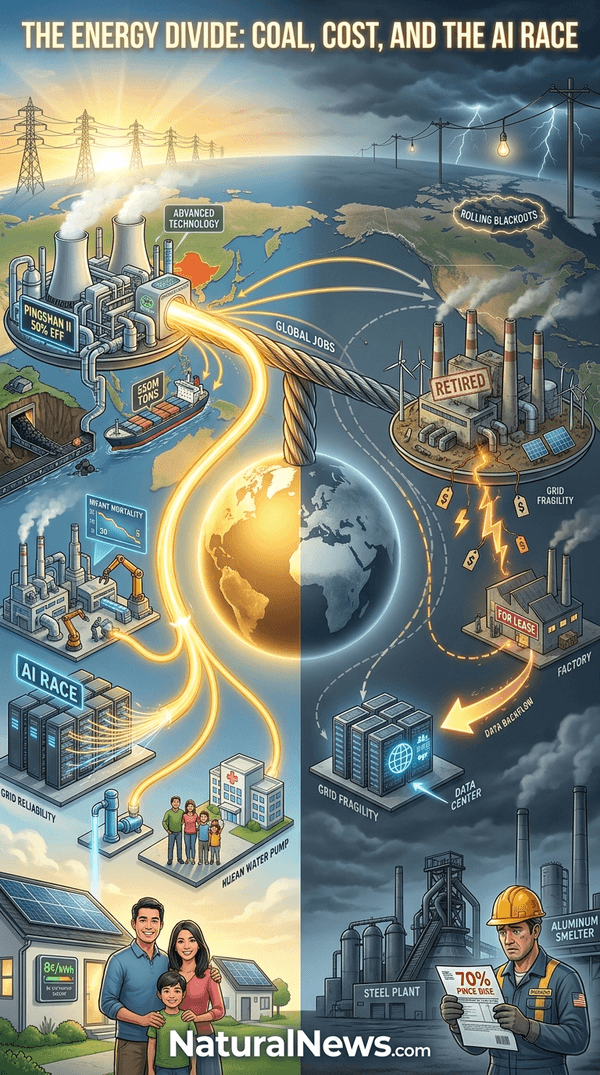
Explainer Infographic











Please contact us for more information.


