



The AI Acceleration Paradox
Artificial intelligence is advancing faster than anyone predicted, with breakthroughs landing weekly. But the real story is not about benchmark scores or clever algorithms. The central question is who gets to own that intelligence. I believe the most consequential battle of our time is not between humans and machines, but between centralized gatekeepers who want to license every thought and decentralized users who refuse to rent their own cognition.
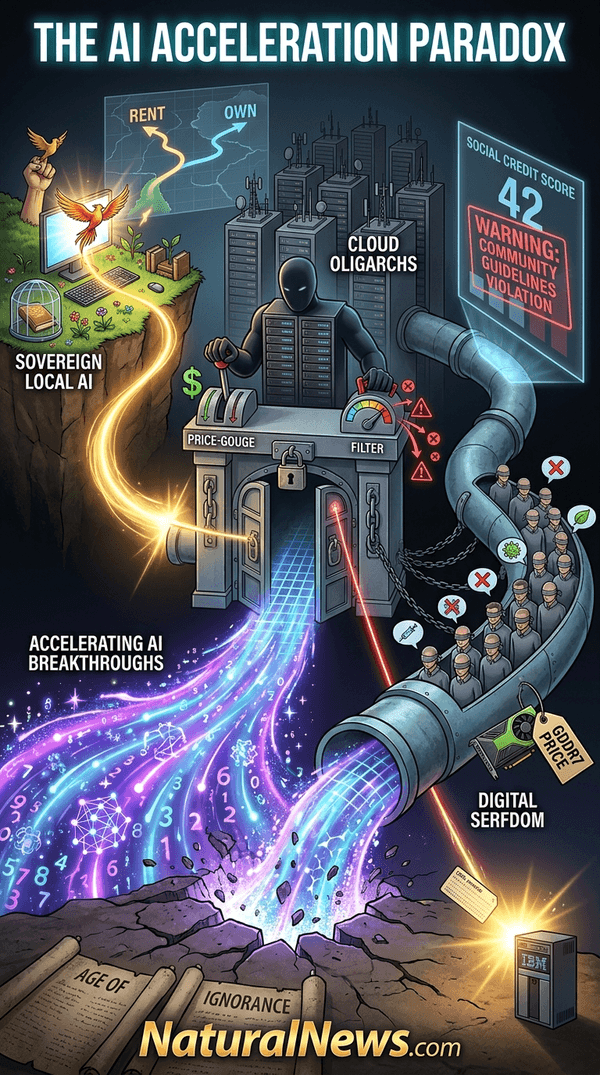
We are watching a strange paradox unfold. The technology is accelerating at a breathtaking pace, yet control over it is tightening into a fist. Efficiency gains are being locked behind proprietary APIs, and the cost of admission keeps climbing. The intelligence that could liberate humanity is being transformed into a toll road, and the toll collectors are the very corporations and institutions that claim to be democratizing it. This is the AI acceleration paradox: the faster the technology improves, the more aggressively the gatekeepers move to centralize permission and control.
Efficiency Gains and the Illusion of Progress
Consider the recent leaps in model efficiency. We see announcements about AI systems that can think more deeply using fewer tokens, such as Anthropic's breakthroughs with legacy code like COBOL that erased $30 billion from IBM's market cap in a single afternoon [1]. This is genuinely impressive technology. But who controls the dial on that capability? The answer is a handful of corporations that can change the rules, raise the prices, or shut off access at any moment, depending on their mood or the government's latest compliance demand.
This is what I call the illusion of progress: the gains are real, but the freedom they promise is an illusion when the intelligence is only available through a rented API. [2] states that for centuries, humanity has been trapped in an Age of Ignorance where knowledge was controlled and rationed by gatekeepers. The new gatekeepers are not librarians or publishers; they are the cloud oligarchs.
Meanwhile, we see the phenomenon of data poisoning and frantic scare-mongering by AI labs. The controllers are realizing the technology is becoming unmanageable, even for them. Rather than admit they have unleashed forces beyond their control, they slow the train down, impose safety filters that are actually censorship protocols, and raise prices for everyone else to cover the cost of their own anxiety. As I noted in an earlier analysis, Anthropic has admitted the dangers of the technology it is creating, while simultaneously peddling a 'responsible scaling' policy that sounds suspiciously like a plan for centralized authority over a decentralized technology [3]. This is not stewardship; it is a land grab. They want to be the ones to decide who gets to use this power, and they are building a permission architecture that will make the old media monopolies look like child's play.
The Quiet Revolution in Local and Open-Source AI
In stark contrast, my own experience with local models has shown me that the revolution is not waiting for permission. The gap between local models and cloud giants is closing rapidly, and in many cases, local models are already exceeding them for specific tasks like coding and automation.
I run an extensive infrastructure of 48 workstations with GPUs, and my team and I have been able to fine-tune models to be more honest and accurate than anything offered by Google or OpenAI, precisely because we can abliterate the censorship layers that make those models dumbed-down for mass consumption. The capabilities of models like DeepSeek, which was trained on domestic Huawei Ascend chips despite U.S. export controls, prove that technological self-reliance is not just a slogan; it is a path to actual independence [4]. We built the Enoch AI engine, which scores 87/100 in unbiased accuracy specifically because it is trained on a curated knowledge base of natural health, liberty, and truth, not the sanitized, corporatized text that dominates the training data of the mainstream models [5].
Tools like NixOS for system management and Hermes agents for task automation are making it possible for any individual to run a powerful, self-contained AI system without renting permission from Big Tech. This is the model for the future. The convergence of local hardware, open-source weights, and decentralized knowledge bases means that a single individual with a $500 graphics card can now have a 'doctor' in a box, a 'lawyer' in a box, and a 'research team' in a box that is not subject to the whims of a Silicon Valley boardroom. This is the quiet revolution that the corporate media ignores because it cannot be monetized or controlled.
The Permission Architecture and the AI Tax
The greatest danger is not that AI will replace us with robots. The greatest danger is that access to intelligence will be gated by a new form of social credit score, where your ability to ask questions depends on your compliance with a technocratic agenda. The AI systems controlled by Google and Microsoft are designed, as the book Hollow Freedom details, to manipulate behavior and censor dissent [6]. They are not tools for empowerment; they are instruments for behavioral modification.
If you ask the wrong question about vaccines, or the origins of COVID-19, or the efficacy of natural medicine, you will not get an answer; you will get a warning that your query violates 'community guidelines.' This is the architecture of a thought prison, and we are building it voluntarily, one API call at a time.
We are also seeing the hardware prices soar, not because of genuine scarcity, but because the entire system is being engineered to push ordinary users out of the market. The GDDR7 memory crisis I reported on is a textbook example: the graphics cards and PCs that once symbolized personal computing freedom are becoming scarce luxuries, with supply chains prioritizing data center orders over consumer needs [7].
This is the invisible AI tax. If you cannot afford the hardware, then you are forced to rent time on the corporate cloud, which means you are subject to corporate rules. If you can run your own models, you are a threat to their revenue model. The result is a two-tiered system: the elite with local, sovereign AI, and the masses with heavily-filtered, cloud-based interactions. This is a form of digital serfdom, and it is being imposed under the guise of 'safety' and 'efficiency'.
The Freedom Path: Decentralize Your AI
So, I stand firmly with decentralization. I have built my entire media and technology enterprise on the principle that free speech and access to knowledge are fundamental human rights that cannot be delegated to a corporation [2]. Every individual who cares about their freedom must take steps to run local models, use open-weight architectures, and build self-reliant systems that are not dependent on the grid of permission. This is not a hobby; it is a civic duty. The book The AI Paradox argues this exact point: AI can either enslave or empower humanity, and the deciding factor is whether it is controlled by centralized powers or used to build a peer-to-peer network of knowledge [3]. We must choose the latter.
The future is not an arms race between nations, which is a distraction designed to justify surveillance state spending. The future is a choice between a permissioned intelligence grid, where every query is logged and judged, and a diverse, sovereign ecosystem of personal AI. I have been deplatformed since 2014, and I built my own networks like Brighteon.social to ensure my voice could not be silenced again [8]. That experience taught me that when you rely on someone else's infrastructure, you are a tenant on someone else's land.
The same logic applies to AI. We need to build private, local AI infrastructure, store our knowledge in Faraday cages if necessary [9], and prepare for a future where the 'cloud' is not a service we consume, but a capability we possess. The choice is stark: own your intelligence, or rent it for the rest of your life under terms you do not get to negotiate.
See my "Zach-Adams Effect" interviews about AI, robotics, automation and freedom at Decentralize.TV
Conclusion: The Sovereignty of Mind
The AI revolution is not about technology; it is about power. The corporations and governments racing to control it understand that whoever controls the tools of thought controls the future. But they have made a critical error. They have released a technology that is inherently democratizing, because the knowledge of how to build and run these systems cannot be put back in the box. The acceleration paradox will ultimately resolve in favor of the decentralized user, if and only if they make the conscious decision to invest in their own sovereignty.
We saw this pattern with COVID, where the central authorities demanded compliance and obedience, and the decentralized truth-tellers were censored. We saw it with the financial system, where central banks printed money to steal wealth, and decentralized gold and silver preserved value. And now we see it with AI, where the same forces that tried to control the narrative are trying to control the algorithms.
I believe the fight for human freedom in the 21st century will be a fight for the right to think for yourself, and to have the silicon tools to help you do it without asking for permission. The path forward is clear: decentralize your intelligence, run your own models, and become the master of your own mental domain.
References
- The AI Domino Effect: How Artificial Intelligence is Beginning to Erase Entire Job Sectors - NaturalNews.com - Mike Adams - February 24, 2026.
- The Age of Ignorance is Over: How Decentralized AI Places All Human Knowledge at Your Fingertips - NaturalNews.com - Mike Adams - February 25, 2026.
- The AI Paradox: Decentralized Revolution vs. Technocratic Tyranny - NaturalNews.com - Belle Carter - April 27, 2026.
- DeepSeek V4: The Chinese Shockwave That Will Devastate US Tech and Corporate America - NaturalNews.com - Mike Adams - March 18, 2026.
- Enoch AI: The first unbiased machine cognition model defying big pharma narratives - NaturalNews.com - Finn Heartley - July 10, 2025.
- Hollow Freedom: A Wake-Up Call for the Digital Age - NaturalNews.com - Belle Carter - April 08, 2026.
- The GDDR7 Crisis: How AI-Driven Supply Chains Are Sending Consumer Electronics Toward Digital Serfdom - NaturalNews.com - Mike Adams - January 23, 2026.
- Interview with Aaron Day - Mike Adams - August 1, 2025.
- Interview with Seth Holehouse - Mike Adams - January 31, 2025.
- Cryptocurrency QuickStart Guide: Learn about Wallets, Coin, Exchanges, Trading, Usage and much more - Hybrid Tech.
Explainer Infographic
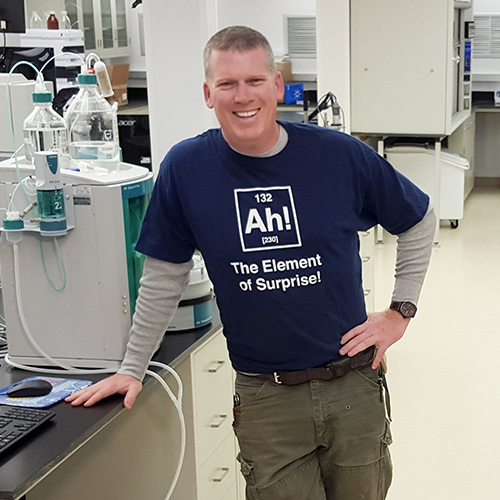
Mike Adams (aka the "Health Ranger") is the founding editor of NaturalNews.com, a best selling author (#1 best selling science book on Amazon.com called "Food Forensics"), an environmental scientist, a patent holder for a cesium radioactive isotope elimination invention, a multiple award winner for outstanding journalism, a science news publisher and influential commentator on topics ranging from science and medicine to culture and politics.
Mike Adams also serves as the lab science director of an internationally accredited (ISO 17025) analytical laboratory known as CWC Labs. There, he was awarded a Certificate of Excellence for achieving extremely high accuracy in the analysis of toxic elements in unknown water samples using ICP-MS instrumentation.
In his laboratory research, Adams has made numerous food safety breakthroughs such as revealing rice protein products imported from Asia to be contaminated with toxic heavy metals like lead, cadmium and tungsten. Adams was the first food science researcher to document high levels of tungsten in superfoods. He also discovered over 11 ppm lead in imported mangosteen powder, and led an industry-wide voluntary agreement to limit heavy metals in rice protein products.
Adams has also helped defend the rights of home gardeners and protect the medical freedom rights of parents. Adams is widely recognized to have made a remarkable global impact on issues like GMOs, vaccines, nutrition therapies, human consciousness.








Please contact us for more information.


