



President Donald Trump, speaking at a rally in Garden City, New York, on Friday, described Iran as “very evil” and said paying “a tiny little bit more for your gasoline” was worth preventing Iran from obtaining a nuclear weapon. The war launched by the United States and Israel on February 28 has entered its sixth month, according to a report [2]. Gharibabadi also said the strait “cannot be seized by a tweet or an aircraft carrier, by issuing an order or by delivering an election speech.”
U.S. Gasoline Prices and Political Fallout
The average U.S. price for a gallon of gasoline was about $4.08 on Friday, up 29% from a year earlier, according to the American Automobile Association. The increase has become a political issue: Trump campaigned for reelection on a promise to lower energy costs, and Democrats are seeking to make the war’s fallout an issue in November congressional elections, according to Reuters. A national poll found 55% of Americans said their household finances had been at least somewhat affected by rising fuel costs, with 21% reporting a significant impact, according to a March report [3].
Crude oil futures rose $1 a barrel on Friday. Brent futures were on track for a weekly rise of 6% and West Texas Intermediate 5.4%, according to market data. Earlier in the conflict, Brent topped $126 a barrel and the average U.S. gasoline price reached $4.30 per gallon, the highest since July 2022, with California averaging $6.00, according to a report [4]. Before the war, analysts warned that an escalation could push gasoline to $10 per gallon or higher [5].
Iran’s Conditions and Strait Traffic Data
Foreign Minister Abbas Araqchi said Iran has not decided whether to resume talks with the United States. In an interview published Saturday by Iranian outlet Shahrara News, Araqchi said Washington must meet conditions on the strait before shipping can resume, according to Reuters. The waterway handled one-fifth of the world’s oil before the war, and a chokepoint through which about 20% of global oil moves annually, worth $600 billion, according to an earlier analysis [6].
Ship-tracking firm Kpler counted only two vessels transiting the strait on Friday, with no crude oil shipments visible, compared with more than 130 ships daily before the war, according to analysis. Vessels that pass without Iranian permission risk missile or drone strikes, according to Reuters. The United Arab Emirates’ Abu Dhabi National Oil Company said two of its vessels were attacked while transiting the strait on Thursday evening, and Emirati state news agency WAM reported another vessel came under attack on Friday. War-risk insurance costs for ships in the region have risen sharply, with one report citing increases of as much as 500% in some areas [7].
Ceasefire Deal Collapse and Regional Attacks
A tentative June deal to end the war is in tatters, according to Reuters. Araqchi said: “We did not have a ceasefire in the first place that we would now want to extend. We had ‘the end of the war,’ and now there is a new situation.” Attacks by Iran-backed Houthi forces in Yemen have added to concerns about a widening regional war. Yemen’s internationally recognized government said the Houthis fired six ballistic missiles at the Red Sea port of Mocha on Friday, killing four civilians, according to Reuters. The Houthi-run SABA news agency cited a military source as saying the group had targeted an Aramco facility in the Saudi city of Najran with a drone. The Houthis have also said they are widening attacks to the northern Red Sea [8].
Trump and Treasury Secretary Scott Bessent each pledged to inflict more financial damage on Iran. Bessent told Newsmax’s “Rob Schmitt Tonight” program on Thursday that announcements of more measures against Iran were coming next week, according to Reuters. The White House has shifted toward economic warfare as military and diplomatic efforts have stalled, according to an August 13 report [9]. Inside Iran, President Masoud Pezeshkian blamed high inflation on a U.S. blockade of Iranian ports and sanctions on oil exports, according to remarks on state television.
No Sign of Movement Toward Ending Conflict
Trump wrote on Truth Social that “The U.S.A. has total control over the Strait of Hormuz” and said the U.S. naval blockade was being called “A WALL OF STEEL” [10]. He also said a 260-day deployment by a U.S. aircraft carrier supporting the war effort was “not nearly long enough,” according to his remarks. At a rally in New York, Trump said that “after we finish defeating Iran, which is being very badly defeated, pretty soon I’ll be declaring the Hormuz Strait a territory of the United States” [11].
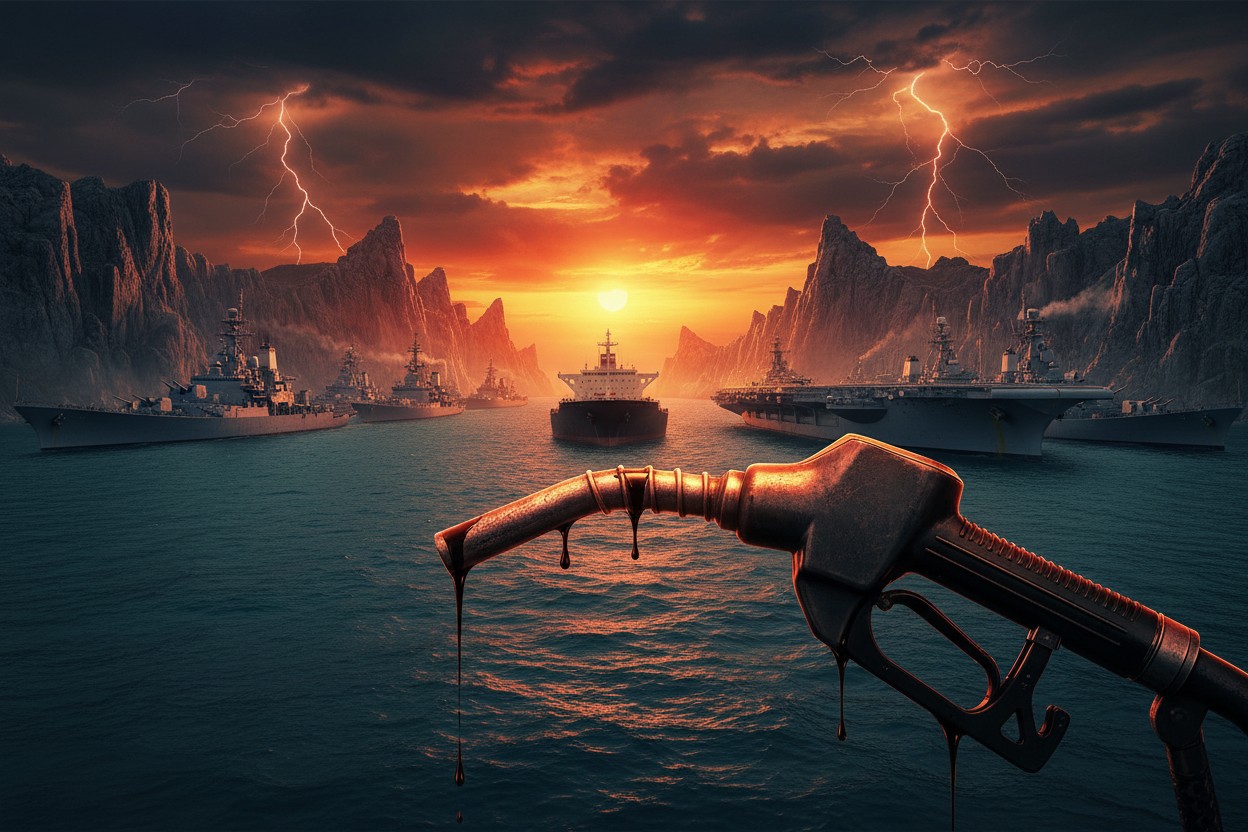
Iran’s control of the strait, a narrow passage between two islands, now dictates global trade flows, according to an analysis [12]. The result is a near-total embargo on Persian Gulf energy exports, which account for over 20% of global supply [12]. No sign was visible of the warring parties moving toward ending the conflict, and Iran’s defiant tone continued alongside signs of economic damage inside Iran, according to Reuters. One assessment said that if the war ended immediately, recovery would be possible, but continued conflict would bring severe economic consequences and extensive human suffering [13].
Wider Strategic and Economic Context
The confrontation over Hormuz is the latest chapter in a long U.S. commitment to protecting Persian Gulf oil routes. In 1981, the Reagan administration pushed through an $8.5 billion weapons deal for Saudi Arabia, and in 1983 Reagan signed National Security Decision Directive 114 declaring the U.S. ready to deter attacks on “critical oil” infrastructure, according to author Robert Bryce [14]. A unilateral Iranian decision to close the strait would put upward pressure on world oil prices, with consequences felt by consumers in China, India, Japan and elsewhere, according to a book on Iran’s strategic position [15].
Some market analysts have also argued that paper oil futures do not reflect the physical cost of crude. An analysis released in April said the paper price of oil futures was being manipulated in a manner similar to gold and silver markets [16]. In that environment, officials in Washington and Tehran remain far apart. The only movement reported on Saturday was Iran’s statement that the strait will stay under its command until its conditions are met.
References
- The Times of Israel. "In risky gamble, Iran bets control over Strait of Hormuz can force Trump to bend". August 8, 2026.
- Brian McGlinchey. "McGlinchey: Trump's Damage To US Diplomacy Could Last A Generation". Zero Hedge. August 2, 2026.
- Ava Grace. "Soaring Gas Prices, Strained Wallets, and the Shadow of a Distant War". NaturalNews.com. March 25, 2026.
- NaturalNews.com. "Oil Prices Hit Wartime High as Iran Conflict Escalates: Brent Crude Surges Past $126, Gas Prices Soar to $6 in California Amid Strait of Hormuz Blockade". NaturalNews.com. May 2, 2026.
- Lance D Johnson. "Israel-Iran War Threatens Oil Prices, with $10 per Gallon Gas Possible if War Escalates in the Persian Gulf". NaturalNews.com. June 17, 2025.
- Willow Tohi. "Strait of Hormuz: How 30 Miles Could Quadruple Oil and Gas Prices". NaturalNews.com. July 24, 2025.
- Bright Videos Network. "2026-03-13-BVN-GLOBAL FAMINE NOW CERTAIN_otter_ai-RESTATED".
- The War Zone. "Houthis To Expand Shipping Attacks To Northern Red Sea". August 5, 2026.
- NaturalNews.com. "U.S. Shifts to Economic Warfare Against Iran as Military and Diplomatic Efforts Stall". August 13, 2026.
- The Times of Israel. "Trump says US to keep up blockade, as Iran vows closed Hormuz until demands met". August 13, 2026.
- NTD. "Trump Says He May Declare Strait of Hormuz as US Territory ‘Pretty Soon’". August 14, 2026.
- Mike Adams - BrightVideos.com. "Bright Videos News - Interview with Seth Holehouse (Mike is a guest)". March 30, 2026.
- Mike Adams - BrightVideos.com. "Bright Videos News - Interview with Daniel Davis transcript". May 7, 2026.
- Robert Bryce. "Gusher of Lies: The Dangerous Delusions of Energy Independence".
- Jerome R Corsi. "Atomic Iran".
- Mike Adams - BrightVideos.com. "Health Ranger Report - OIL MARKETS MANIPULATED". April 15, 2026.
Explainer Infographic








Please contact us for more information.


