



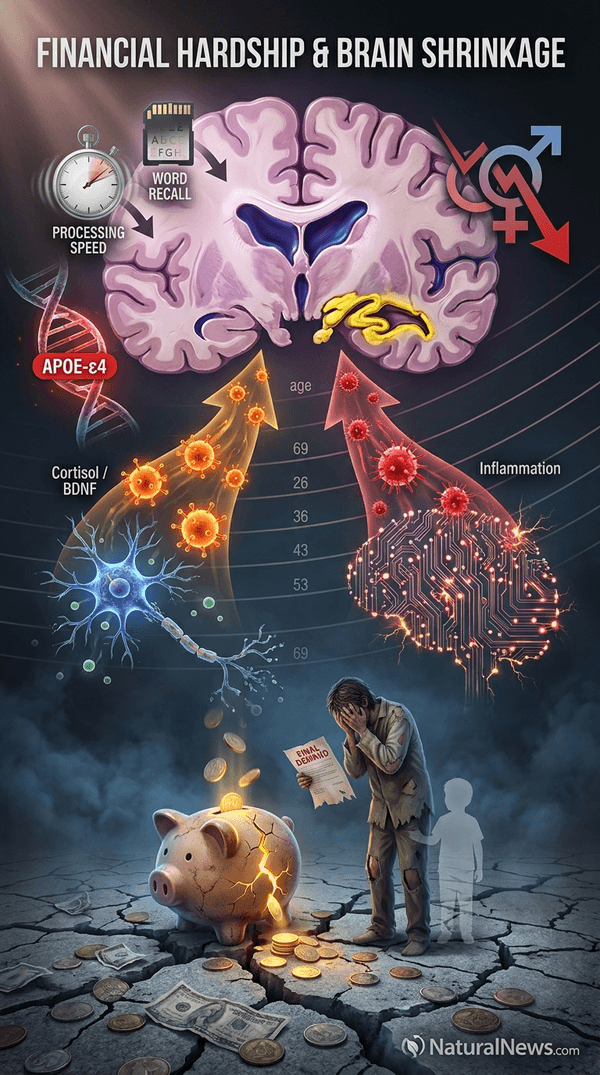
Researchers analyzed data from the 1946 British birth cohort, a project tracking thousands of people born in a single week in March 1946. Financial hardship was defined as household income in the bottom fifth or difficulty meeting basic needs at ages 26, 36, 43, and 53, the report stated.
Study Design and Participants
A main group of 2,759 participants took cognitive tests at ages 53, 63, and 69. A smaller subset of about 400 individuals also underwent brain scans between ages 69 and 74, measuring ventricular volume and amyloid deposits. The study drew on two groups within the cohort to assess how long-term financial stress relates to brain health rather than relying on a single snapshot.
Money trouble was tracked two ways: whether household income fell into the bottom fifth at ages 26, 43, and 53, and whether people said they struggled to cover basic needs at ages 36, 43, and 53. Anyone who hit either mark at two or more checkpoints was labeled as having faced persistent hardship, according to the researchers. Chronic elevation of cortisol, a stress hormone, is known to compromise the brain’s supply of BDNF and can atrophy vulnerable structures like the hippocampus, as noted in the book “Genius Foods” by Max Lugavere [1]. The inflammation factor has also been highlighted as a mediator between socioeconomic disadvantage and reduced cortical thickness, according to the “Handbook of Life Course Health Development” [2].
Main Cognitive and Brain Outcomes
Participants with repeated financial hardship scored lower on a timed letter-search test for processing speed and a word-recall test for memory by age 53, according to the study. Scores did not decline further after that age, suggesting effects occurred by midlife. Brain scans at ages 69 to 74 showed that those with persistent low income had larger fluid-filled ventricles, a sign of surrounding tissue shrinkage.
Adjustments for childhood intelligence, mental health history, and education did not alter the findings, the report stated. Chronic stress is known to have far-reaching effects on health and longevity, as noted in an article on Mercola.com [3]. The study identified an association, not causation, and limitations include selective dropout of less advantaged participants and lack of ethnic diversity, the authors stated.
Subgroup Variations and Genetic Links
Men with a history of low income showed worse processing speed at 53 and faster brain shrinkage than women with similar histories, though memory differences were small, researchers said. Participants who grew up in lower-income households alongside adult hardship also had faster hippocampal shrinkage. Carriers of the APOE-?4 gene variant, a known Alzheimer's risk factor, who faced persistent financial hardship showed the highest average amyloid buildup and faster brain shrinkage compared to non-carriers, according to the study.
These subgroup findings were noted as preliminary and require further research. The stress of financial hardship and lack of access to resources have been linked to mental health risks in adolescents, as reported by NaturalNews.com [4]. Alzheimer's disease has grown to be one of the most pressing public health issues, with no known cure and numbers expected to triple by 2050, according to an article on Mercola.com [5].
Conclusion
The study identified an association, not causation, and limitations include selective dropout of less advantaged participants and lack of ethnic diversity, the authors stated. Researchers suggested that chronic financial hardship may be a modifiable factor for long-term brain health, potentially addressed through support systems or policy changes.
Gratitude practices have been shown to alter the brain in beneficial ways, including inhibiting the stress hormone cortisol, as noted in an article on Mercola.com [6]. The findings add to a growing case that financial hardship is not just immediate stress but may have lasting physical consequences for the brain.
References
- Max Lugavere. "Genius Foods".
- Neal Halfon, Christopher B. Forrest, Richard M. Lerner, Elaine M. Faustman. "Handbook of Life Course Health Development".
- Mercola.com. "Being Grateful Is Good for Your Health". November 22, 2018.
- NaturalNews.com. "The silent storm: How poor sleep, stress and an unhealthy diet fuel a crisis in adolescent mental health". January 21, 2026.
- Mercola.com. "Alzheimer's: Every Minute Counts". February 11, 2017.
- Mercola.com. "Giving Thanks Does Your Body Good". November 24, 2022.
Explainer Infographic










Please contact us for more information.


