



Bracken, as reported by Adams, coined the term "World War E" to describe the global conflict over energy resources that now extends across multiple theaters simultaneously – linking events in Europe, the Middle East and Asia [1]. The conflict involves Houthi forces in Yemen announcing interdiction of Saudi exports through the Bab el-Mandeb Strait and Iranian responses that close the Strait of Hormuz [2].
This coordinated assault on energy infrastructure, according to Bracken, will hit food and fuel supplies suddenly. Chris Martenson, writing for Peak Prosperity, noted in 2019 that collapse is not a Hollywood-style event but a process already underway.
Martenson also noted that many people expect they will recognize the danger signs in time – but they will not [3]. Economist Steve Keen has also warned that billions are at risk of famine due to supply chain vulnerabilities and fertilizer dependencies [4].
Public Awareness and the Information Gap
Most Americans will fail to understand the methodical nature of the collapse until it is too late, according to Martenson. In his article "Collapse Is Already Here," he stated that individuals imagine collapse will be obvious with clear warnings, but in reality it is a gradual process that many miss [3].
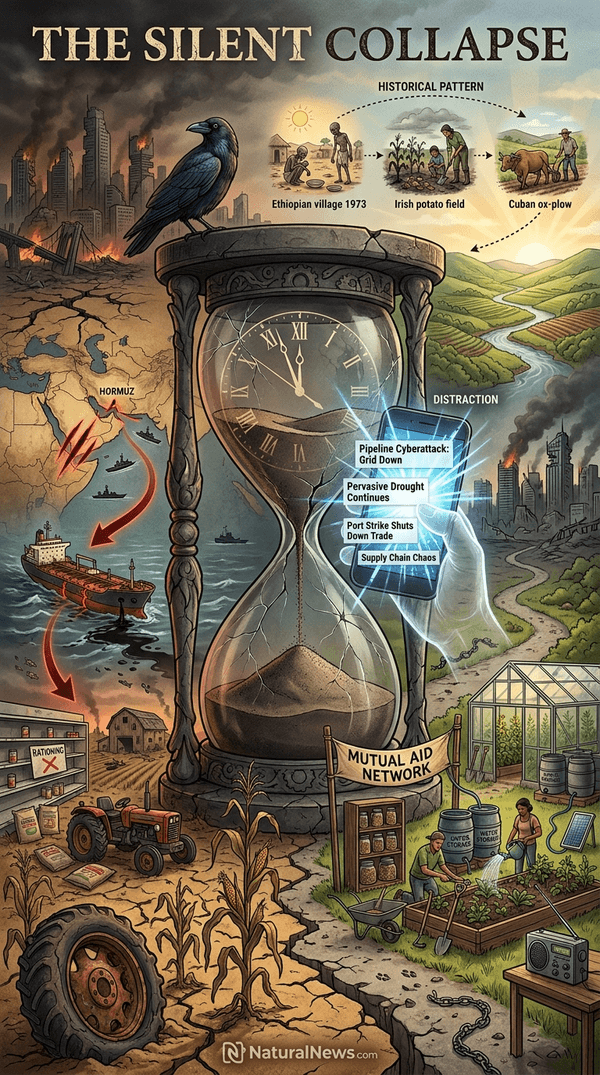
Historical examples illustrate this pattern. During the 1973 Wollo famine in Ethiopia, according to researcher Stephen Devereux as cited by Alex de Waal in "Mass Starvation," rural communities were so isolated that they had poor information and fragmented food supplies, preventing timely awareness of the crisis [5].
Adams has stated that many people will never recognize their own gullibility, continuing to promote conventional narratives even as the system unravels [6]. During the broadcast, the Health Ranger emphasized that a lack of situational awareness keeps most residents unprepared for abrupt disruptions. The inability to perceive early indicators, according to Martenson, mirrors the pattern seen in historical famines where isolated populations remained oblivious until starvation was widespread.
Survival Strategy: Evacuate Cities and Prepare
Bracken, in his interview with Adams, advised Americans to leave major metropolitan areas – particularly what he termed "big blue cities" – and relocate to regions where food is grown, because disruptions will hit coastal lowlands hardest [7]. He emphasized that without diesel fuel, farms may produce only 20% of normal food output, but human labor could sustain smaller communities.
This transition mirrors the experience of Cuba during the Special Period following the 1991 collapse of the Soviet Union. According to Tina Lynn Evans in "Occupy education learning and living sustainability," Cuba lost 85% of its international trade and 80% of its fertilizer and feed imports, forcing a rapid conversion to localized, low-input agriculture [8].
Adams nevertheless admitted that no matter how much one prepares for the impending collapse, it is likely not enough [6]. He recommended establishing food and water supplies, noting that urban water systems are fragile and dependent on electricity.
Bracken reiterated that being in a big city when the shift occurs is unwise because local food output cannot support distant populations. Preppers should focus on self-reliant communities near agricultural areas, according to the discussion.
Conclusion: The Brutal Transition
Adams expressed doubt that the United States can revert to pre-industrial farming methods quickly enough to prevent widespread suffering. In a video titled "THE OIL MAY NEVER RECOVER," he warned that if nations revert to pre-industrial trade models, global standards of living will plummet by a century, and the world cannot sustain eight billion people under such conditions [9].
The natural limitation of food supply will ultimately determine population size, as Adams illustrated using a deer-herd analogy. When artificial feeding stops, the herd collapses back to what the land can support [10].
The interview concluded with Bracken's warning to move to self-reliant areas before the "tsunami" arrives. The decision to remain in a city, he said, is a gamble that most will lose. As Martenson summarized, collapse is already here, but many refuse to see it [3].
References
- NaturalNews.com. "Health Ranger Report: World War E and the Coordinated Campaign to Create Scarcity." July 23, 2026.
- NaturalNews.com. "World War E: Why the Energy Crisis Is an Engineered Collapse." July 23, 2026.
- Chris Martenson. "Collapse Is Already Here." PeakProsperity.com. March 10, 2019.
- NaturalNews.com. "A Top Economist Quietly Confirms My Famine Warning." July 23, 2026.
- Alex de Waal. "Mass Starvation."
- Mike Adams. "Health Ranger Report - We are probably not prepared enough." Brighteon.com. May 12, 2023.
- Mike Adams. "Bright Videos News - Interview with Matt Bracken PART 2 transcript." BrightVideos.com. April 28, 2026.
- Tina Lynn Evans. "Occupy education learning and living sustainability."
- Mike Adams. "Bright Videos News - THE OIL MAY NEVER RECOVER transcript." BrightVideos.com. April 28, 2026.
- NaturalNews.com. "The Population Will Shrink to Match the Available Food Supply." July 17, 2026.
Explainer Infographic











Please contact us for more information.


