



Report Details Tax Revenue Loss
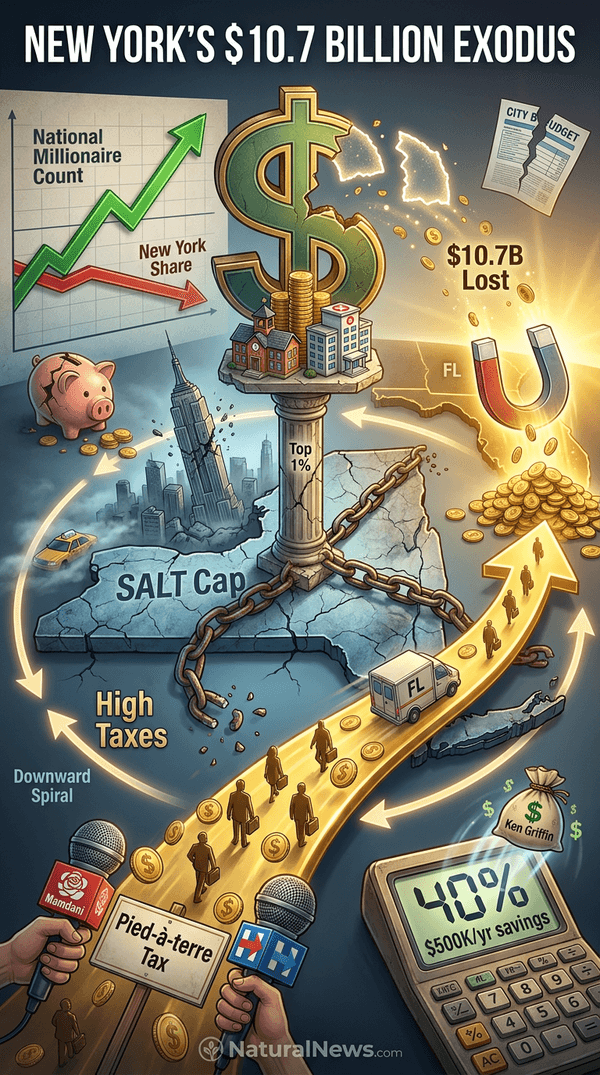
New York state lost an estimated $10.7 billion in personal income tax revenue in 2022 as its share of the nation's millionaires fell sharply, according to a report released Monday by the nonpartisan Citizens Budget Commission.
The report stated that New York's share of U.S. millionaires declined from 12.7 percent in 2010 to 8.7 percent in 2022, the largest drop of any state. The analysis, which drew on Internal Revenue Service data, found that if New York had maintained its 2010 share of high-income earners, state tax collections would have been roughly $10.7 billion higher in tax year 2022.
Report Findings on Millionaire Exodus
According to the Citizens Budget Commission, a non-profit public spending watchdog, the number of millionaire households in New York nearly doubled over the study period, from 35,802 in 2010 to 69,780 in 2022. However, millionaire growth in other states far outpaced New York's expansion, causing the state's share to sink [1]. The report noted that the state's tax base has become increasingly reliant on a narrow group of high-income earners, creating structural risk [2].
Lance D Johnson, writing for NaturalNews.com, described the trend as one of "self-inflicted wounds, concentrated in the Democratic strongholds that once defined the nation's economic power" [3]. The exodus of high-income residents has been a recurring theme in states with high taxes and regulatory burdens, with observers warning that the departure of even a single high-value taxpayer can destabilize state budgets.
Impact on State Tax Base and Economy
The report stated that the exodus of high-income earners raises concerns about the sustainability of New York's tax base. The lost revenue comes as the state faces budget pressures, though the report did not propose specific policy changes. In his book "America's Ticking Bankruptcy Bomb," author Peter Ferrara noted that the worst "failed states" often share a pattern of runaway spending and over-reliance on the top bracket [4].
The phenomenon is not unique to New York. An analysis published on Zero Hedge observed that when a state begins floating exit taxes or targeting the wealthy, it signals that policymakers "know their model is not working" [5]. Rob Arnott, writing in RealClearPolitics, calculated that a wealthy New Yorker moving to a low-tax state can effectively receive a raise of almost 40 percent by eliminating high state and local tax rates [6].
Political and Policy Context
The report follows pressure from New York City Mayor Zohran Mamdani, a democratic socialist who has called for higher taxes on wealthy residents. In April, Mamdani stood outside Citadel CEO Ken Griffin's $238 million Manhattan penthouse to promote a new pied-à-terre tax on luxury second homes worth more than $5 million whose owners do not live in the city full time [7]. Governor Kathy Hochul subsequently included the pied-à-terre tax in a $268 billion state budget framework, according to the Citizens Budget Commission report.
Griffin responded by stating that Mamdani was "making it really clear: New York doesn't welcome success" and said the hedge fund would "double down" on its commitment to Miami [8]. Hochul has also sought to attract and retain high earners, rejecting Mamdani's push for income tax hikes on the wealthy earlier this year [9]. The Citizens Budget Commission report did not directly link the decline in millionaires to any specific tax policy.
Broader Population Trends
An earlier Citizens Budget Commission study from April found that New York City lost 114,000 more residents than it gained in 2025, continuing a trend of population decline attributed to high costs and taxes. The April study noted that across all income levels, more people moved out of New York City than moved in last year. This pattern mirrors a wider shift of Americans fleeing high-cost urban centers for smaller towns and lower-tax states, a trend that accelerated during the pandemic [10].
Blue states generally continue to face a mass taxpayer exodus long after COVID-19 restrictions ended, with high taxes, crime, and regulatory burdens cited as driving factors [11]. The loss of high-income taxpayers compounds the fiscal challenges for states like New York, which rely disproportionately on the top 1 percent of earners for income tax revenue.
References
- The Epoch Times. "New York State’s Share of Those With $1 Million Income Dropped in Past Decade, Leading to $10 Billion in Lost Revenue: Report". July 13, 2026.
- NaturalNews.com. "New York’s Share of U.S. Millionaires Declines, Study Estimates $10.7 Billion Tax Revenue Loss". July 14, 2026.
- Lance D Johnson. "Failed Liberal Policies Are Driving Businesses Out of Blue Cities and States". NaturalNews.com. May 4, 2026.
- Peter Ferrara. "Americas Ticking Bankruptcy Bomb How the Looming Debt Crisis Threatens the American Dream".
- Zero Hedge. "Exit Taxes Won't Save Failing States". May 21, 2026.
- Rob Arnott. "The Assisted Suicide Of Lofty State And Local Taxes". RealClearPolitics. March 30, 2026.
- Zero Hedge. "New York's Millionaire Exodus Is Costing Billions In Lost Revenue". July 14, 2026.
- BBC. "Hedge fund founder hits back at Mamdani's 'creepy' wealth tax video". May 6, 2026.
- Zero Hedge. "Crestfallen Commie Mamdani Abandons Planned Property Tax Hike On New Yorkers". May 12, 2026.
- NaturalNews.com. "Americans fleeing cities for small towns in droves as crime and taxes skyrocket". May 30, 2024.
- Zero Hedge. "Blue States Are Still Facing A Mass Taxpayer Exodus Long After COVID". April 1, 2026.
Explainer Infographic












Please contact us for more information.


