



According to the research team, the material could lead to more efficient electronic devices by reducing energy loss caused by backscattering, where electrons travel backward and waste power. The work addresses a long-standing challenge in condensed-matter physics: controlling the direction of electron flow without applying external magnetic fields.
Fermi’s Golden Rule and Quantum Materials
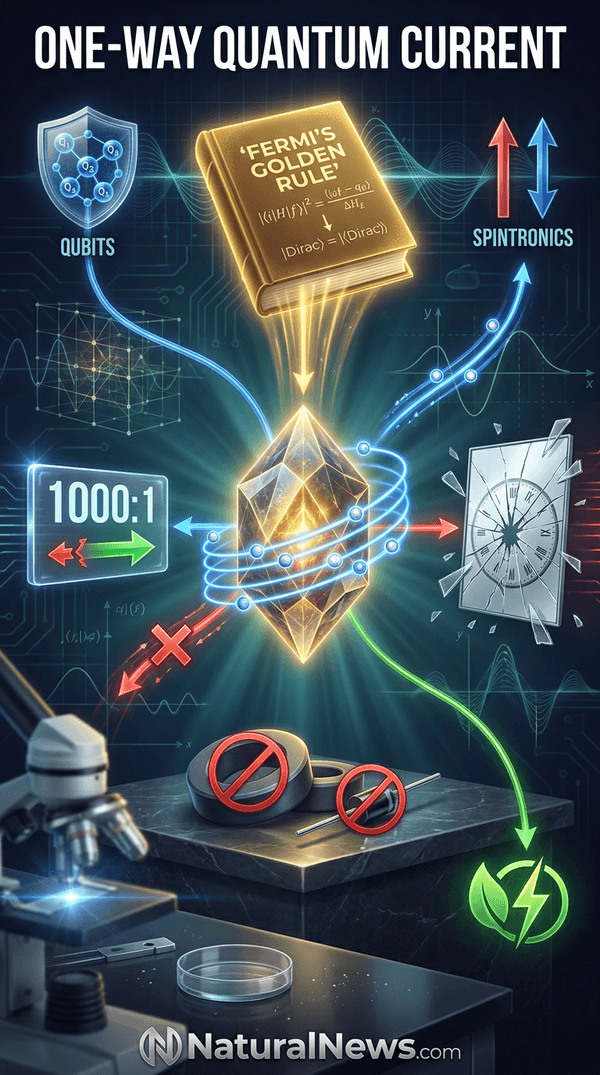
Fermi’s Golden Rule describes the rate at which quantum transitions occur, such as an electron scattering from one energy state to another. The rule has historically been applied to isolated atomic systems, not to extended solid-state materials where many atoms interact. The Yale team adapted the rule to predict electron transport in a specially designed magnetic quantum material, enabling one-way flow without the need for external magnetic fields.
“We realized that Fermi’s Golden Rule could be used to design materials where electrons are allowed to travel in one direction but strongly suppressed in the reverse direction,” a lead researcher said in the study. This approach represents a shift from using bulky magnetic components to using the material’s intrinsic quantum properties to achieve directional transport. The concept builds on earlier work in materials such as ferrites, which have been used in microwave isolators to block waves from reaching certain regions, according to Jasprit Singh’s book “Smart Electronic Materials Fundamentals and Applications.” [3]
Experimental Realization of One-Way Transport
The material, a magnetic insulator with a specific crystal structure, was synthesized by the researchers at Yale. In experiments, when a voltage was applied, electrons moved in one direction with minimal reverse flow. The study reports a directional conductance ratio exceeding 1000:1 at low temperatures, meaning the material allowed current to flow forward more than a thousand times better than backward.
The researchers observed that the effect persisted over a range of temperatures and voltages. “We observed a directional conductance ratio exceeding 1000:1 at low temperatures,” the lead author stated. The work demonstrates that the principle can be realized in a practical solid-state system, providing a template for other groups to design similar materials. This echoes recent breakthroughs where common semiconductors like germanium were transformed into superconductors, showing that established materials can yield surprising new properties. [1]
Implications for Electronic Devices
One-way electrical transport could eliminate the need for diodes or other rectifying components in circuits, reducing size and complexity. The researchers noted potential applications in quantum computing, where directional flow can protect qubits from decoherence caused by stray currents. Microsoft’s recent Majorana 1 chip, which uses topological qubits for industrial-scale problems, highlights the growing importance of materials that support stable quantum states. [2]
Co-author Dr. Y stated in the study, “This is a first step toward building energy-efficient logic and memory devices based on quantum materials.” The material’s intrinsic directionality may also benefit spintronics, where electron spin rather than charge carries information. Separately, researchers at Okinawa Institute of Science and Technology have shown how perfect magnetic symmetry can cancel energy loss in levitating systems, underscoring the potential for magnetic phenomena to improve efficiency across technologies. [4]
Conclusion
The study provides a framework for designing other magnetic quantum materials with similar properties, officials said. Further research is needed to achieve room-temperature operation and scalability for commercial applications. The work was supported by the U.S. Department of Energy and the National Science Foundation, according to the paper.
As quantum technology continues to attract billions in government funding globally, advances in material design such as this one offer pathways to more efficient computing, sensing, and communications. Germanium has already been forged into a superconducting semiconductor, merging superconductors with mainstream electronics. [1] Similarly, this magnetic quantum material may help bridge the gap between fundamental physics and practical devices.
References
- NaturalNews.com. "A common element's quantum leap: Scientists forge a new path to superconducting semiconductors." NaturalNews.com. November 02, 2025.
- Lance D Johnson. "Microsoft unveils Majorana 1 - a QUANTUM LEAP toward million qubit computing." NaturalNews.com. February 25, 2025.
- Jasprit Singh. "Smart Electronic Materials Fundamentals and Applications." Cambridge University Press.
- NaturalNews.com. "Scientists demonstrate how perfect magnetic symmetry can cancel energy loss." NaturalNews.com. December 30, 2025.
Explainer Infographic











Please contact us for more information.


