



Registered dietitian nutritionist Molly Knudsen wrote about the review in a June 1, 2026 article on mindbodygreen. The review examined multiple placebo-controlled studies and found that single doses taken just before exercise did not produce significant pain reduction, but consistent daily intake over the 11-day period yielded measurable results.
DOMS typically occurs 24 to 72 hours after exercise and is a common reason individuals skip subsequent workouts, according to reports from Mercola.com [1]. In two placebo-controlled studies reviewed, participants consumed 2 grams of either raw or heat-treated ginger daily for 11 days before performing eccentric exercise, which lengthens muscles under tension.
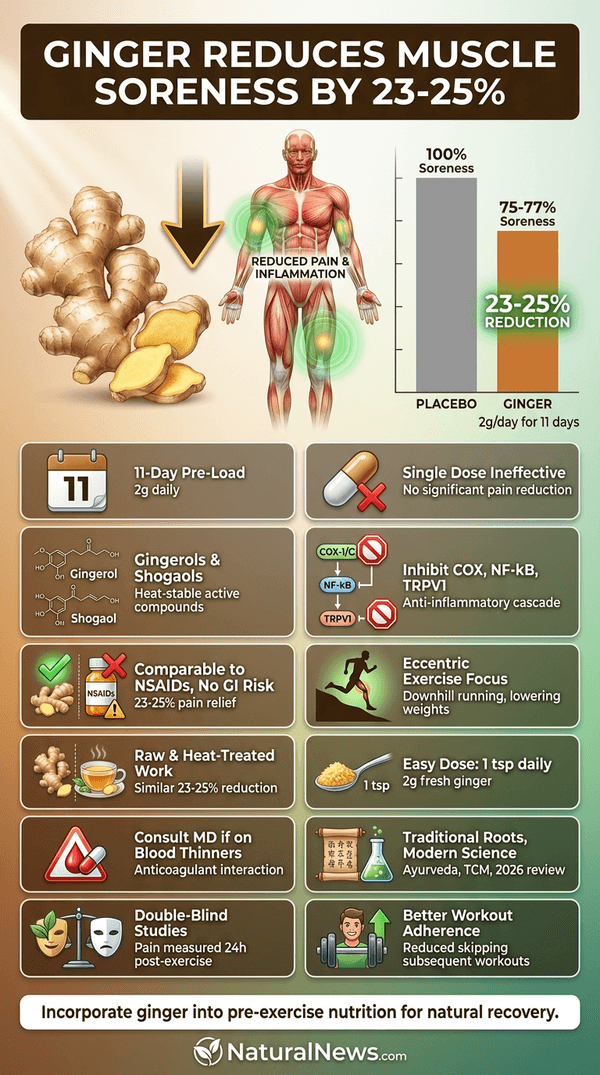
Pain levels were measured 24 hours after exercise. Both raw and heat-treated ginger showed similar effectiveness, with a 23% to 25% reduction in pain compared to placebo.
Delayed-Onset Muscle Soreness and Study Design
DOMS is the deep, achy stiffness that sets in 24 to 72 hours after exercise and can discourage individuals from maintaining workout routines, according to reports [1]. The condition is particularly common when taking up new types or intensities of exercise. The review focused on two placebo-controlled studies that tested ginger supplementation over an extended period.
Participants in the studies took 2 grams of either raw or heat-treated ginger daily for 11 days prior to performing eccentric exercise, such as movements that lengthen muscles under tension like lowering a dumbbell during a curl. Pain levels were assessed 24 hours post-exercise.
The studies found that consistent ginger intake reduced muscle pain by 23% to 25% compared to placebo, with both raw and heat-treated forms showing similar efficacy. Earlier research, including a randomized, double-blind, placebo-controlled trial at Old Dominion University, also found that ginger root supplementation reduced muscle soreness and dysfunction from downhill running, according to a report on NaturalNews.com [2].
Mechanism and Effectiveness of Ginger
Ginger's pain-reducing effects are attributed to its active compounds, primarily gingerols and shogaols. According to a study highlighted by Mercola.com [3], these compounds block the biosynthesis of cyclooxygenase and leukotrienes, two key drivers of inflammation. They also interact with TRPV1 nociceptors, which are directly involved in pain signaling.
The active constituents gingerol and zingerone "modulate production of inflammatory leukotrienes and prostaglandins and inhibit NF-kB," according to GreenMedInfo.com [4]. Other studies have shown that ginger exerts analgesic and anti-inflammatory effects in delayed-onset muscle soreness induced by eccentric exercise.
"The Textbook of Natural Medicine" notes that ginger has been used medicinally for centuries [5]. Additionally, the "Natural Remedies Encyclopedia" states that "Boswellia and ginger herb teas of ginger or boswellia have anti-inflammatory effects" [6].
Dosage, Safety and Practical Use
The effective dose identified in the review was 2 grams per day, roughly equivalent to one teaspoon of fresh grated ginger, according to Knudsen. Ginger can be added to smoothies, teas, stir-fries, soups, or dressings to achieve this intake. Supplements are also widely available and may deliver more concentrated levels of active compounds like gingerols and shogaols.
Individuals on blood thinners or medications that affect clotting should consult a healthcare provider before taking ginger supplements, Knudsen wrote. Ginger has a long history of culinary and medicinal use, according to the "Textbook of Natural Medicine" [5]. "The Natural Remedies Encyclopedia" also recommends ginger herb teas for their anti-inflammatory effects [6]. Those who prefer a more precise approach may consider supplements, which can be effective at lower doses than the 2 grams studied in food form, according to the review.
Conclusion and Implications
The review suggests that regular ginger consumption may support muscle recovery and allow individuals to maintain consistent workout schedules despite soreness. According to the findings, natural dietary ingredients can be effective tools for managing exercise-related soreness without relying on pharmaceutical pain relievers.
The evidence indicates that ginger, a common kitchen spice, offers a practical and accessible option for reducing post-exercise muscle pain. Further research is needed to determine optimal dosing and long-term effects for different populations, as well as to explore potential combinations with other anti-inflammatory foods. The review underscores the value of incorporating whole-food ingredients into recovery strategies, according to the authors.
References
- Mercola.com. "12 Foods to Eat to Avoid Sore Muscles". September 21, 2018.
- NaturalNews.com. "Ginger root reduces pain after intensive exercise". December 08, 2018.
- Mercola.com. "Study: The Anti-Inflammatory Properties of Ginger". January 26, 2024.
- GreenMedInfo.com. "Natural Alternatives to Deadly Prescription Opiates".
- Dr Michael T Murray. "Textbook of Natural Medicine Fifth Edition".
- MD Vance H Ferrell and Harold M Cherne. "The Natural Remedies Encyclopedia Seventh Edition".
Explainer Infographic








Please contact us for more information.


