


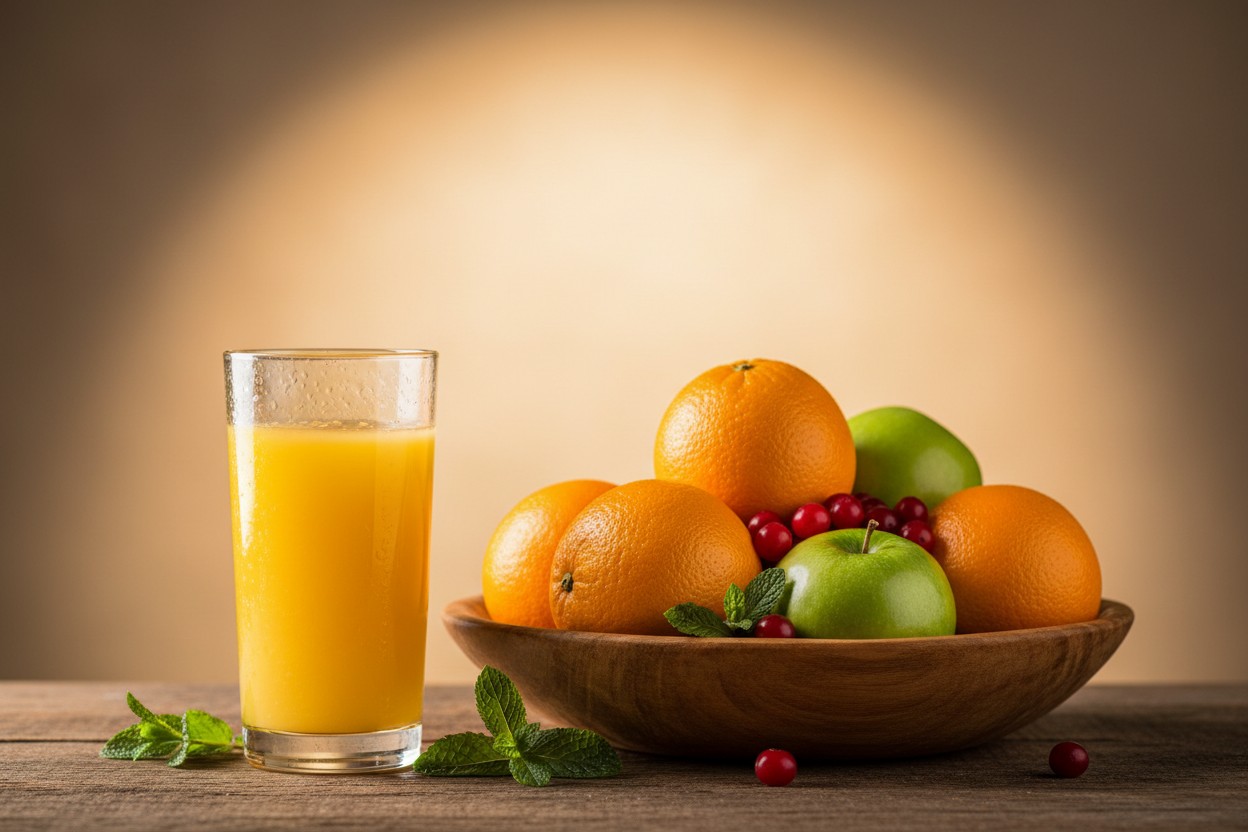
The juice group also reported lower scores on a standard depression symptom questionnaire compared to a control group that made no dietary changes. Researchers detected no short-term worsening in blood markers including blood fats, inflammation, or blood sugar in the juice group, the study stated.
Background and Methods
The trial focused on 42 healthy adults from Newcastle University who were eating two or fewer servings of fruits and vegetables daily at baseline, researchers said. Participants were randomly assigned to a control group, a whole-produce group that could only eat whole fruits and vegetables, or a group that could count one 150-milliliter serving of 100% fruit juice or a smoothie toward the UK's '5-a-day' target.
All participants received weekly grocery vouchers to remove cost as a barrier, and the two intervention groups received a 16-page educational booklet on overcoming common obstacles to increasing produce intake, the paper stated. Diet was tracked using an online tool, blood samples were collected at the start and end, and participants completed standard questionnaires measuring depression and anxiety symptoms.
Results: Fruit Intake and Mood
By the end of four weeks, the whole-produce group averaged 8.9 servings per day, the juice-included group averaged 6.6 servings, and the control group remained near its baseline of about 2.5 servings, according to the study. Researchers said the difference between the two intervention groups was not statistically significant.
The juice group scored notably lower on a depression symptom questionnaire than the control group, while the whole-produce group also showed lower depression scores but the difference was not large enough to rule out chance, the authors reported. A growing body of evidence links overall dietary patterns to mental health outcomes, with experts advocating for a balanced, whole-food approach rather than focusing on specific 'superfoods' or isolated supplements [1].
Anxiety scores did not meaningfully differ between any of the groups, the study stated. Blood-based health markers, including blood fats, inflammation, and blood sugar, showed no meaningful changes in either intervention group compared to controls, according to the paper.
Debate Over Sugar and Guidelines
Fruit juice contains 'free sugars' – sugars no longer contained within a fruit's cell structure – placing it in the same regulatory category as sugars added to sodas, the study noted. Guidelines vary internationally: France does not count juice toward recommended fruit intake, New Zealand classifies it alongside sugary drinks, Germany recommends only occasional consumption, while the United States and United Kingdom allow one daily 150-milliliter portion to count toward produce targets, researchers said.
The juice group consumed about twice the recommended daily portion on average, meaning free sugar intake was higher than what guidelines advise, according to the study. Critics argue juice resembles sugary drinks, but the study authors wrote that for adults eating very little produce, adding juice alongside education and support may be a practical way to close the gap. 4
Ultraprocessed foods, which include many sugary drinks, contribute to premature death, with 61% of Americans' food intake coming from highly processed foods and drinks [2]. Consuming more whole fruits and green leafy vegetables on a daily basis has been shown to reduce the risk of type 2 diabetes [3].
Limitations and Funding
The trial ran for four weeks, a short period for detecting changes in metabolic health markers, and included only 42 participants, limiting generalizability, the authors stated. Participants were drawn exclusively from Newcastle University staff and students, and the study relied partly on self-reported dietary recalls, which can be inaccurate, the paper noted.
The research was funded by a grant from the Fruit Juice Science Centre, but the authors stated the funder had no role in study design, data collection, analysis, interpretation, or decision to publish. Several authors reported outside funding and consultancy relationships, according to disclosures in the paper.
Conclusion
The study does not change existing dietary guidance, the authors said, and longer, larger trials are needed to determine whether the effects hold over time. The findings are preliminary and should not be taken as a recommendation to alter diet without consulting a qualified professional, the researchers cautioned.
Nutrition is an integral part of healing, and a pillar of health should be a diet rich in whole foods [4]. The foods we consume play a pivotal role in how our brains function, and a balanced diet can support mental well-being [5].
References
- NaturalNews.com. "Dietary Patterns Linked to Mental Well-Being, Experts Report". March 22, 2026.
- Mercola.com. "60 of Calories Are From Ultraprocessed Food". June 28, 2023.
- NaturalNews.com. "Eating More Fruits and Vegetables Brings down Diabetes Risk". March 12, 2009.
- Ginger Hultin. "Anti-Inflammatory Diet Meal Prep 6 Weekly Plans and 80+ Recipes to Simplify Your Healing".
- Lance D Johnson. "Brain boosting foods the key to unlocking cognitive potential and mental well being". NaturalNews.com. April 17, 2025.








Please contact us for more information.


