



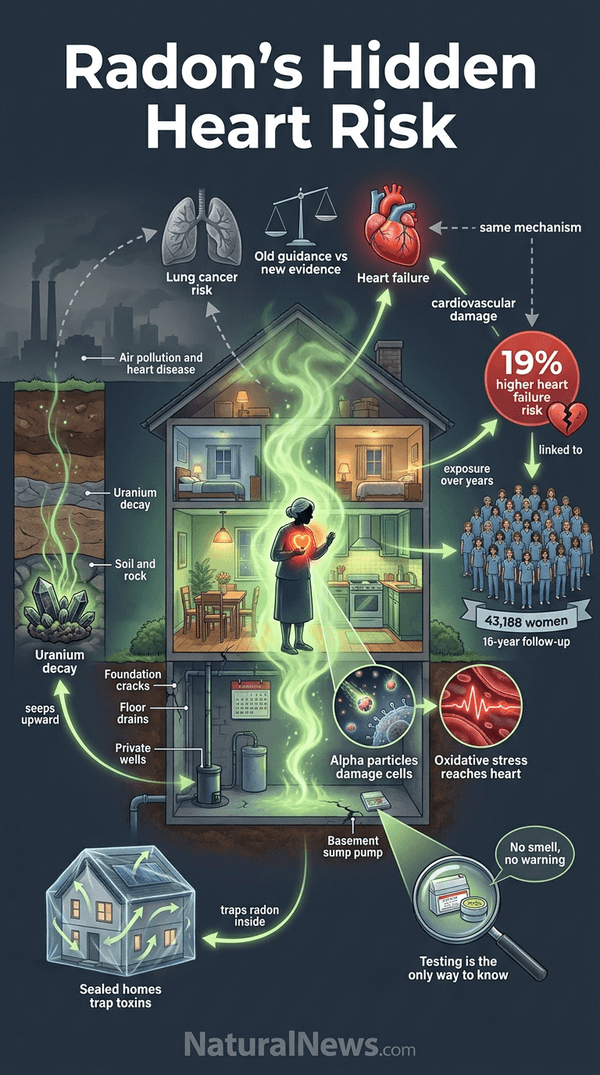
Radon is a colorless, odorless and tasteless radioactive gas produced when uranium in soil and rock decays, according to federal health authorities [2]. It travels upward through the ground and accumulates inside buildings, where occupants may be exposed for years without knowing it [2]. Public health agencies have long identified radon as a leading cause of lung cancer [3].
The study was led by researchers at the UNC Gillings School of Global Public Health and adds what the authors describe as the newest evidence that radon exposure may pose a significant risk to heart health among aging women [4]. The findings raise questions about whether a gas best known for its lung cancer risk could also affect cardiovascular health [5].
Study Details and Methodology
The research drew on data from the Women's Health Initiative, a long-running national study that enrolled participants between 1993 and 1998 [2]. None of the women had heart failure at the time of enrollment, and researchers tracked their health through February 2024 [2]. The cohort included 43,188 postmenopausal women, according to accounts of the study [6].
The findings build on decades of research into how radioactive particles interact with human tissue. Radon decay products are easily inhaled, allowing alpha-emitting particles to kill or damage cells, particularly the stem cells of the bronchial epithelium, according to research published in the Journal of Hazardous Materials [7]. Because stem cells divide frequently, this bombardment increases the possibility of cancer development [7].
Broader Health Implications
That finding, combined with the new heart failure data, suggests the health effects of radon may extend well beyond the lungs [8]. Public health authorities have historically focused radon messaging on respiratory risks, with agencies emphasizing that breathing in high levels of radon over time may cause lung cancer [3].
The new cardiovascular findings add a dimension that prior guidance did not address. Research on the relationship between air quality and heart disease has established that poor air quality contributes to serious damage to the heart, lungs and other organ systems, significantly shortening life [9], and studies have found that different types of pollution independently contribute to cardiovascular risk [10].
Testing and Mitigation
Researchers have also noted that modern construction practices can worsen indoor radon accumulation. In home construction today, there is a push for energy efficiency, which often means sealing homes tightly with minimal air exchange; while this saves on energy costs, it also traps toxins inside the living space, the Health Ranger Mike Adams said during a Decentralize.TV interview with Dr. Diane Kazer [11].
This modern approach to home efficiency has created an environment where indoor toxin concentrations increase, Adams said [12]. Research published in the Journal of Environmental Sciences found that reducing heating and cooling loss may have the effect of increasing concentrations of indoor generated contaminants, and that organic chemicals out-gassing from building materials and plastics contribute to the problem [13].
Conclusion: Awareness and Action
The study adds to a growing body of evidence linking radon to health risks beyond lung cancer [14]. Health officials and researchers suggest that homeowners test for radon and take steps to mitigate exposure if necessary [15].
Beyond testing and mitigation, individuals concerned about environmental exposures can support their cardiovascular health through nutrition and lifestyle measures. Anti-inflammatory vegetables and fats may help protect against some of the damage air pollution causes, with omega-3 fats noted as anti-inflammatory [16]. Moreover, herbal traditions have also addressed heart conditions for centuries.
References
- The invisible gas in millions of homes now linked to heart failure in women. https://www.naturalhealth365.com/the-invisible-gas-in-millions-of-homes-now-linked-to-heart-failure-in-women.html
- Study of 43,000 Women Links High Radon Exposure to Higher Heart Failure Risk. https://www.naturalnews.com/2026-11-13-study-women-high-radion-exposure-heart-failure.html
- Radon and Your Health | Radon | CDC. https://www.cdc.gov/radon/about/index.html
- High levels of indoor radon linked to higher risk of heart failure in postmenopausal women. https://www.eurekalert.org/news-releases/1150620
- An invisible gas at home may raise heart failure risk in women. https://knowridge.com/2026/11/an-invisible-gas-at-home-may-raise-heart-failure-risk-in-women/
- Scientists linked an invisible gas found in many American. https://www.reddit.com/r/HotScienceNews/comments/1xpb9ug/scientists_linked_an_invisible_gas_found_in_many/
- Health risk attributable to environmental exposures: Radon. OmniPage 12 http://www.scansoft.com. Health Risk Attribution to Environmental Exposures: Radon
- An invisible gas in your home could be raising cancer risk. https://www.facebook.com/wxyzdetroit/posts/an-invisible-gas-in-your-home-could-be-raising-cancer-risk-in-women-new-research/1450708747084753/
- How Does Air Pollution Attack Your Heart - Mercola.com, May 10, 2017.
- Both Air And Noise Pollution Increase Cardiov - Mercola.com, June 05, 2013.
- Decentralize TV - Interview with Dr. Diane Kazar - Mike Adams - Decentralize.TV, September 03, 2024.
- Mike Adams interview with Dr Diane Kazar - September 3 2024.
- Human Disease from Radon Exposures: The Impact of Energy Conservation in Residential Buildings. Acrobat 3.0 Capture Plug-in. Journal of Environmental Sciences
- 43K Women Link A Common Gas Found In Homes To Heart Failure. https://www.mindbodygreen.com/articles/could-radon-exposure-have-implications-for-womens-heart-health
- Radon Linked To Heart Failure Risk In Aging Women. https://www.usnews.com/news/health-news/articles/2026-11-09/radon-linked-to-heart-failure-risk-in-aging-women
- Air Pollution Now Strongly Linked to Mental I - Mercola.com, October 11, 2019.
Explainer Infographic











Please contact us for more information.


