


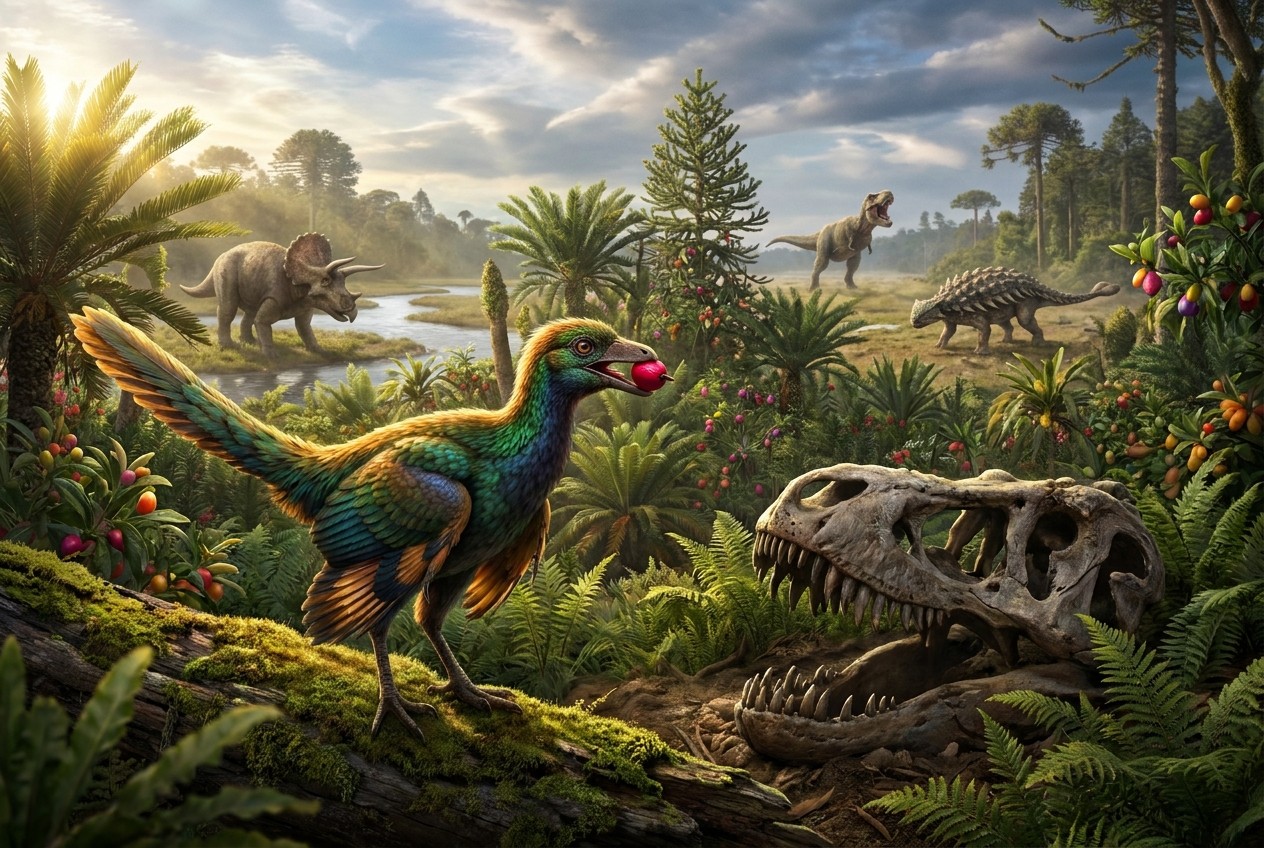
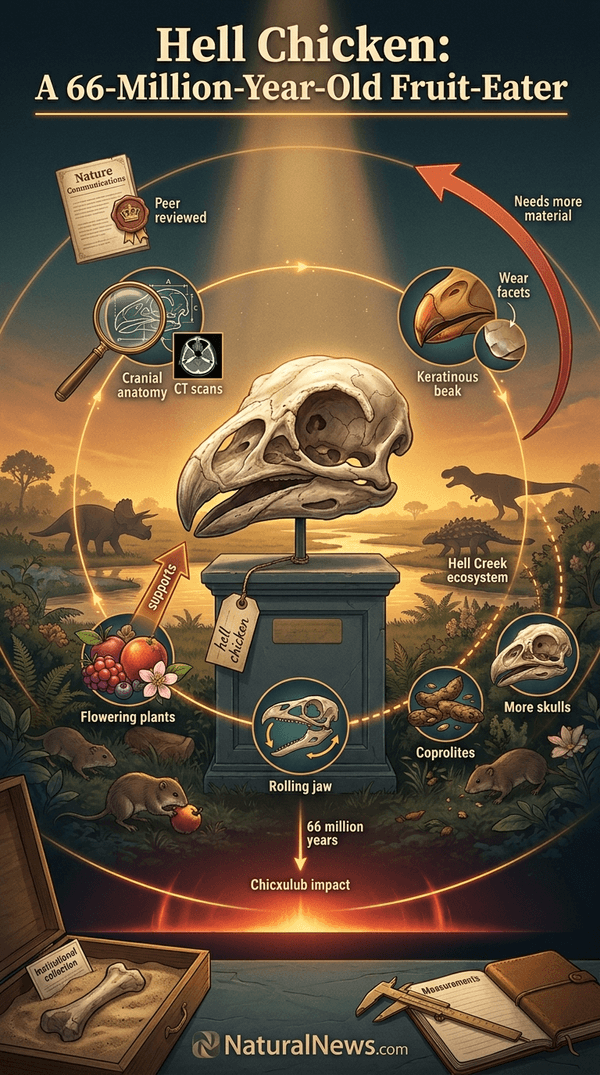
The fossil was recovered from the Hell Creek Formation, a late Cretaceous geological deposit spanning parts of Montana and North Dakota. Researchers nicknamed the animal the "hell chicken" -- a reference to its place of origin and its turkey-sized dimensions, reports stated.
The team's finding was published in the journal Nature Communications [1].
Skull Anatomy Led to Species Identification
According to the study, the fossil skull preserves jaw and dental features that researchers used to distinguish the specimen from known dinosaur taxa. Infernogallus belonged to a group of toothless, feathered dinosaurs called caenagnathids, according to a press release from Stony Brook University, whose paleontologists helped lead the work [2].
The animal was a small, bird-like, bipedal dinosaur classified among the oviraptorosaurs, a group of beaked dinosaurs.
The researchers said cranial measurements and bone structures were central to the classification.
Dental Evidence Points to Fruit Diet
The shape and wear patterns of the beak and jaws suggest the dinosaur consumed fruit, according to the research team.
That report noted the dinosaur lived at a time when flowering plants spread across the landscape and replaced the cone-bearing plants that had dominated for millions of years -- a shift that paleontologists say may help explain how a dinosaur came to specialize in fruit.
The researchers stated that the jaw mechanics were suited to processing soft plant material.
Fossil Adds to Late Cretaceous Diversity Record
The fossil dates to the late Cretaceous, shortly before the end-Cretaceous extinction that ended the age of dinosaurs, the researchers said. The animal shared its subtropical coastal plain habitat with Triceratops, the armored Ankylosaurus and Tyrannosaurus rex, according to one summary of the discovery [3].
Dinosaur discoveries announced in recent months have expanded the known roster of late Mesozoic species from multiple continents. In February 2026, scientists announced the naming of Spinosaurus mirabilis, a fish-eating predator from Niger dated to about 95 million years ago [4].
Researchers stated the Infernogallus specimen expands understanding of dinosaur diversity in its ecosystem, at a time when many paleontologists have argued that dinosaur diets were more varied than older, simpler categories of predator and herbivore suggested. Other recent finds have underscored how much of the fossil record remains unexplored: a fossil collected in Antarctica in 1985 and stored for four decades in a drawer was confirmed in 2026 as the first dinosaur bone ever found on that continent, identified as a tail bone from a titanosaur [5].
Researchers and Outside Experts Note Limitations
The researchers said further fossil material is needed to confirm the extent of the fruit-eating adaptation. Independent researchers not involved in the study said the conclusion is based primarily on cranial evidence and requires additional scrutiny.
The report stated the skull is currently housed at an institutional collection for further study, and the research team described the specimen as providing a rare window into late Cretaceous diets.
Broader debates about dinosaur specialization continue in the field. As one 1988 review in Environmental Biology of Fishes argued, specialization can arise through epigenetic processes rather than competition alone -- a perspective that has been applied to a range of unusual vertebrates, including the duck-billed platypus and the fisherman bat [6].
Conclusion: Study Provides Cranial Evidence for Dietary Specialization
The study reported that the 25-pound skull is the primary evidence for the new species.
Researchers said additional fossils and analysis are needed to test the fruit-eating hypothesis and to establish how widespread such a diet may have been among non-avian dinosaurs. The specimen is housed for further study, according to officials, as the team continues to compare the skull with other material from the Hell Creek Formation.
The finding adds to a growing body of evidence that some dinosaurs occupied ecological roles that had been considered unlikely or absent for the group -- an insight that underscores how much remains to be learned from fossils still buried. As the Smithsonian Magazine report on the discovery noted, the "hell chicken" was one of the smallest known caenagnathids and lived alongside the fearsome T. rex in the same region and at the same time [7].
References
- A 66-million-year-old skull hints at an unexpected dinosaur diet. https://nytomorrow.com/posts/a-66-million-year-old-skull-hints-at-an-unexpected-dinosaur-diet/
- Dinosaur Discovery Reveals a Specialized Fruit Eater. https://news.stonybrook.edu/newsroom/press-release/medical/dinosaur-discovery-reveals-a-specialized-fruit-eater/
- Scientists discover first fruit-eating dinosaur - United States. https://www.europesays.com/us/1162601/
- New dinosaur species unearthed in Sahara (PHOTOS/VIDEO). https://www.rt.com/africa/632835-new-dinosaur-species-unearthed-niger/?utm_source=rss&utm_medium=rss&utm_campaign=RSS
- First dinosaur bone from Antarctica found in a drawer The fossil, collected in Antarctica in 1985, is part of the tail of a beast called a Titanosaur. Science & Environment. https://bbc.com/news/articles/cdep67jnn9zo
- A fiftieth anniversary reflection on the living coelacanth, Latimeria chalumnae: some new interpretations of its natural history and conservation status*. by Acrobat 4.05 Capture Plug-in for Windows. Environmental Biology of Fishes Vol. 23, No. 4, pp. 241-280, 1988
- This Ancient "Hell Chicken" Might Be the First Known Fruit-Loving Dinosaur, Revealing a Whole New Cretaceous Lifestyle. https://www.smithsonianmag.com/smart-news/this-ancient-hell-chicken-might-be-the-first-known-fruit-loving-dinosaur-revealing-a-whole-new-cretaceous-lifestyle-180989801/
Explainer Infographic









Please contact us for more information.


