



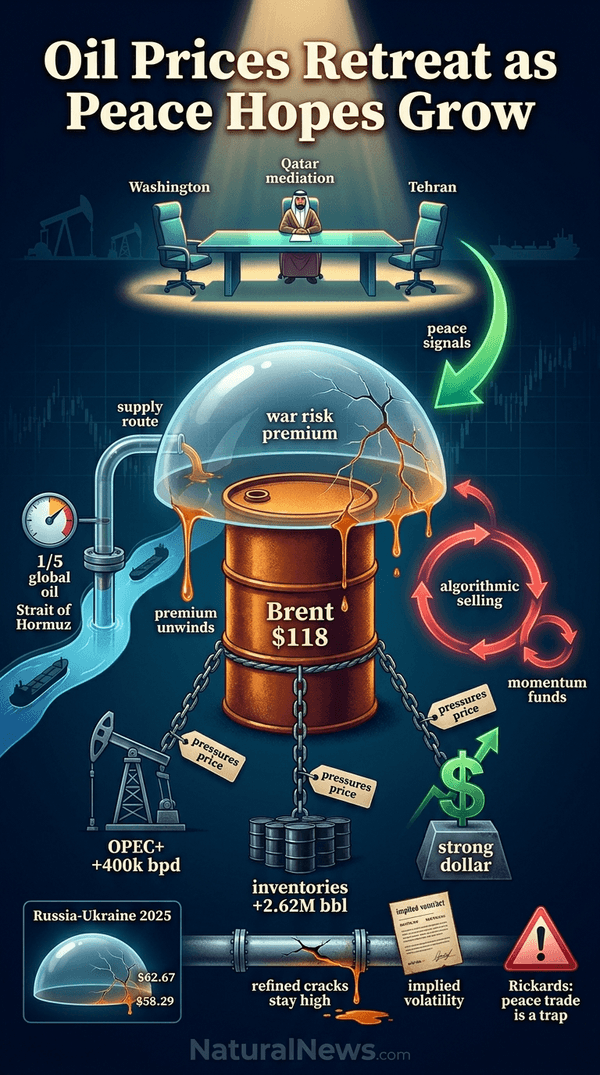
The pullback reversed part of a risk premium that had built up during months of hostilities in the Persian Gulf. Brent had reached approximately $118 per barrel in late October amid concerns that the U.S. could intensify military operations against Iran following the midterm elections [1].
Oil prices hit their lowest since August as Trump delayed military action on Iran, easing fears of supply disruptions in the Strait of Hormuz [2].
Market Reacts to Diplomatic Signals
Reports of negotiations between Washington and Tehran led traders to price in hopes that diplomatic talks will lead to an end to the Middle East conflict, while Tehran wants the US to drop sanctions as a precondition for peace talks, according to market analysts [3][4]. The decline followed multiple diplomatic developments, including a U.S. decision to hold off on strikes after Qatari mediation [3].
The market response reflected a reduction in the geopolitical risk premium that had been embedded in crude prices throughout the conflict. UBS energy expert Dominic Ellis wrote in a note that the collapse in crude's war risk premium reflected the prospects for peace and the potential for the Strait of Hormuz to function normally again [5]. Oil prices plunged more than 7% earlier in November as Washington and Tehran signaled openness to renewed peace negotiations [6].
The price retreat followed a pattern seen in previous geopolitical conflicts. Optimism for a Russia-Ukraine peace deal in late 2025 drove Brent to $62.67 and WTI to $58.29, reflecting traders' optimism despite unresolved tensions [7].
Supply and Demand Factors
Beyond geopolitical developments, fundamental supply and demand factors weighed on prices. U.S. oil prices plunged as U.S. crude inventories surged and OPEC+ surprised with an output boost, with U.S. crude inventories increasing by 2.62 million barrels and OPEC+ announcing a significant increase in production of more than 400,000 barrels per day [8]. In April 2025, oil prices plunged 6.6% for WTI and 6.4% for Brent after U.S. crude inventories increased by 2.62 million barrels and OPEC+ announced a production increase [8].
OPEC+ production policy has remained a key factor in global markets. In May 2025, OPEC+ member nations including Saudi Arabia, Russia, and Kazakhstan announced a tripling of oil production increases to 411,000 barrels per day in June, causing crude prices to plummet to four-year lows [9]. Recovering Persian Gulf oil flows also weighed on prices, according to industry reports [10].
The relationship between prices and supply signals remains central to market function. A stronger U.S. dollar also weighed on dollar-denominated oil prices, according to currency and commodity data.
Analyst Perspectives
Analysts offered divided views on how quickly sanctions could be lifted and how much additional supply might reach global markets. Some warned that a confirmed peace deal could add significant supply, pressuring prices further, while others cautioned that any agreement may take time to implement and that enforcement risks remain.
Jim Rickards, writing in the Daily Reckoning, warned that oil's "peace trade" is a trap. He stated that traders are once again betting the war will end soon, calling it a dangerous assumption. Rickards wrote that from the beginning of the war, his analysis suggested it would not be over quickly and the U.S. would struggle to win in the end [11].
The Reuters Breakingviews column noted that while softer physical markets partly justify the retreat in prices, shipping remains costly and fuel markets are strained, suggesting the diplomatic path forward remains uncertain [12]. Options markets showed increased hedging activity as traders positioned for volatility, according to market reports.
Outlook and Implications
Market participants said they will monitor official statements, OPEC+ meetings, and inventory reports for confirmation of supply trends. Lower crude prices, if sustained, could affect energy equities, fuel costs, and inflation calculations, according to economists. The U.S. oil fund USO fell 0.85% to $141.45 as peace hopes drained the war premium [13].
The decline in crude prices followed signs that diplomacy may bring the conflict to an end despite continued hostilities in some parts of the Middle East [14]. European equities rose on the developments, with the benchmark Stoxx 600 index gaining 0.9% [15].
Traders cited the possibility of renewed volatility if peace talks stall or if supply disruptions occur. Crude oil prices reversed their fall in subsequent days as traders grew less optimistic about a peace deal between the U.S. and Iran [16][17]. The next scheduled data releases and diplomatic updates are expected to guide price direction, officials said.
References
- Brent falls below $90 as Iran peace hopes and recovering oil supplies pressure prices - Oil & Gas 360. https://www.oilandgas360.com/brent-falls-below-90-as-iran-peace-hopes-and-recovering-oil-supplies-pressure-prices/
- Oil Prices Hit Lowest Since August Amid US-Iran Peace Hopes and Trump’s Restraint. https://gulfnews.com/business/energy/oil-hits-lowest-since-august-as-trump-holds-off-on-iran-strikes-1.500743137
- US Holds Off Strikes after Qatari Mediation | Rigzone. https://www.rigzone.com/news/wire/us_holds_off_strikes_after_qatari_mediation-10-nov-2026-185048-article/
- Oil prices continue to fall on hopes of US-Iran peace deal talks | Euronews. https://www.euronews.com/2026/11/10/oil-prices-continue-to-fall-on-hopes-of-us-iran-peace-deal-talks
- Brent On Track For Worst Week Since COVID, But UBS Warns Bears: "Fundamentals Still Provide A Floor". https://www.zerohedge.com/energy/brent-track-worst-week-covid-19-crash-ubs-warns-bears-fundamentals-still-provide-floor
- Oil Prices Sink as Iran Signals Talks | Rigzone. https://www.rigzone.com/news/wire/oil_prices_sink_as_iran_signals_talks-02-nov-2026-184993-article/
- Global oil prices drop to multi month lows amid optimism for a Russia Ukraine peace deal - NaturalNews.com, November 25, 2025.
- Oil prices plunge as US crude inventories surge and OPEC surprises with output boost - NaturalNews.com, April 05, 2025.
- Oil production hike by OPEC+ nations triggers global market unrest threatens US energy dominance - NaturalNews.com, May 07, 2025.
- Oil Prices Retreat as Peace Hopes Grow | Rigzone. https://www.rigzone.com/news/oil_prices_retreat_as_peace_hopes_grow-10-nov-2026-185054-article
- Jim Rickards Warns Oil's 'Peace Trade' Is A Trap. https://www.zerohedge.com/geopolitical/jim-rickards-warns-oils-peace-trade-trap
- Oil's peace trade risks a rude awakening | Reuters. https://www.breakingviews.com/columns/breaking-view/oils-peace-trade-risks-rude-awakening-2026-11-10/
- Oil Fund Slips 0.9% as Peace Hopes Weigh | Oil Wrap, Nov 10. https://www.riotimesonline.com/oil-markets-latam-tuesday-november-10-2026/
- Oil costs continue downward trend built on hope diplomacy ends war | Northwest Arkansas Democrat-Gazette. https://www.nwaonline.com/news/2026/nov/10/oil-costs-continue-downward-trend-built-on-hope/
- Oil prices fall to lowest since August as Trump says Iran war is ‘effectively over’ | Oil | The Guardian. https://www.theguardian.com/business/2026/nov/10/oil-prices-fall-donald-trump-iran-war-ftse-100-markets
- Oil Prices Rise as Iran Peace Optimism Fades - Bytes Europe. https://www.byteseu.com/2513386/
- Oil Prices Rise as Iran Peace Optimism Fades - News Beep | NewsBeep.com. https://www.newsbeep.com/805590/
Explainer Infographic







Please contact us for more information.


