


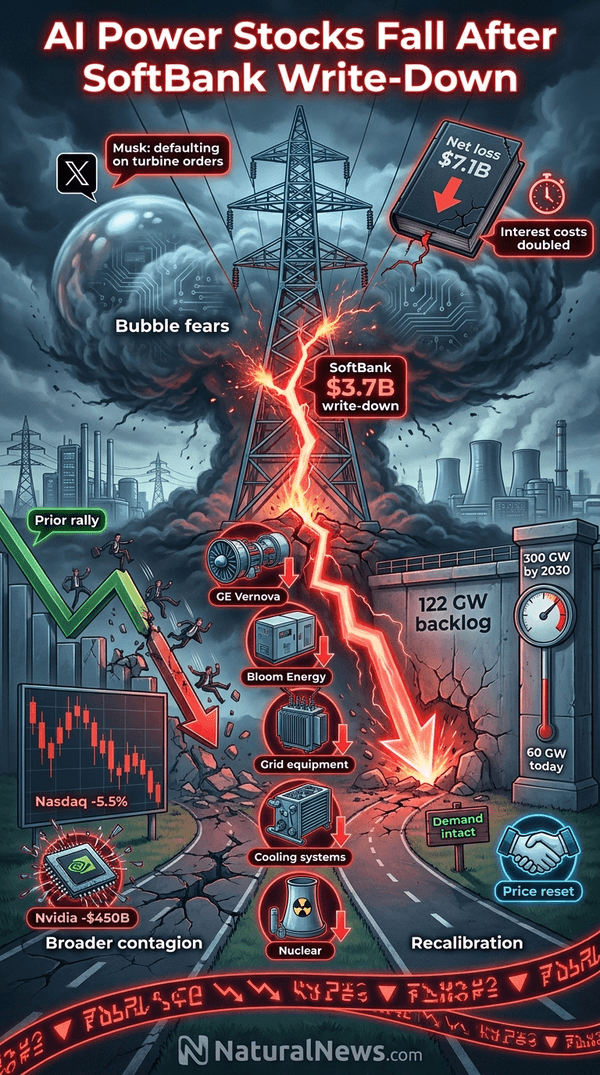
The write-down accompanied SoftBank's disclosure of a net loss of ¥1.12 trillion ($7.1 billion) for the July-September quarter, the company's first loss in almost two years [2]. SoftBank shares fell after the results, according to the report [3]. The disclosure arrived after Elon Musk stated last week on X that SoftBank was defaulting on turbine orders, according to ZeroHedge [4].
Market participants said the charge raised questions about whether the write-down, a cancellation, or a revised procurement strategy in the AI spending boom signals trouble ahead for suppliers, according to the report [1]. Analysis suggests the SoftBank disclosure could be the first in a series of pullbacks, weighing on sentiment across AI-linked power equities [5].
SoftBank Discloses Write-Down
SoftBank Group reported a net loss of ¥1.12 trillion ($7.1 billion) for the July-September quarter, its first loss in almost two years, when Wall Street had been looking for a profit, according to ZeroHedge [2]. The loss included a $3.7 billion charge related to procuring AI power equipment, according to the report [6]. Interest costs doubled during the period [2].
The write-down followed Elon Musk's claim posted last week on X that SoftBank was defaulting on turbine orders [4]. SoftBank's strategy for powering the largest AI data center buildout had been characterized as buying equipment first and figuring out specifications later, according to the report [2]. The company's shares declined following the results, according to the Longbridge quote feed [3].
SoftBank has been a prominent participant in AI-related investment. Japan, through its SoftBank entity, pledged around half a trillion dollars in investments to the United States, according to remarks by Mike Jeffrey [7]. Analyst commentary cited by JPMorgan analyst Julian Mitchell said such write-downs could weigh on sentiment across energy equipment suppliers exposed to AI spending, according to a market note quoted by ZeroHedge [8].
AI Data Center Power Demand and Valuation Concerns
AI power stocks had risen over the prior period on projections of electricity demand from data centers, according to analysts. Companies in power generation, transformers, cooling, and utilities saw valuation increases, according to market data. Nuclear stocks swung sharply around the midterm elections, with Oklo closing on Election Day at $23.49, hitting a fresh 52-week low of $19.20 by Thursday, and finishing Friday at $23.55, according to ZeroHedge [9]. X-energy signed a second Amazon-backed reactor project, a 960MW, 12-unit plant on the site of a retired coal plant in Indiana, while its stock sat at $10.36, the bottom of its 52-week range and 71 percent below its high, according to the report [10].
The selloff reflected concerns that AI capital spending may not meet revenue expectations. Alphabet, Amazon, Meta, and Microsoft outlined plans to spend more than $740 billion on capital expenditures over a two-week period, which Wall Street read as AI infrastructure spending including data centers and chips, according to TechCrunch [11]. Earlier in the boom, investors largely rewarded such outlays; more recently, the response has turned skeptical, according to the report [11]. The Nasdaq Composite fell 2 percent for the week as several technology bellwethers posted earnings that missed elevated expectations, according to NTD [12].
Analyst commentary pointed to valuation risk. A market note quoted by ZeroHedge stated that despite the cancellation scare for GE Vernova, the company had 122 gigawatts of orders at the end of the third quarter, was targeting at least 130 gigawatts by year-end, and was booking projects through 2031, a backlog that could allow it to absorb some cancellations [8]. Some client feedback questioned how much should be extrapolated from SoftBank specifically, while the same note stated that the market was not in a forgiving mood, with concerns that this could be the first shoe to drop and lead to broader contagion [8]. Data center construction has drawn similar observation: over 3,000 facilities have been built or are under construction, representing compute capacity that exceeds current customer demand for computing services and revenue potential, according to Mike Adams [13]. Separately, IBM's CEO argued that spending trillions on AI data centers will not yield profitable results given today's infrastructure costs, according to remarks cited by Chris Martenson [14].
Bubble Debate Intensifies
Debate over whether AI-related equities are in a bubble intensified after the SoftBank write-down, market participants said. Some analysts compared current valuations to past technology cycles. The stock valuations of the leading hyperscalers and frontier AI modeling companies are almost certainly in bubble territory, according to James Rickards [15]. The market will sort that out in time, Rickards wrote [15]. Others said demand for AI computing and power remains strong.
One market note stated that concerns exist that this could be the first shoe to drop and lead to broader contagion, according to ZeroHedge [8]. The same note stated that the market was clearly not in a forgiving mood, according to the report [5]. A separate piece of market analysis described the episode as a recalibration of expectations rather than a wholesale retreat from AI investments, noting that confidence among risk-tolerant investors has eroded and appetite for high-beta positions has shrunk, according to BullBear.news [16].
The write-down occurred amid a broader retreat from AI-linked equities. The Nasdaq fell 5.5 percent on Thursday, its worst day since April 2025, and Nvidia lost almost $450 billion in market value, according to The Creators AI [17]. Google CEO Sundar Pichai acknowledged the transformative potential of AI but warned against irrational exuberance, comparing it to the dot-com era, according to NaturalNews [18]. Prior episodes have echoed the pattern, including Oracle's invocation of force majeure on Project Jupiter, its $18 billion Stargate data center campus in New Mexico, described as the first visible crack in the AI data-center buildout's facade [19].
Outlook and Market Reaction
Market participants are watching upcoming earnings from AI power companies and SoftBank's next disclosures. Analysts said further volatility is possible, and no consensus exists on whether the pullback is temporary or the start of a broader correction.
Some market commentary pointed to a rotation away from speculative technology and AI-related investments and toward established businesses with more predictable earnings and cash flows, with Dow futures green while Nasdaq futures fell roughly 0.5 percent on a Thursday morning, according to QTR's Fringe Finance [20]. Dip buyers returned after the S&P posted its worst week since April 2025, according to ZeroHedge [21].
The debate now turns on whether the write-down marks an isolated adjustment or the start of a broader reassessment of AI infrastructure spending. Investors will watch forthcoming earnings and SoftBank's next disclosures for signals, according to the reports.
References
- "Could Be First Shoe To Drop": AI Power Stocks Tumble As SoftBank's Write-Down Deepens Bubble Fears. https://www.zerohedge.com/markets/ai-power-stocks-tumble-softbanks-write-down-deepens-bubble-fears
- Masa's $3.7 Billion Bonfire: SoftBank Posts $7 Billion Loss After Torching Deposits On AI Power Gear As Interest Costs Double. https://www.zerohedge.com/markets/masas-37-billion-bonfire-softbank-posts-7-billion-loss-after-torching-deposits-ai-power
- SoftBank Group Corp. (9984.JP) Latest News & Headlines | Longbridge. https://longbridge.com/quote/9984.JP/news
- "Could Be First Shoe To Drop": AI Power Stocks Tumble As SoftBank's Write-Down Deepens Bubble Fears. https://zerohedge.com/markets/ai-power-stocks-tumble-softbanks-write-down-deepens-bubble-fears
- “Could Be First Shoe To Drop”: AI Power Stocks Tumble As SoftBank’s Write-Down Deepens Bubble Fears. https://johnmichaelchambers.com/could-be-first-shoe-to-drop-ai-power-stocks-tumble-as-softbanks-write-down-deepens-bubble-fears/
- GEV.US (GEV.US) — Related News. https://longbridge.com/en/quote/GEV.US/news.md
- Bright Videos News - Interview with Mike Jeffrey (WED) - Mike Adams - BrightVideos.com, September 12, 2025.
- "Could Be First Shoe To Drop": AI Power Stocks Tumble As SoftBank's Write-Down Deepens Bubble Fears. https://www.mixedtimes.com/business/could-be-first-shoe-to-drop-ai-power-stocks-tumble-as-softbanks-write-down-deepens-bubble-fears-
- Blue Wave, Same Reactors: Nuclear Is The One Energy Source Washington Still Agrees On. https://www.zerohedge.com/energy/blue-wave-same-reactors-nuclear-one-energy-source-washington-still-agrees
- Everyone Wants Nuclear Power, Nobody Wants Nuclear Stocks: Inside The Great Uprate Rush. https://www.zerohedge.com/energy/everyone-wants-nuclear-power-nobody-wants-nuclear-stocks-inside-great-uprate-rush
- Cracks are emerging in the AI spending boom. https://techcrunch.com/2026/10/30/cracks-are-emerging-in-the-ai-spending-boom/
- Wall Street Review: Small Caps Beat Tech Again Amid AI Cost Concerns. https://www.ntd.com/wall-street-review-small-caps-beat-tech-again-amid-ai-cost-concerns_1182713.html
- Bright Videos News - THE BIRTH OF AI GODS - Mike Adams - BrightVideos.com, May 07, 2026.
- Redefining Poverty: What 140K Means in Today’s U.S. Economy - PeakProsperity.com, December 08, 2025, by Chris Martenson
- Rickards: The Real In AI Is Not 'Super-Intelligence', It's China. https://www.zerohedge.com/ai/rickards-real-ai-not-super-intelligence-its-china
- "Could Be First Shoe To Drop": AI Power Stocks Tumble As SoftBank's Write-Down Deepens Bubble Fears. https://bullbear.news/news/125965
- AI Stocks Crash, Anthropic’s IPO Wobbles, GPT-6 Cyber Goes Critical | Weekly Digest. https://thecreatorsai.com/p/ai-stocks-crash-anthropics-ipo-wobbles
- Markets tumble amid tech selloff; AI bubble fears intensify as Google CEO warns no company is immune - NaturalNews.com, November 20, 2025.
- Oracle's Force Majeure Reveals the AI Bubble's First Real Crack - NaturalNews.com, September 28, 2026.
- Life After AI: Where The Money Is Now Moving. https://www.zerohedge.com/markets/life-after-ai-where-money-now-moving
- Futures Rise As Dip Buyers Shrug Off Jensen's Spy Scandal, Oil Slides On Iran Hopes. https://www.zerohedge.com/markets/futures-rise-dip-buyers-shrug-jensens-spy-scandal-oil-slides-iran-hopes
Explainer Infographic




Please contact us for more information.


