



Researchers said the findings suggest everyday movement habits may be connected to sustained attention, distraction management and decision-making.
Study Tracked Steps and Blood Pressure Over 14 Years
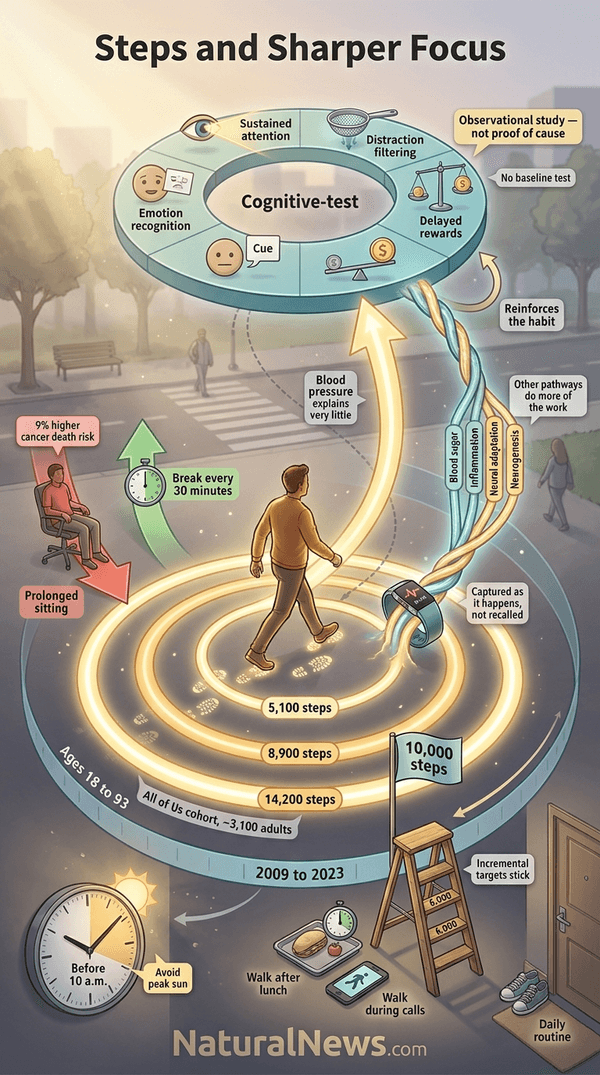
Researchers used Fitbit step counts and blood pressure readings from medical records covering 2009 to 2023, according to the study. At the end of the observation period, participants completed four computerized tests measuring concentration, ability to ignore distractions, decision-making and emotion recognition.
The researchers wanted to see whether people who consistently moved more performed differently on these tests, and whether blood pressure helped explain any connection. The study was observational, and researchers said it could not prove that taking more steps directly improved brain function.
Researchers also measured cognitive performance only at the end of the study, so they could not determine how participants' thinking skills changed over time.
Higher-Step Groups Outperformed Least Active Group on Cognitive Tests
Participants were divided into three groups based on average daily steps: about 5,100 steps, about 8,900 steps and about 14,200 steps, the study stated. Both the 8,900-step and 14,200-step groups performed significantly better than the lowest-step group on tests measuring sustained attention, the ability to filter out distractions, and decision-making involving future rewards, researchers said.
Each additional 1,000 daily steps was associated with better performance on several cognitive measures, and researchers said participants did not necessarily need to reach 10,000 steps to see a connection.
The study gives some of the clearest evidence yet on the relationship between movement and mental function, according to the report [1]. Other research has linked higher daily step counts to lower dementia incidence among older adults over approximately seven years [2].
Blood Pressure Explained Little of the Association, Researchers Said
Blood pressure explained very little of the relationship between physical activity and cognitive performance, according to the study. That suggests walking may be connected to brain health through other pathways, potentially including improved blood sugar regulation, reduced inflammation and changes that support the brain's ability to adapt and form connections.
Scientists have long linked physical exercise to brain health, and there is evidence that physical activity helps build a brain that resists shrinkage and enhances cognitive abilities by promoting neurogenesis, the brain's ability to adapt and grow new cells [3]. Physical activity produces biochemical changes that strengthen and renew both the body and the brain, according to the research.
Separate research has reported that prolonged, uninterrupted sitting is associated with a 9% higher risk of cancer death, with effects observed across overall incidence and obesity-related cancers [4]. Breaking up sitting every 30 minutes significantly lowers mortality rates, according to a separate report [5].
Researchers Suggest Incremental Increases in Daily Steps
For people averaging about 5,000 steps per day, researchers suggested working toward 6,000 or 7,000 steps rather than immediately aiming for 10,000. Suggestions included taking a 10-minute walk after lunch, walking during phone calls, breaking up long periods of sitting and making walking part of a daily routine.
These recommendations were reported as practical ways to add movement, not as proven treatments for cognitive decline. The study's findings offer another reason to make everyday movement a priority, according to the report [6].
The popular perception remains that a person is not really physically active until they play regular sports or join a gym, and these notions are fueled by social and economic pressures to institutionalize physical activity, according to Bernard E. Levine, a researcher cited in the report. Reports state that walking before 10 a.m. supports the circadian system while avoiding the period of peak solar intensity [7].
Conclusion: Findings Add to Evidence on Movement and Brain Health
The study found an association between higher daily step counts and better performance on several cognitive tests, but researchers said it could not establish causation. Walking has been widely linked to cardiovascular health, and researchers said the new findings offer another possible reason to make everyday movement a priority.
The report stated that the results add to existing research on physical activity and brain function without endorsing a specific step target for all adults. Other studies have linked higher total daily step counts to a reduced risk of death from all causes, including heart disease, and cancer over an average follow-up period of approximately ten years [8].
References
- Higher daily step counts linked to fewer mental health. https://www.reddit.com/r/science/comments/1wv689g/higher_daily_step_counts_linked_to_fewer_mental/
- Walk Your Way to a Healthier Brain? New Study Says Yes!
- Increase Daily Movement to Avoid Age Related - Mercola.com, February 26, 2016.
- Prolonged Sitting Linked to Higher Cancer Death Risk, Study Finds. https://www.naturalnews.com/2026-09-12-prolonged-sitting-linked-higher-cancer-death-risk.html
- A simple 30 minute rule could slash your risk of early death new study reveals - NaturalNews.com, January 06, 2026.
- Long?term Walking Linked to Better Attention and Decision?Making in Adults, Study Finds. https://kenya-today.com/report-longterm-walking-linked-to-better-attention-and-decisionmaking-in-adults-study-finds-16367/
- Morning Walk May Support Health All Day, Research Indicates - NaturalNews.com, September 18, 2026.
- Study Finds Higher Daily Step Count Tied to Lower Death Risk, Independent of Walking Speed. https://www.naturalnews.com/2026-09-04-higher-daily-step-count-tied-lower-death.html
Explainer Infographic











Please contact us for more information.


