



The government said the measures aim to strengthen cybersecurity defenses, improve investigations, support victims, and prevent further damage.
Prime Minister Cites Escalating Cyberattacks in AI Era
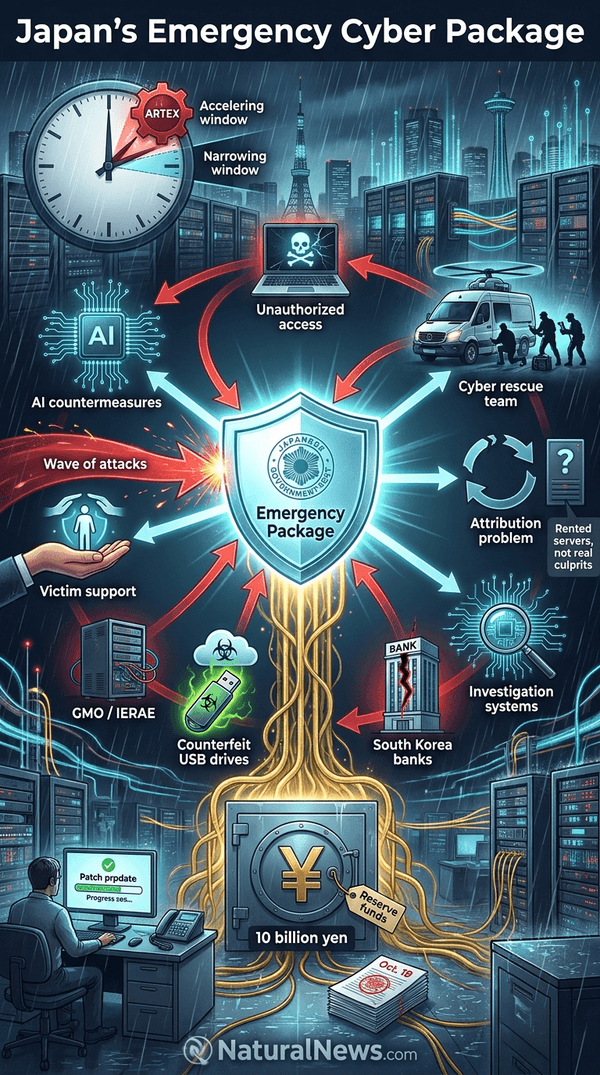
The package will initially receive 10 billion yen (US$63 million) from the government's fiscal 2026 budget-reserve funds, Takaichi said. The initial allocation was reported by shattered.io [2].
Takaichi said the government needed to mobilize resources to keep pace with increasingly sophisticated cyberattacks in the AI era.
"Even at this very moment, incidents of unauthorized access and information leaks are occurring one after another, having a major impact on the lives of our citizens and on corporate activities," she said.
Her remarks underscored concerns that the growing frequency and speed of cyberattacks are challenging existing security defenses.
Package Includes AI Countermeasures, Investigation Support and Victim Aid
The emergency measures include security countermeasures partly involving AI, stronger investigative capabilities, and expanded assistance for victims.
Media reports also said the package would establish a "cyber rescue team" comprising government and private-sector experts. The Japan Times reported that the initiative includes recruiting highly specialized cybersecurity professionals to respond to threats [3].
Recent security incidents have exposed vulnerabilities beyond the private sector. Japan's Ground Self-Defense Force reportedly used counterfeit Chinese USB flash drives infected with malware linked to Chinese hacker groups for nearly a year before discovering the compromised devices, according to a Nikkei Asia report cited by The Epoch Times [4].
The incident highlights the cybersecurity risks facing Japanese institutions, including government and military organizations.
Recent Attacks and Chinese AI Tool Cited by Security Firm
GMO Cybersecurity by IERAE said on Oct. 19 that investigators confirmed the use of ARTEX, a tool that uses AI to find and exploit weaknesses in computer systems, after examining servers used to attack Japanese businesses [5].
GMO Internet Group itself is among the entities that have come under attack, the company said. The IT and internet services giant said on its blog that it believes the attacker has published information allegedly linked to customers and its business, though the contents are still being verified and the full extent of the incident remains unclear, according to TechCrunch [6].
The incidents come amid a global increase in hacks and data breaches, with AI's ability to find previously unknown methods of intrusion in the spotlight.
Security researchers have linked Chinese AI tools to attacks beyond Japan's borders. South Korea's financial institutions were hit by another wave of cyberattacks roughly a month after an earlier series of incidents, with researchers pointing to the growing risk of AI-driven hacking in Asia [7].
Government Vows Full Mobilization as Funding Details Remain Pending
Further details on implementation and funding were not immediately announced, according to the government.
Japan's emergency measures highlight the practical difficulties of cyber defense at a time when attribution remains a persistent challenge. Cybersecurity professionals face attribution problems because of the inherent anonymity of the cyber environment; even after tracking an attack to a source computer and physical address, verifying the identity of the human attacker can be exceedingly difficult, according to Ben McCarty's book "Cyberjutsu" [8].
Accountability questions may also intensify.
For Japanese citizens and businesses, the government's guidance emphasized the need for vigilance. Japanese authorities urged organizations to apply available patches promptly, the report stated.
Conclusion
Japan's emergency cybersecurity package marks a government response to a series of breaches affecting businesses and government institutions.
The initial 10 billion yen allocation will support measures ranging from AI-assisted security defenses and specialized investigations to victim assistance. However, the package's effectiveness will depend on how quickly authorities implement these measures and coordinate with private-sector cybersecurity experts.
As AI continues to change the nature and speed of cyberattacks, Japan faces the challenge of strengthening its defenses while improving its ability to investigate breaches and identify those responsible.
References
- Japan unveils emergency cybersecurity package amid data breach concerns. https://mainichi.jp/english/articles/20261106/p2g/00m/0na/053000c
- Japan Emergency Cybersecurity Package: ¥10B Plan [2026]. https://shattered.io/japan-10-billion-yen-emergency-cybersecurity-package-cyber-rescue-team-2026/
- Takaichi administration announces emergency cyberdefense package. https://www.japantimes.co.jp/news/2026/11/06/japan/takaichi-cybersecurity-package/
- Japanese Military Used USB Drives With China-Linked Virus: Report. https://theepochtimes.com/china/japanese-military-used-usb-drives-with-china-linked-virus-report-6054017
- Chinese AI Tool Used Against South Korean Banks Also Identified in Cyberattacks on Japanese Firms: Report. https://theepochtimes.com/article/chinese-ai-tool-used-against-south-korean-banks-also-identified-in-cyberattacks-on-japanese-firms-report-6106746
- Japan internet giant GMO says hackers posted stolen customer data. https://techcrunch.com/2026/10/27/japan-internet-giant-gmo-says-hackers-posted-stolen-customer-data/
- South Korea’s financial industry hit by fresh wave of cyberattacks. https://techcrunch.com/2026/10/28/south-koreas-financial-industry-hit-by-fresh-wave-of-cyberattacks/
- Cyberjutsu by Ben McCarty
Explainer Infographic










Please contact us for more information.


