


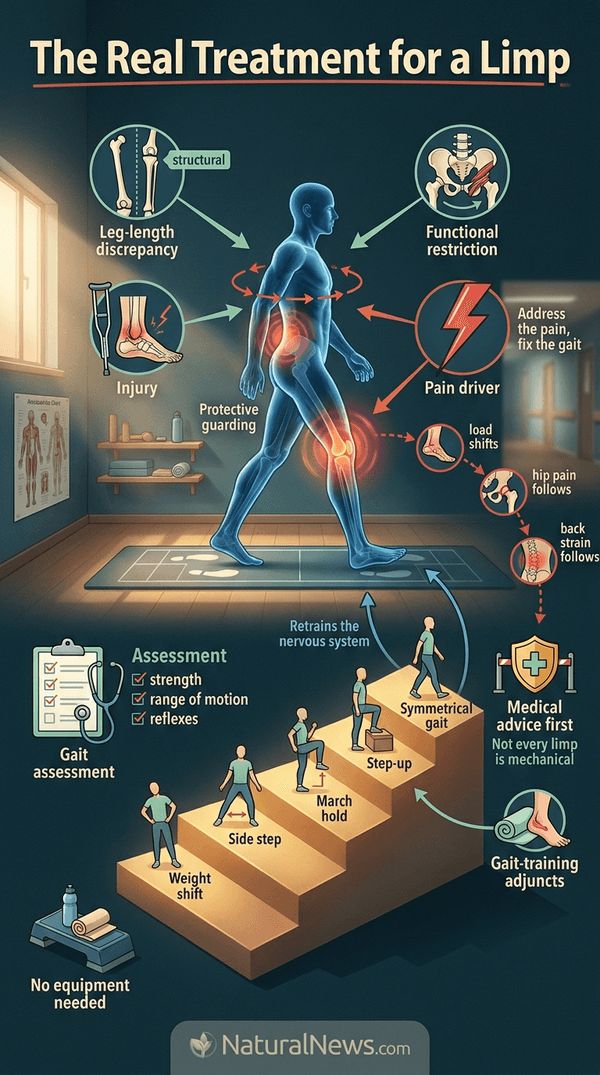
Shelley outlined five exercises that may lessen a limp in an article published by the Epoch Times. He wrote that limps are the most common movement issue he observes and that they can be caused by leg-length discrepancies, injuries, deformities, and pain.
Unlike structural causes, he stated that pain altering gait patterns is often something that can be addressed directly. "Address the pain, fix the gait," Shelley wrote.
Causes and Approach to Limp Treatment
Shelley noted that limping is a complex issue with many possible causes and that several factors can combine to produce the behavior. He advised that people with a pronounced limp seek medical advice to determine whether deeper causes exist that may require more intensive investigation.
The exercises Shelley presented are intended to address pain and stiffness and to teach the body to move better. He cautioned that there are no guarantees for improving limps and recommended that patients speak with their medical provider to confirm the exercises are appropriate for them.
The article's exercise guidance aligns with broader gait-training practice, which can include ankle pumps and calf towel stretches to improve range of motion and is often part of a physical therapy program, though the movements can also be performed at home, according to Verywell Health [1]. Physical therapy assessments for walking-related conditions commonly evaluate functional skills, gait, muscle strength, pain, range of motion, and reflexes, according to the clinical text Quick Reference to Physical Therapy [2].
First Two Exercises: Weight Shifting and Stepping
The first exercise is side-to-side weight shifting, a gentle movement that alternates weight-bearing from side to side without moving the legs. The instructions call for standing with the feet approximately hip-width apart, slowly leaning to the right until all weight is on the right leg while gently lifting the left foot a few inches off the ground, then placing the left foot down and repeating on the left side.
Shifting weight to one side counts as one repetition, with a target of three sets of 30 repetitions. Shelley stated that the rhythmic weight-bearing can strengthen the hip and leg muscles individually and train a person to better bear weight on both sides instead of favoring one side.
The second exercise, side-to-side stepping, progresses from the weight-shifting movement by adding lateral steps. A person stands with the feet a few inches apart, slowly steps the right foot out until the feet are about hip-width apart, transitions weight onto the right foot, and then brings the left foot close.
The movement is repeated to the left. Stepping to a side and bringing the other foot over counts as one repetition, with a target of three sets of 30 repetitions.
Exercises 3 and 4: March Holds and Step-Ups
The third exercise is standing march holds, which are designed to train balance and the hip flexors. The steps call for standing with the feet hip-width apart, slowly lifting the right leg until all weight is on the left leg and the hip and knee are at approximately 90 degrees of flexion, holding for a few seconds, and then lowering the leg before repeating on the other side. Shifting weight to one side and lifting the other leg counts as one repetition, with a target of three sets of 30 repetitions per side.
The fourth exercise, step-ups, converts the standing march into a weight-bearing movement. A person stands facing a staircase or yoga step, steps up onto the first step with the right foot, brings the left foot up beside it, steps back down with the right foot first, and then brings the left foot down. Stepping up and back down counts as one repetition, with a target of three sets of 30 repetitions.
The loading demands of the hip during walking are substantial: when the left limb is lifted, the right hip joint is subjected to compression forces several times greater than body weight, according to Biomedical Acupuncture for Pain Management [3]. Exercise-based approaches to knee and hip recovery, including developing a functional gait, are standard in rehabilitation protocols after knee surgery, according to The Swiss Ball: Theory, Basic Exercises and Clinical Application [4].
Exercise 5 and Recommendations
The fifth exercise is heel-to-toe stepping, a narrow-stance movement that emphasizes postural control. A person slowly steps forward with the right foot, placing the heel of the right foot directly in front of the toes of the left foot, and then proceeds forward with the left foot in the same manner. The target is three sets of 30 steps.
Shelley recommended performing the exercises at least three times per week, and preferably five times.
References
- 10 Gait Training Exercises to Improve Your Mobility. https://www.verywellhealth.com/gait-training-in-physical-therapy-5069884
- Quick reference to physical therapy by Pauls Julie A
- Biomedical acupuncture for pain management an integrative approach by Yun-tao Ma
- The Swiss Ball Theory Basic Exercises and Clinical Application by Beate Carriere
Explainer Infographic










Please contact us for more information.


