



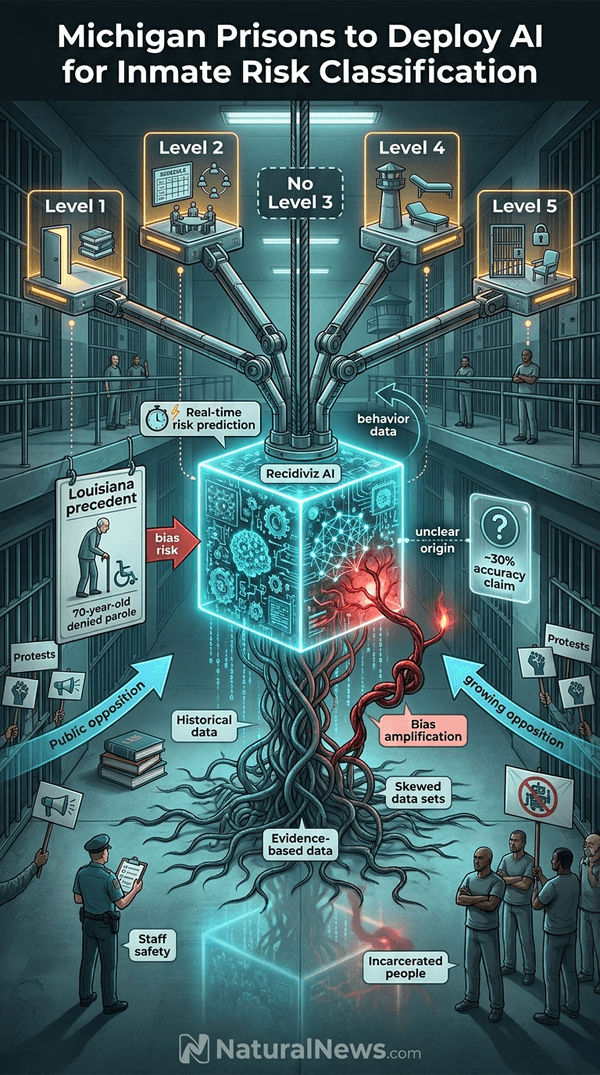
The pilot is scheduled to begin on Dec. 1, 2026, according to the release. According to the statement, then program seeks to "optimize placement of incarcerated individuals" and "improve MDOC's ability to more accurately predict incarcerated individuals' risk of future violence by approximately 30%." But according to a Futurism piece on the development, it is unclear as to how the MDOC arrived at the vague figure [1].
The system will assign incarcerated people to security levels that determine their housing assignments and access to programs, according to the department. The MDOC added that the pilot will begin in a number of men's facilities.
How the Classification System Works
Under the pilot, incarcerated individuals will be sorted into five security levels, with Level 1 being the least restrictive and Level 5 the most restrictive, according to the department. There is no Level 3 designation, according to a report by Fox 2 Detroit [2].
The pilot will make determinations of violence potential in real time instead of on a scheduled basis, the department said.
Prisoners assigned to Level 1 are granted the most freedom of movement and a wide choice of activities, with this classification focusing on education, skill-building and preparation for re-entering society [2]. Those in Level 2 are organized into a structure environment, but with many programs available. Level 2 emphasizes education, evidence-based programming and positive routines [2].
Meanwhile, inmates in Level 4 face increased supervision and controlled movement. Level 4 focuses on evidence-based programming that emphasizes behavior and substance use interventions, alongside high school equivalency completion [2].
Inmates classified as Level 5, the highest tier, have the most restricted movement with closed supervision. This level touches on evidence-based programming, with an emphasis on preventing violence and resolving behavior issues through therapy [2].
Recidiviz and the Technology
MDOC Director Heidi E. Washington told Fox 2 Detroit that she is optimistic that Recidiviz "will strengthen the security of our facilities." Washington added: "Classifying prisoners at the security level that fits their current behaviors and needs keeps everyone safer – the individual, other incarcerated people and correctional staff."
The MDOC said the tool uses evidence-based and historical data, though the department did not provide details on what specific data sources the system will draw from.
Concerns About Data Bias and Accuracy
Futurism also pointed out, citing a ProPublica investigation, that a similar program exists in Louisiana. One instance from the Pelican State involved a 70-year-old inmate with disabilities who was deemed to be at "moderate risk" of recidivism despite having a clean disciplinary record. The "moderate risk" classification resulted in the inmate being ineligible for parole. [1]
The concerns are not limited to Louisiana. Researchers have documented that facial recognition software and other machine learning systems trained on skewed data sets can disproportionately affect Black communities, particularly as such tools are increasingly used within the justice system [3].
The broader risk is that AI systems trained on biased sources can encode and amplify existing human prejudices into their core reasoning [4]. It is unclear what data Michigan's system will collect and how that data will be weighted.
Official Statements and Context
Washington said the system will keep everyone safer by matching security levels to current behaviors and needs. The department said the pilot is a response to that uptick in violence.
The announcement comes as public opposition to artificial intelligence and its infrastructure has been growing across the country, with protests erupting at county meetings, school board hearings and rural town halls over the costs and consequences of AI expansion [5]. Critics of algorithmic risk assessment have argued that such tools can replicate existing biases rather than correct them.
Unanswered Questions and Ongoing Debate
Critics have raised concerns that AI could replicate existing biases and worsen outcomes, as the Louisiana case illustrates. The pilot will begin in select men's facilities, with no announced plans for expansion. Ultimately, the question of whether software alone can solve the Great Lakes State's ongoing corrections crisis remains an open one.
References
- Prisons Using AI to Predict When Incarcerated People Will Commit Future Crimes. https://futurism.com/artificial-intelligence/prisons-ai-prediction-incarceration-algorithm
- Michigan prisons turn to software to determine inmate potential for violence. https://www.fox2detroit.com/news/michigan-prisons-using-ai-determine-inmate-potential-violence
- Nature of work The new story of work for a living age. Miller Paul 1957- author
- The algorithmic leviathan How cheap biased AI threatens democracy and your job - NaturalNews.com, November 14, 2025.
- Feds Targeting “Anti-Tech Extremism” as AI Backlash Spreads. https://thenewamerican.com/us/tech/feds-targeting-anti-tech-extremism-as-ai-backlash-spreads/
Explainer Infographic











Please contact us for more information.


