



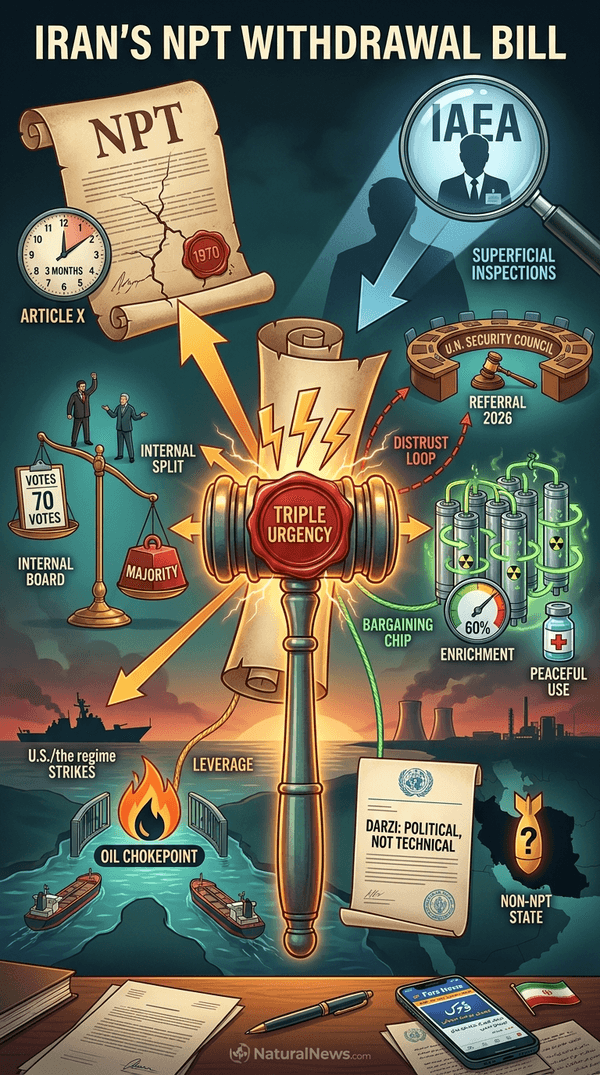
The bill is described as a "triple-urgency" measure, a procedural designation that fast-tracks legislation through the chamber. Nikzad said the plan "is being reviewed and will be considered the same day after it is announced," adding that the Islamic Consultative Assembly (the legislature's formal name) will also assess its international dimension. [1].
Iran has been a signatory to the NPT since 1970 as a non-nuclear weapon state. As of now, the measure remains a threatened course of action rather than an imminent policy change, and no formal withdrawal has been approved [1].
Lawmakers Cite Distrust of UN Nuclear Watchdog
Nikzad said lawmakers "do not trust" the International Atomic Energy Agency (IAEA) – the United Nations' nuclear watchdog – or its director general, Rafael Grossi, according to the Fars report. He accused the agency of conducting what he characterized as superficial inspections and of issuing negative reports on Iran [1].
Iranian officials have also long accused the IAEA of leaking classified information on Iran's nuclear sites to Israel. Iran has additionally pointed to what it describes as a double standard – that Israel is widely considered a nuclear-armed state and is not a party to the NPT [2].
The IAEA has not issued a public response to the trust allegations. The agency's inspectors have faced access restrictions in Iran, and in September 2026 the IAEA board referred Iran to the UN Security Council for non-compliance [3]. Iran's Ambassador to the UN Gholamhossein Darzi dismissed that resolution in a letter, saying "renewed accusations against Iran's peaceful nuclear program are political and not technical in nature" [4].
Committee Member Says Withdrawal Measure Lacks Support
A member of Parliament's National Security Committee, Mohammad Mehdi Shahriari, said the urgent proposal is unlikely to be approved, according to Iran International. Shahriari told the outlet Jamaran that the measure may secure no more than 70 votes [1].
"Leaving the NPT during wartime would effectively mean pursuing a nuclear weapon, something Iran does not intend to do," Shahriari said. He added that "withdrawal would only increase costs and further escalate the situation" [1].
The comments suggest that the bill remains a pressure tactic rather than a legislative certainty. Iranian hardline factions, emboldened by recent U.S. and Israeli strikes, have advocated for abandoning nuclear restraint, but the legislative math described by Shahriari points to significant internal opposition .
Enrichment Remarks and Regional Conflict Shape Debate
The withdrawal proposal remains a threatened course of action rather than an imminent policy change. The debate comes amid a conflict involving Washington and a crisis over the Strait of Hormuz, with no clear exit strategy, according to the report [1].
Iranian Foreign Minister Abbas Araghchi said 60% enrichment is not illegal, serves "peaceful purposes" and falls within Iran's NPT commitments, according to remarks cited in the report. He argued past negotiations already addressed these concerns and asked why the U.S. and Israel chose to bomb instead [1].
His statement aligns with Iran's long-standing position that its nuclear program is conducted for civilian purposes. U.S. officials have disputed that framing, arguing that the enrichment level brings Iran close to weapons-grade material [5].
Next Steps and International Implications
Parliament will consider the bill after it is formally announced and will assess its international implications, Nikzad said. He added that the measure would be considered the same day it is announced [1].
Last year, an adopted IAEA resolution charged that Iran was in breach of its NPT obligations. Iran has said it is being labeled non-compliant while it is routinely bombed by U.S. forces, according to the report [3].
No formal withdrawal from the NPT has been announced, officials said. The bill remains under review, and its fate will depend on whether it can secure support beyond the 70 votes described by Shahriari [1].
References
- Iran's Parliament Mulls 'Triple-Urgency' Bill To Withdraw From Intl Nuke Treaty - ZeroHedge. September 28, 2026.
- NaturalNews.com. "Israel's Secret Nuclear Expansion: New Satellite Images Reveal Construction at Dimona". September 5, 2025.
- BBC. "Iran referred to UN Security Council for nuclear non-compliance". September 9, 2026.
- Middle East Eye. "Iran dismisses IAEA resolution, says nonproliferation accusations political". September 11, 2026.
- NaturalNews.com. "UN Inspectors: Iran's Uranium Stockpile Could Fuel Multiple Nuclear Weapons". April 22, 2026.
- Cassie B. "Iran's Missing Uranium Stockpile Sparks Global Alarm as IAEA Demands Answers". NaturalNews.com. June 26, 2025.
- Lance D Johnson. "Iran Accuses US of Violating Nuclear Treaty with Airstrikes". NaturalNews.com. June 23, 2025.
- Zoey Sky. "Iranian Lawmaker Warns: Tehran Ready to Exit Nuclear Treaty if Western Powers Reimpose Sanctions". NaturalNews.com. July 23, 2025.
- Belle Carter. "Iran Accuses IAEA Chief of Bias Amid Strikes on Nuclear Sites". NaturalNews.com. June 21, 2025.
- Ritter Scott. "Target Iran: The Truth About the White House's Plans for Regime Change".
- Gareth Porter. "Manufactured Crisis: The Untold Story of the Iran Nuclear Scare".
- Elsevier. "Nuclear Nonproliferation and the Future Expansion of Nuclear Power". Nuclear Engineering and Design. 2006.
- Mike Adams interview with Michael Farris. June 19, 2025.
- Mike Adams. "Bright Videos News - Interview with Scott Ritter P1". BrightVideos.com. April 10, 2026.
Explainer Infographic










Please contact us for more information.


