


Texas Diesel Emergency and Why I'm Still Going Electric
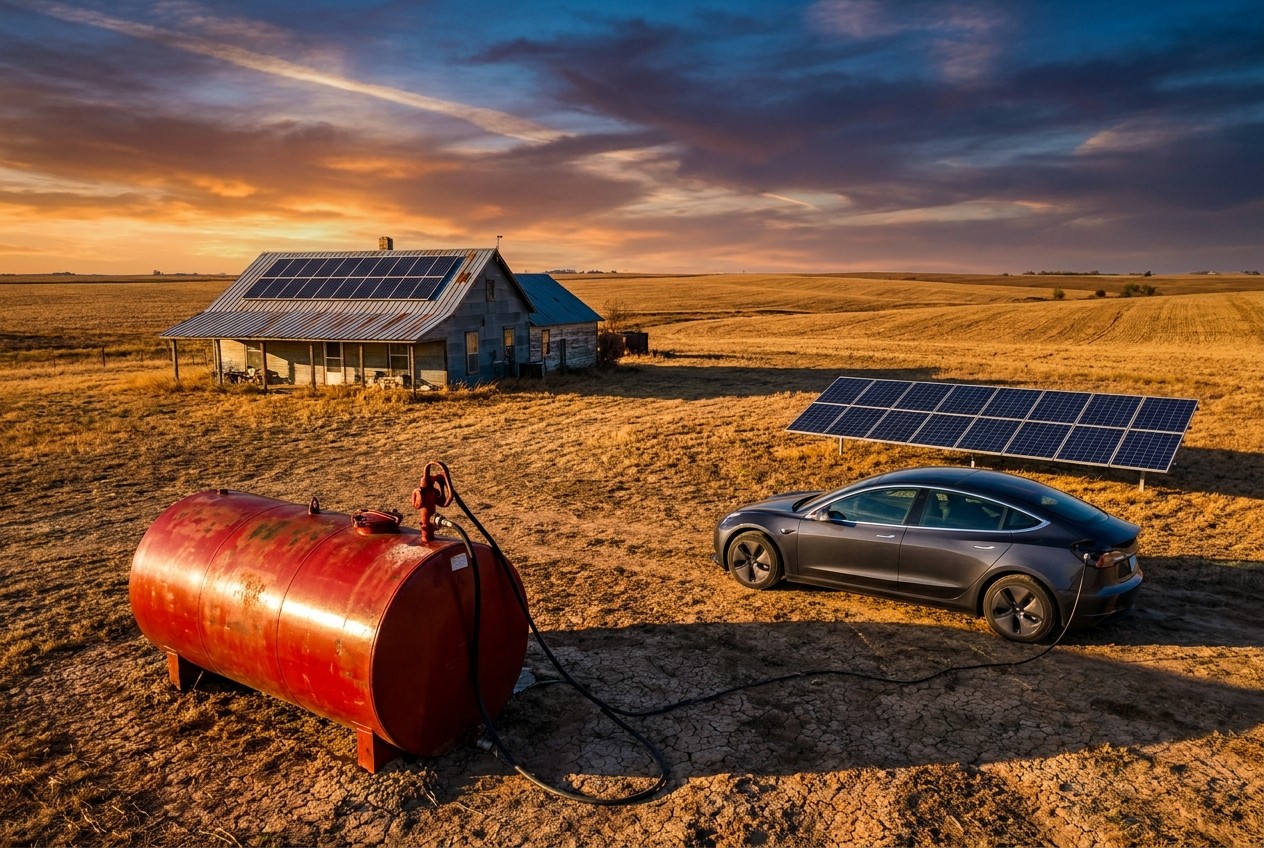
I live on a farm in rural Texas, and I have been preparing for fuel chaos for years. When diesel was cheap, I stocked up. When red diesel was $2.50 a gallon, I filled my storage tanks. Then I sold my diesel truck because I saw the writing on the wall. Now, as Texas Governor Greg Abbott issues a statewide disaster declaration over diesel shortages, I find myself in the odd position of supporting his emergency order while simultaneously planning to buy an electric vehicle anyway.
The diesel market is a mess. Prices have topped $6.50 a gallon nationally, and the Texas Railroad Commission is calling Abbott's move a "common-sense step towards expanding access to cheaper diesel" [1]. I agree. But emergency orders are not energy policy. They are Band-Aids on a bullet wound. The real solution is personal energy independence, and that is why I am going electric -- not to save the planet from the hyped-up "climate change" hoax, but to save myself from the coming fuel rationing.
The Red-Dye Rules and the Tax Trap I Know Too Well
For those who do not farm, let me explain the red-dye rules. Normal road diesel is taxed heavily. Agricultural diesel, known as red diesel, is dyed red and taxed far less because it is meant for off-road use -- tractors, generators, irrigation pumps, and so on. If you get caught running red diesel on public roads, the fines can exceed $20,000. Abbott's emergency order suspends those penalties, making it legal for road vehicles to use red diesel during this crisis [1]. That immediately expands the usable fuel supply for truckers, ranchers, and anyone else who needs to keep moving.
I remember the 2021 Texas freeze. The grid failed. Pipes burst. People died. During that disaster, many of us relied on red diesel to run generators and heaters. I had stored fuel, and it kept my animals warm with diesel forced-air blowers.
One of our solar generator units was used to power a diesel heater blower [2]. That experience taught me that self-reliance is not a hobby -- it is a survival strategy. The red-dye rules exist to protect tax revenue, not to help people. When the emergency hits, those rules become obstacles. Abbott is right to waive them, but we should ask why they exist in the first place.
Why the Diesel Market Is Broken -- and Won't Heal Soon
The diesel crisis is not a temporary glitch. It is the result of years of refining capacity destruction, global war, and supply chain sabotage. National average diesel prices are above $6 a gallon, and regular gasoline is firmly above $4.20, according to ZeroHedge [3]. Disruptions tied to the Russia-Ukraine war and turmoil in the Gulf are intensifying a global refining squeeze [3]. The Trump administration is even considering invoking the Defense Production Act to boost refining capacity -- a tool never before used for that purpose [4].
Meanwhile, the Strait of Hormuz remains a flashpoint. Iran has offered deals to reopen it, but prospects are dimming [5]. A zero-flow closure would trigger a cascading crisis across civilization, as one analysis put it [6]. Even if the strait reopens, the damage is done. Experts say it will take years to fix, and consumers should expect costs to go up and stay up [7].
The Strategic Petroleum Reserve is at its lowest level since 1982 [8]. President Trump authorized a historic 172 million barrel release from the SPR to address energy costs [9]. But that is a short-term fix. The real problem is that we have built a society entirely dependent on just-in-time fuel deliveries, and that system is fragile.
I stocked up early because I saw this coming. Self-reliance beats waiting for government. When the shelves are empty and the pumps are dry, the only person you can count on is yourself.
The Enforcement Problem: Everybody's Tank Will Be Red
Here is the dirty secret about red diesel enforcement: it relies on dye staining fuel filters. When inspectors check a truck, they look for red stains. If they find them, you are guilty of tax evasion. But after Abbott's emergency order, thousands of trucks will have red-stained filters. The moment the emergency ends, enforcement becomes impossible. Every trucker in Texas will have a plausible excuse: "I ran red diesel during the emergency."
This exposes the absurdity of the punitive tax regime. We should not need an emergency order to make fuel affordable. We should not be fining people $20,000+ for using the wrong fuel. I would rather see lower fuel taxes across the board than a system that criminalizes hardworking people for trying to survive.
The government's answer to every problem is more rules, more fines, more control. But when the crisis hits, they suspend the rules. That tells you everything you need to know. The rules were never about safety or fairness. They were about revenue. And now that revenue is drying up, along with the fuel.
My Take: Relief Now, But Don't Depend on Diesel
Abbott did the right thing. I am glad he issued the order, even though I will not need it because I stored my own red diesel years ago. But emergency orders are not energy policy. The real answer is decentralization, preparedness, and personal energy independence.
That is why I sold my diesel truck and plan to buy an EV this year. Not because I trust the climate narrative -- I do not. Carbon dioxide is good for plants, and the climate change narrative has been used to crush domestic energy production [10]. I am going electric because I refuse to be held hostage by diesel scarcity. When the trucks stop rolling and the pumps run dry, I want to be able to charge my vehicle from my own solar array.
I have written before about how off-grid solar suddenly makes instant sense [11]. The technology is here. The batteries are here. The only thing holding people back is the belief that the government will save them. It will not. Abandon all such delusions before they hurt you.
Follow my work at brightvideos.com and naturalnews.com, where I document the collapse and the solutions in real time. And watch my interviews with expert guests at Decentralize.TV
References
- Texas Gov. Abbott issues disaster declaration citing diesel fuel crisis, waives restrictions. - Just The News. September 28, 2026.
- Mike Adams interview with Tina - March 26, 2024. Mike Adams.
- Trump Admin Weighs Emergency Powers To Boost Refining As Diesel Tops $6. - ZeroHedge. September 13, 2026.
- Trump weighs emergency powers as diesel tops $6, threatening economy ahead of midterms. - NaturalNews.com. September 15, 2026.
- Prospects Dimming On Iran-U.S. Deal To Open Strait, End War. - TWZ. April 27, 2026.
- Systemic Risk: A 12-Order Cascading Analysis Of A Zero-Flow Strait Of Hormuz Closure. - ZeroHedge. March 5, 2026.
- U.S.-Israel-Iranian conflict escalating global energy, supply chain crisis. - Just The News. April 7, 2026.
- U.S. Strategic Petroleum Reserve Drops To Lowest Level Since 1982 – Can Washington Afford To Refill It?. - NaturalNews.com. September 29, 2026.
- Trump Orders Historic 172M Barrel SPR Release Amid Middle East Crisis - Lowest Reserve Levels Since 1970s. - NaturalNews.com. March 17, 2026.
- Weekly Climate and Energy News Roundup #703. - Watts Up With That. August 24, 2026.
- Why Off-Grid Solar Suddenly Makes Instant Sense. - NaturalNews.com. June 12, 2026.
- Health Ranger Report - hard times made Americas enemies strong - Mike Adams - Brighteon.com. April 17, 2024.
- Brighteon Broadcast News - Arctic Blast SCARE - Mike Adams - Brighteon.com. January 08, 2024.
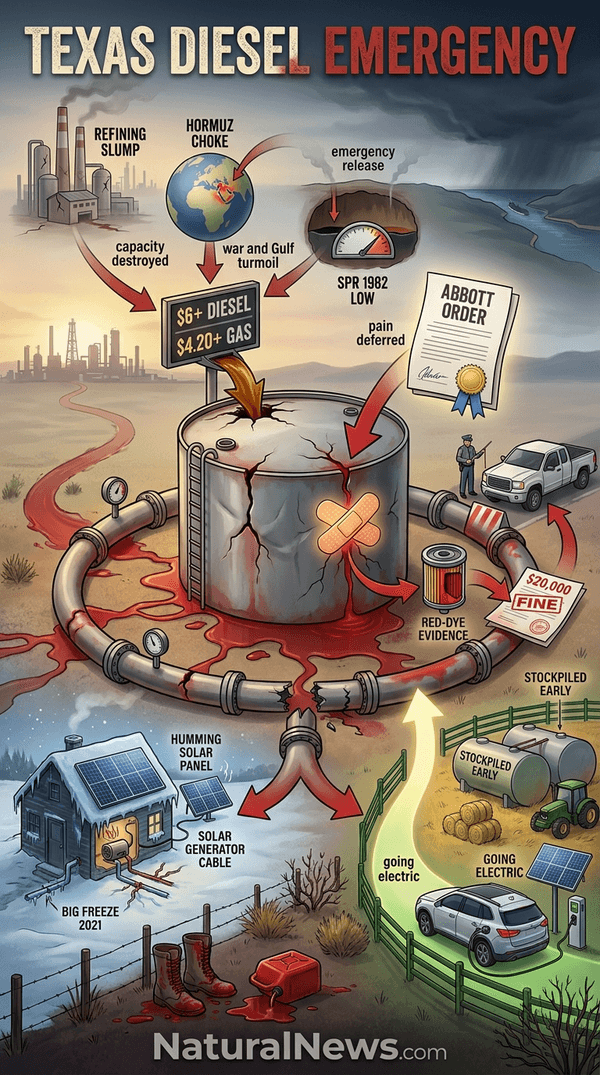
Explainer Infographic
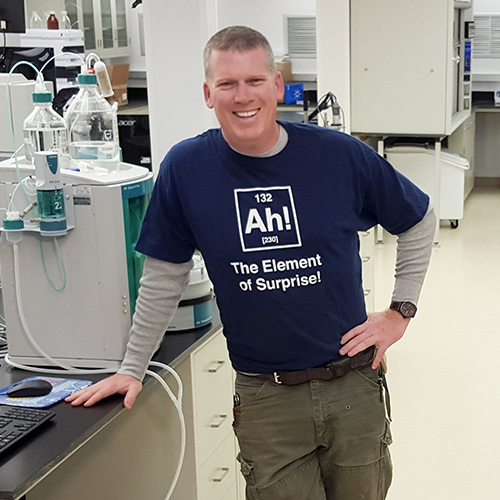
Mike Adams (aka the "Health Ranger") is the founding editor of NaturalNews.com, a best selling author (#1 best selling science book on Amazon.com called "Food Forensics"), an environmental scientist, a patent holder for a cesium radioactive isotope elimination invention, a multiple award winner for outstanding journalism, a science news publisher and influential commentator on topics ranging from science and medicine to culture and politics.
Mike Adams also serves as the lab science director of an internationally accredited (ISO 17025) analytical laboratory known as CWC Labs. There, he was awarded a Certificate of Excellence for achieving extremely high accuracy in the analysis of toxic elements in unknown water samples using ICP-MS instrumentation.
In his laboratory research, Adams has made numerous food safety breakthroughs such as revealing rice protein products imported from Asia to be contaminated with toxic heavy metals like lead, cadmium and tungsten. Adams was the first food science researcher to document high levels of tungsten in superfoods. He also discovered over 11 ppm lead in imported mangosteen powder, and led an industry-wide voluntary agreement to limit heavy metals in rice protein products.
Adams has also helped defend the rights of home gardeners and protect the medical freedom rights of parents. Adams is widely recognized to have made a remarkable global impact on issues like GMOs, vaccines, nutrition therapies, human consciousness.










Please contact us for more information.


