



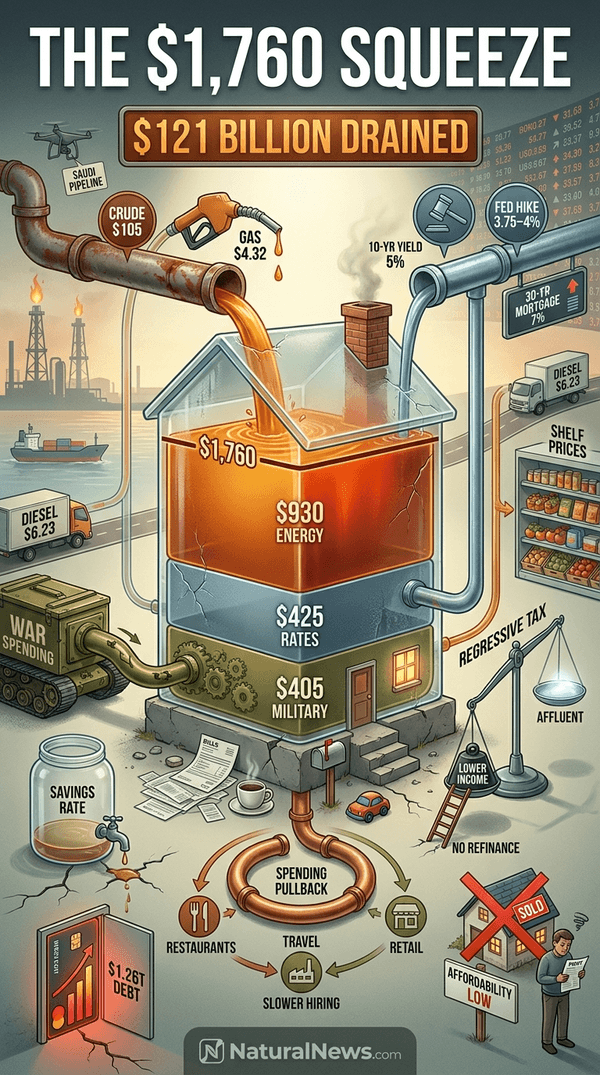
The estimate breaks down into approximately $930 in added energy costs, $425 from higher interest rates and $405 from increased military spending, according to the report. U.S. consumers have spent more than $121 billion extra on energy alone since the conflict began, Moody's found.
"Consumers are under a lot of financial pressure," said Mark Zandi, chief economist at Moody's Analytics. The strain arrives as crude oil prices reaccelerated in recent weeks following renewed fighting between the U.S. and Iran, pushing pump prices and bond yields higher in tandem [1].
Oil Prices and Pump Costs
U.S. crude oil topped $105 per barrel on Tuesday, Sept. 15 – its highest closing level since mid-May, according to the report. The average gallon of gasoline in the U.S. exceeded $4.32 on Tuesday, up 6% month over month and 36% from a year ago, according to the American Automobile Association (AAA).
Diesel prices hit all-time highs above $6 per gallon and were roughly 70% higher than the same day a year prior, according to AAA data. National average retail diesel topped $6.23 a gallon as a refining crisis tied to the Russia-Ukraine war compounded the Gulf conflict [2].
U.S. Energy Secretary Chris Wright told CNBC that the closure of a Saudi Arabian pipeline would last only a few days. Oil prices remain elevated despite that assurance, with Brent crude trading near $108 per barrel following a drone attack that damaged Saudi Arabia's East-West pipeline and threatened to cut roughly 4% of global oil supply [3] [4]. Ukrainian drone strikes on Russian refineries have also removed Russian diesel exports from global markets [5].
Slightly over 29% of respondents to the University of Michigan's consumer sentiment survey mentioned gas prices in September, up from around 12% and 6% in the same month of 2024 and 2025, respectively. Deloitte found that a 20% gain in crude oil prices translates to an estimated increase in inflation of about three-tenths of a percentage point, excluding knock-on effects on categories such as airfare and food.
Treasury Yields and Borrowing Costs
The 10-year U.S. Treasury yield climbed this week to its highest level since 2007, briefly topping 5% on Monday and reaching 5.04% on Tuesday before easing back, according to BBC reporting [6]. The benchmark for consumer loans and corporate funding sits roughly a full percentage point higher than it did a year ago. The move higher comes amid a global bond sell-off driven by inflation concerns, surging energy prices, and large fiscal deficits [7].
The average rate on the 30-year fixed mortgage topped 7% this month for the first time in more than a year, tracking longer-term bond yields. Michigan's consumer survey found 44% of respondents expected borrowing costs to rise in the next year as of July, up 10 percentage points compared with a year prior.
CNBC's Fed Survey found that most respondents expect the Federal Reserve to raise rates at least twice in the next year, and fed funds futures priced a more than 92% likelihood of a rate hike at Wednesday's meeting. The Federal Reserve subsequently voted unanimously to raise rates to between 3.75% and 4% from between 3.5% and 3.75% – its first increase in more than three years – with Fed Chair Kevin Warsh stating that "inflation is too high and has been for too long" [8].
Higher borrowing costs for companies can slow hiring, said Nicole Bachaud, a labor economist at ZipRecruiter, making it harder for Americans looking to enter the workforce or switch jobs. Total U.S. credit card debt rose to $1.26 trillion in the second quarter, sitting near a record high, according to the New York Fed.
Household Strain and Savings
"People experience higher interest rates much like they experience inflation," said Diane Swonk, chief economist at KPMG. "It makes things less affordable." Several economists have said that higher energy costs tied to the war have more than erased the benefit from larger tax refunds, with lower-income consumers – who typically spend a larger share of income on energy – feeling the pain more acutely.
With inflation once again rising faster than income, U.S. consumers are left with negative real earnings growth and less purchasing power. Luke Tilley, chief economist at M&T Bank and Wilmington Trust, said consumers are drawing on savings, with the personal savings rate in the U.S. in 2026 falling to levels rarely seen since the Global Financial Crisis.
"It's reflecting the times," Tilley said. "Costs have gone up and income growth has gone down, so something has got to give."
The Bureau of Economic Analysis reported that consumer spending rose 0.2% in July, a modest slowdown from the prior month [9]. The Atlanta Federal Reserve's home ownership affordability index fell to lows rarely seen on record this summer.
Outlook and Attribution
Tilley said U.S. consumers may eventually need to pull back on spending, a concern because consumer spending accounts for the majority of the country's gross domestic product. Economists continue to describe the current environment as a "K"-shaped economy, in which lower-income households bear a disproportionate share of the burden while higher-income households remain more insulated.
Oil prices and Treasury yields remain key factors heading into the fall, with Moody's estimating the household burden at approximately $1,760 as of Sept. 11, including $930 in energy costs, $425 from higher interest rates and $405 from military spending. The report attributes its data to Moody's Analytics, KPMG, M&T Bank, ZipRecruiter, the University of Michigan, AAA, Deloitte, the Bureau of Labor Statistics, the Federal Reserve Bank of Atlanta, and the New York Fed.
References
- BBC Verify. "How escalating Saudi oil crisis could drive up prices everywhere". BBC. September 16, 2026.
- ZeroHedge. "$6 Diesel Flashes 2008 Warning As Energy Shock, AI Slowdown Fears Fuel Perfect Storm". ZeroHedge. September 14, 2026.
- Middle East Eye. "Attack on Saudi Arabian pipeline may cut four percent of world's oil supply". Middle East Eye. September 14, 2026.
- NaturalNews.com. "Drone Attack Damages Saudi East-West Pipeline, May Cut 4% of Global Oil Supply". NaturalNews.com. September 16, 2026.
- Daily Reckoning. "Putin, Persia and a Perfect Storm for Diesel". Daily Reckoning. September 16, 2026.
- BBC. "US borrowing costs hit highest level since 2007". BBC. September 15, 2026.
- The New American. "Global Bond-market Sell-off Drives Yields Higher Amid Fiscal Pressures". The New American. September 15, 2026.
- BBC. "US interest rates raised for first time in three years". BBC. September 16, 2026.
- BBC. "US inflation holds steady as diesel prices pass $6 a gallon". BBC. September 11, 2026.
Explainer Infographic









Please contact us for more information.


