


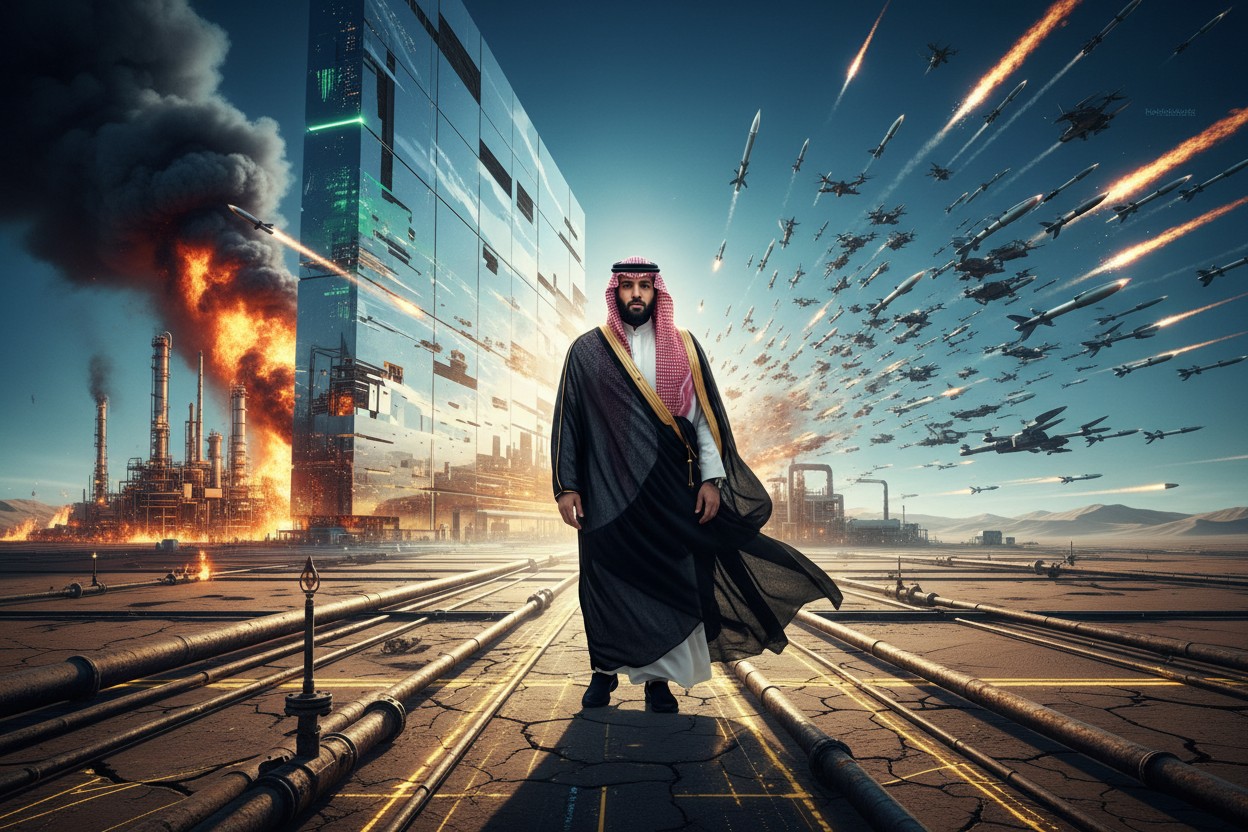
According to NaturalNews.com, Vision 2030 – introduced in 2016 as a blueprint for a life after oil – has already strained the kingdom's finances amid delays, budget cuts and a growing government deficit [1]. Riyadh has run a budget deficit for six consecutive quarters and has become the largest issuer of international debt in emerging markets [1]. Aside from this, the kingdom faces pressure from Iran-backed militias in Iraq to the north, Houthi forces along Yemen's Red Sea coast to the south and Washington's war on Iran disrupting the Strait of Hormuz to the east [2].
Vision 2030 Requires Peace, but War Closes In on Saudi Arabia
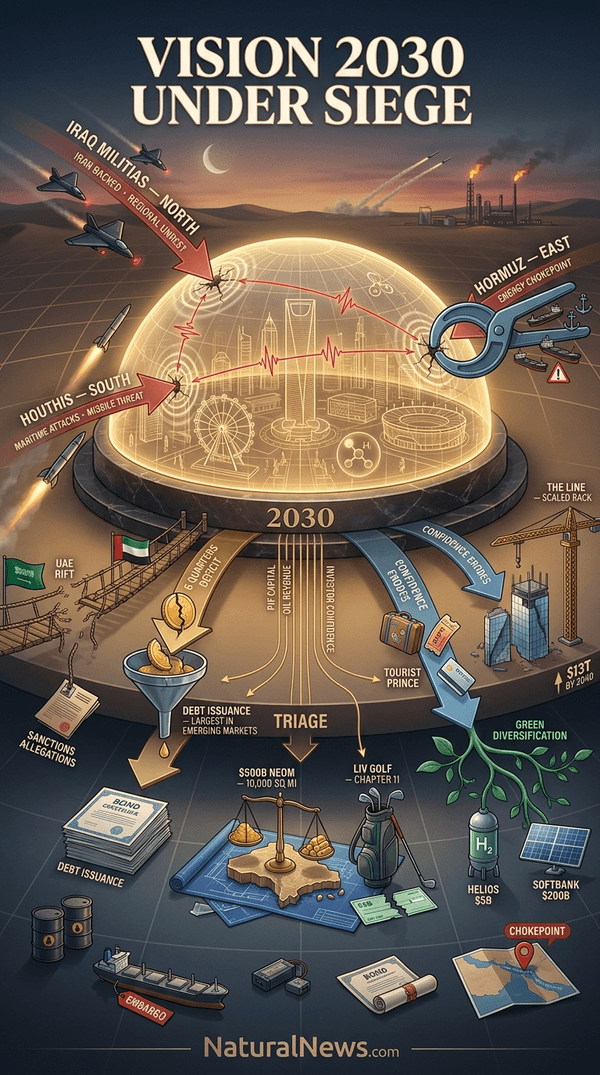
The core of Vision 2030 – attracting tourists, hosting concerts and international sporting events and building futuristic cities such as Neom – requires a stable regional environment, which is now under threat [3]. Neom, a $500 billion city project spanning 10,000 square miles in the southwestern corner of the Saudi peninsula, is a flagship component of the plan [3].
Saudi Arabia has also pursued green energy diversification, including a $5 billion hydrogen plant called Helios Green Fuels and a $200 billion solar project with SoftBank [4][5]. These projects are intended to reduce the kingdom's dependence on petrodollars, which analysts project could cost petrostates as much as $13 trillion by 2040 due to climate-change targets [4].
But the war is closing in. According to a report by Responsible Statecraft, Saudi air defenses shot down drones launched from Iraqi territory by Iran-affiliated militias on July 28, targeting oil facilities in the Eastern Province and Riyadh itself [2]. Houthi forces also said they had hit sensitive oil transport sites linking Saudi Arabia to its southern ports [2].
Military Options Elusive as Houthis Pressure Red Sea, Allies Hold Back
The July 13 Saudi strikes on Sanaa International Airport reignited the war with the Houthis, ending a ceasefire that had held since 2022 [6]. In response, Houthi leader Abdul Malik al-Houthi said there were indications Saudi Arabia was planning a major escalation in Yemen, and he warned, "We will work to establish the equation of siege with siege" [7].
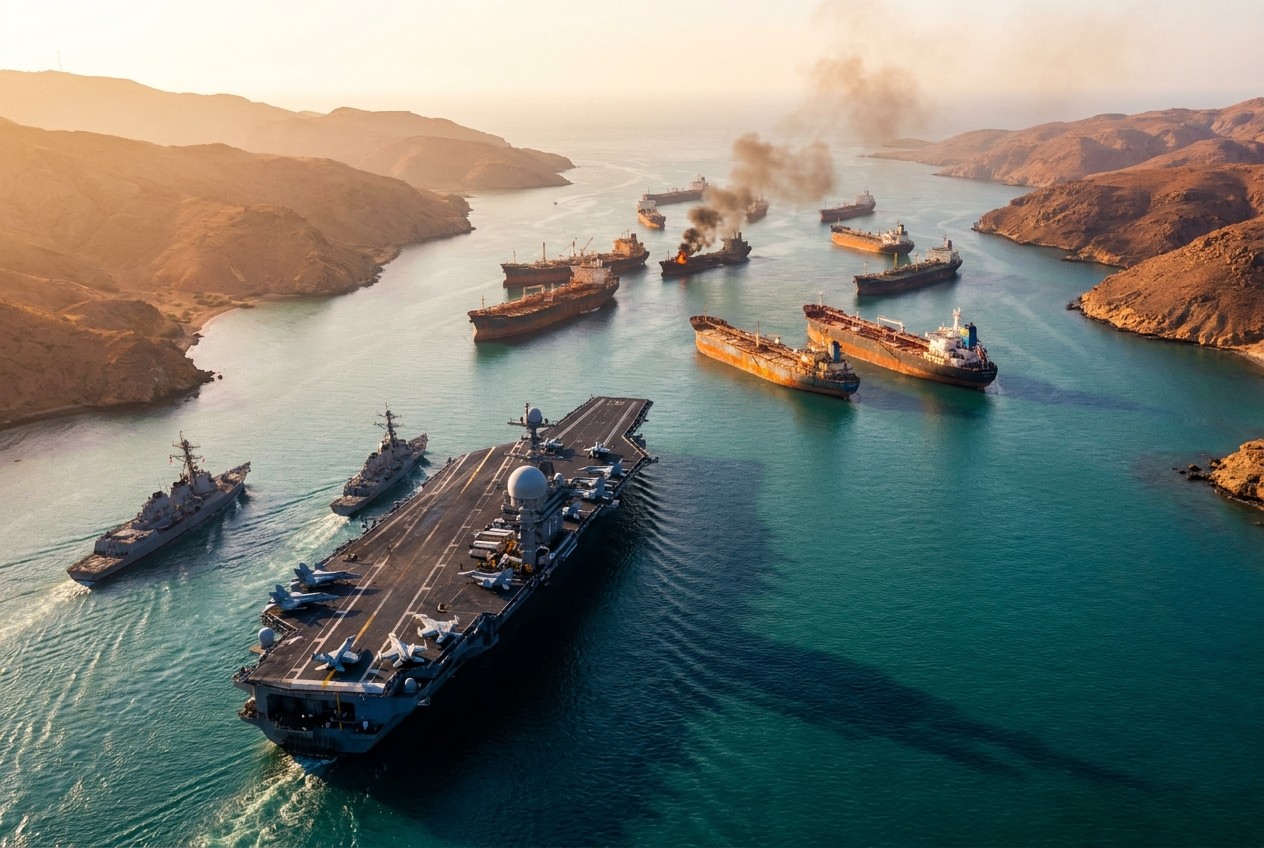
Yemeni military spokesman Yahya Saree later announced that Houthi forces launched ballistic missiles and drones at Saudi-backed government forces in the port city of Mokha, describing the attack as a tit-for-tat response to the kingdom's "aggression" [8]. According to a NaturalNews.com report, the Houthis declared a full maritime embargo against Saudi Arabia on July 20, based on an "eye for an eye" principle in response to what the group called an "unjust and oppressive siege" imposed on Yemen for nearly 12 years [9].
The United Arab Emirates, once Riyadh's indispensable partner against the Houthis, is now on fragile terms with the kingdom. According to Middle East Eye, bin Salman sent a letter to the Emirati national security advisor saying Riyadh was "shocked" by sanctions allegations, and U.S. President Donald Trump told Emirati President Mohammed bin Zayed that Saudi Arabia wanted the emirates sanctioned [10].
Economic Pressures Mount as The Line, LIV Golf Face Setbacks
Saudi Arabia's economic diversification efforts have encountered significant obstacles. According to a report by Responsible Statecraft, The Line – a 106-mile mirrored city intended to embody the new Saudi Arabia – has been dramatically scaled back [7]. Riyadh also poured more than $5 billion into LIV Golf, which entered Chapter 11 bankruptcy proceedings after the Public Investment Fund (PIF) withdrew support [7].
Ahmed Alkhuzaie, a Gulf affairs analyst from Bahrain, argued that scaling back The Line and reallocating PIF capital is discipline, not retreat. "When launching ambitious, multi-billion-dollar visions, one either adapts to market realities or goes broke," he said [7]. Despite these challenges, Saudi Arabia continues to make major international investments.
In 2025, the kingdom announced a $1 trillion commitment to the U.S. economy during a White House visit by bin Salman [11]. The PIF also acquired video game company Electronic Arts in a $55 billion leveraged buyout, the largest such deal in history [12]. Saudi Arabia has additionally invested $3 billion in Elon Musk's xAI, gaining a stake in SpaceX [13].
Conclusion: Immediate Threat Is Not the Throne but a Dangerous Neighborhood
Bin Salman has survived previous political crises. The 2018 killing of Jamal Khashoggi made him a pariah in much of the West, but world leaders and executives returned to Riyadh within years [14].
Alkhuzaie argued that Western observers see the crown prince through the lens of Khashoggi rather than the social changes Saudis have experienced, and said bin Salman built a massive base of domestic support, particularly among the country's youth. He added that the prince's control over state institutions is solid. Dr. Kristian Alexander, a Gulf security and foreign-policy analyst, said a coup remains highly unlikely and there is no credible basis for forecasting one within months or even several years [7].
The immediate threat to the crown prince is not his throne, but that the world around Saudi Arabia becomes too dangerous and too expensive for the transformation on which he has staked it. According to Responsible Statecraft, "Riyadh finds itself at the center of overlapping wars and skirmishes, including Iran and Iraq" [2].
References
- NaturalNews.com. "Saudi Arabia's Vision 2030 economic revival plan strains the kingdom's finances amid delays, budget cuts and a growing government deficit". NaturalNews.com. July 19, 2024.
- Responsible Statecraft. "Houthis v. Saudi Arabia: Round 2. This time it's regional.". Responsible Statecraft. July 30, 2026.
- NaturalNews.com. "Saudi Arabia to build futuristic oasis of Neom in a bid to move beyond oil". NaturalNews.com. August 11, 2023.
- NaturalNews.com. "Saudi Arabia starts shift to green fuel production, builds $5B hydrogen plant". NaturalNews.com. April 04, 2022.
- NaturalNews.com. "Saudi Arabia to create the world's largest solar project as the kingdom tries to wean off its dependence on oil". NaturalNews.com. May 17, 2018.
- Antiwar.com. "Saudi-Led Forces Bomb Yemen's Sanaa Airport, Reigniting War With the Houthis". Antiwar.com. July 13, 2026.
- ZeroHedge. "Saudi Arabia Planning Major Escalation In Yemen, Possible Ground Op: Reports". ZeroHedge. July 31, 2026.
- RT. "Houthis unleash missile barrage on Saudi-backed troops". RT. August 10, 2026.
- NaturalNews.com. "Pakistan Warns of Military Response to Yemeni Blockade in Red Sea". NaturalNews.com. July 26, 2026.
- Middle East Eye. "Trump told UAE leader Saudi Arabia wanted emirates sanctioned: Report". Middle East Eye. February 27, 2026.
- NaturalNews.com. "A trillion dollar handshake: US and Saudi Arabia forge new economic and security pact". NaturalNews.com. November 20, 2025.
- Belle Carter. "Saudi Arabia and Kushner-led consortium acquire Electronic Arts in record $55 billion deal". NaturalNews.com. October 03, 2025.
- Cassie B. "Musk deepens Saudi ties with $3 billion AI deal, raising national security questions". NaturalNews.com. February 20, 2026.
- Belle Carter. "Elon Musk joins Trump's lavish White House dinner for Saudi Crown Prince amid thawing tensions". NaturalNews.com. November 21, 2025.
Explainer Infographic







Please contact us for more information.


