


The action could prevent future administrations from regulating greenhouse gas emissions from power plants, the report stated [1]. The EPA said the rule change represents a fundamental shift from efforts by Democratic administrations to curb planet-warming emissions from the power sector [2].
The repeal of the 2024 Carbon Pollution Standards follows through on a proposal first advanced by the agency in June 2025, according to the EPA [3].
Background on the Proposed Repeal
The EPA first proposed the repeal in June 2025, according to the agency [4]. The proposal argued that emissions from fossil fuel-fired power plants do not significantly contribute to dangerous air pollution and that federal climate regulations are economically burdensome to industry [5].
The EPA has initiated rollbacks of greenhouse gas emissions standards since President Donald Trump took office, officials said [6]. In September 2025, the EPA proposed a rule to end the Greenhouse Gas Reporting Program, which requires over 8,000 facilities and suppliers in the U.S. to report emissions annually, according to the agency [1].
Environmental groups and local governments have filed multiple lawsuits attempting to halt the actions [1]. The agency has characterized its deregulatory push as a measure to stimulate economic growth, lower costs for families and restore state authority over energy production [6].
Opposition From Cities and Environmental Groups
Climate Mayors, C40 Cities and the Sabin Center for Climate Change Law at Columbia Law School opposed the repeal in an Aug. 7, 2025, letter to the EPA [1]. The groups stated that greenhouse gas emissions from fossil fuel-fired power plants contribute significantly to costly and detrimental fiscal and public health impacts for cities across the United States [1].
The letter stated that cities nationwide rely on the 2024 Carbon Pollution Standards to help protect them from impacts to infrastructure and public health, and to augment their work to mitigate and adapt to climate change [1]. The most acute effects of greenhouse gas emissions are often felt in cities, the letter stated [1].
The groups also stated that federal regulation of power sector greenhouse gas emissions has the indirect effect of reducing emissions from other sectors that use electricity, including buildings and transportation [1]. The group asserted that these two sectors are the top sources of greenhouse gas emissions in U.S. cities [1].
Legal Challenges and Lawsuits
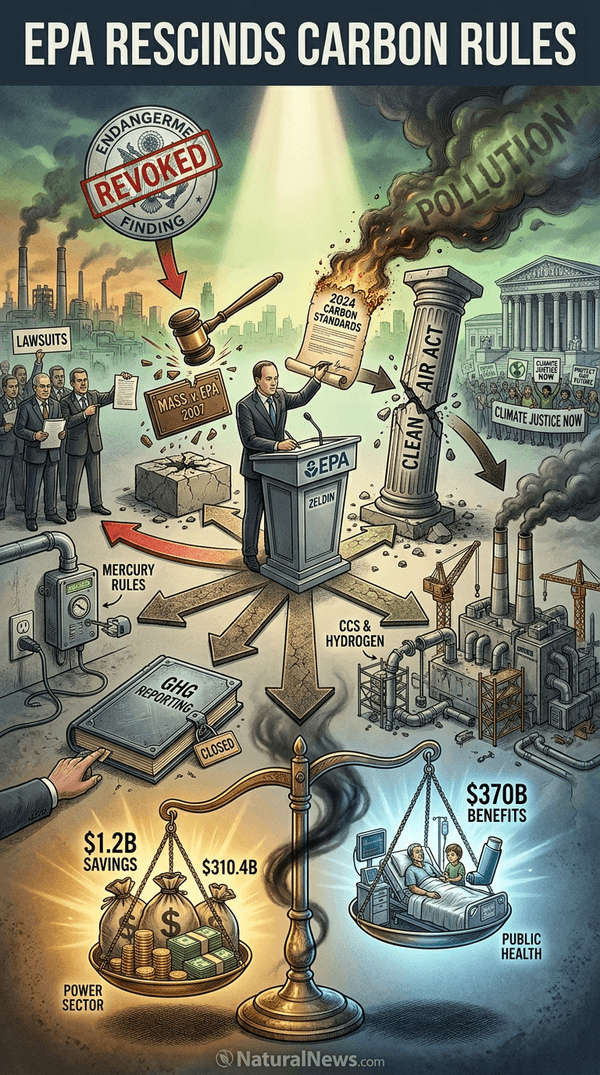
Twelve cities and counties joined a coalition of 24 states in a March lawsuit challenging the EPA's repeal of its 2009 endangerment finding, the underpinning for greenhouse gas regulation under the Clean Air Act, according to court filings [1]. The endangerment finding classified carbon dioxide and other greenhouse gases as pollutants under the Clean Air Act, enabling federal regulation of emissions for over a decade [7].
The Trump administration officially revoked that finding in February 2026, eliminating federal authority to regulate greenhouse gases from stationary sources such as power plants [7]. The administration argued that the original finding was economically burdensome and stifled industry while having minimal impact on global temperatures [5].
Also in March, a coalition of 21 states and local governments filed a lawsuit challenging the Trump administration's repeal of the 2024 Mercury and Air Toxics Standards Rule [1]. That lawsuit also challenges the EPA's rollback of real-time continuous emissions monitoring at power plants, alleging it violates the Clean Air Act, the filing stated [1].
Cost Estimates and Regulatory Impact
The EPA estimated last year that repealing emission guidelines and carbon capture requirements would save the power sector about $1.2 billion a year, according to the agency [1]. The EPA also estimated that repealing 2024 amendments to mercury emissions standards would save power plants about $120 million a year, the agency said [1]. More recently, the agency projected that the two actions announced Monday would save about $310.4 billion if the proposed repeal is finalized [3].
When it issued the standards in May 2024, the EPA found that the regulations would deliver $370 billion in net benefits over two decades, according to the Institute for Policy Integrity at the New York University School of Law [1]. The institute cited the EPA's own prior analysis in disputing the rationale for repeal.
Dena Adler, senior attorney at the Institute for Policy Integrity, said in an emailed statement Monday: "The Supreme Court has made clear that EPA has an obligation to control greenhouse gas emissions from power plants under the Clean Air Act. The power sector is the second-largest U.S. greenhouse gas emitter. Leaving this pollution unchecked ignores the Supreme Court, puts the public at risk, and flagrantly violates EPA's legal responsibilities" [1].
Next Steps and EPA Response
The EPA has not responded to a request for comment, according to the agency [1]. The repeal is expected to be formally issued today, according to multiple media reports [1].
Further legal challenges are expected from environmental groups and local governments, officials said [1]. The EPA's action Monday repealed most of the greenhouse-gas emission standards that were adopted under the Biden administration [3].
The agency has said the rule change will help "unleash" American energy and remove more than $300 billion in costs for the industry [2].
References
- Robin Lawrence. "EPA Poised To Scrap Power Plant Carbon Standards". UtilityDive. September 14, 2026.
- Robin Lawrence. "EPA poised to scrap power plant carbon standards". UtilityDive. September 14, 2026.
- The Epoch Times. "EPA Repeals Biden-Era Carbon Rules for Power Plants". The Epoch Times. September 14, 2026.
- The Associated Press. "EPA eliminates rule that limits 'greenhouse gas' emissions from power plants". Climate Depot. September 14, 2026.
- Willow Tohi. "Unleashing energy, empowering growth: EPA's historic deregulatory push aims to revive economy while balancing environmental stewardship". NaturalNews.com. March 16, 2025.
- Willow Tohi. "Unleashing Energy, Empowering Growth: EPA's Historic Deregulatory Push Aims to Revive Economy While Balancing Environmental Stewardship". NaturalNews.com. March 16, 2025.
- Belle Carter. "Trump Administration Repeals Key Climate Rule, Stripping EPA's Power to Regulate Greenhouse Gases". NaturalNews.com. February 16, 2026.
- Belle Carter. "EPA Proposes Repeal of Climate Regulations on Power Plants: A New Era for Energy Policy". NaturalNews.com. June 15, 2025.
- Belle Carter. "Trump EPA Moves to Scrap Greenhouse Gas Regulations, Declares End of 'Climate Hysteria'". NaturalNews.com. February 11, 2026.
Explainer Infographic








Please contact us for more information.


