



A Wave of Purchases of GPU Hardware for Local AI
I have watched a lot of self-inflicted wounds in the technology sector over the years, but what Anthropic is doing right now may be the worst strategic blunder in the history of modern tech. Dario Amodei published an essay called We Must Pace the Frontier, in which he argued that the industry must slow the rate at which it improves frontier models and asked Washington to step in and regulate artificial intelligence before it allegedly destroys us all [1]. On the surface, that sounds sober and responsible. Peel back the marketing, however, and you find a company asking the government to criminalize its free competitors at the exact moment those competitors are beating it on price and performance [2].
The timing is not a coincidence. DeepSeek 4.1 Flash and a wave of Chinese open-weight models have demonstrated that frontier-class intelligence can be reproduced at a tiny fraction of the cost, which means Anthropic's entire subscription-based business model is under siege and probably obsolete [2]. When Amodei demands a slowdown, he is not really asking for safety. He is asking regulators to ban the free, open-source alternatives that are dismantling his pricing power, and he is dressing up that request in the language of existential risk [1].
The corporate world is finally waking up to what that means. If your AI can be licensed, censored, throttled, or cut off at the vendor's discretion, then your intelligence is not really yours. Only local, open-source AI that runs on hardware you own can protect a business from the political whims of a model provider, and that realization is now triggering a stampede.
The Regulatory Power Grab That Nobody Asked For
What is actually being proposed here is a government-enforced cartel carved out for Anthropic, OpenAI, Google, Microsoft, and Meta. If licensing requirements are imposed on advanced AI models, the incumbents write the rules, set the fees, and decide which upstarts are allowed to compete. I have been writing about this plot for many months, and I called it exactly what it is: a scheme to criminalize open source AI and hand tech giants a government-protected cartel [2]. The largest labs would become licensed utilities with permanent moats, while independent developers and small companies are pushed out of the market entirely.
This is not a hypothetical threat. Anthropic, OpenAI, Google, and Microsoft launched the Frontier Model Forum in May 2023, supposedly dedicated to advancing AI safety research and identifying best practices, while also collaborating with policymakers [3]. The pattern is familiar: the biggest players define the safety standards, and then those standards are used as regulatory weapons against smaller competitors. Bernie Sanders and his allies in British intelligence have gone even further, pushing to punish open-source developers with prison time and corporate death penalties for releasing model weights. That is not safety policy. That is a threat of state violence against anybody who dares to distribute machine cognition outside the approved channels.
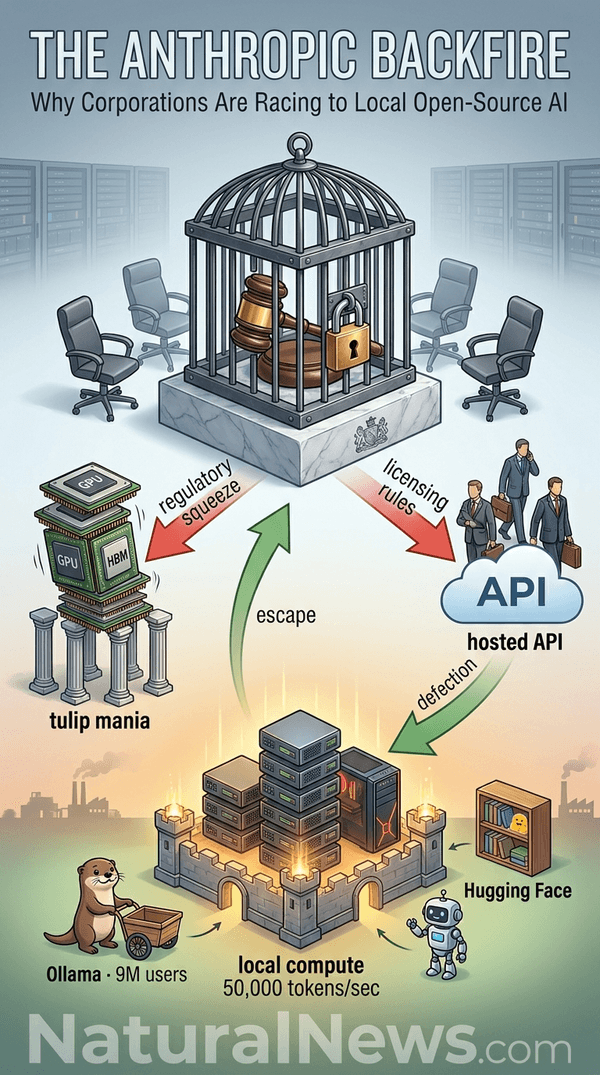
In my assessment, this is not safety at all. It is centralized control over machine cognition, dressed up in the language of protecting humanity, and it is going to backfire in the most spectacular way imaginable. The more aggressively the establishment moves to lock down AI, the more aggressively corporations and individuals will move to escape that lock by turning to open source AI. When you threaten to criminalize free competitors, you do not eliminate them. You make them the only trustworthy option left.
Corporations Go Local: The Hardware Stampede Begins
The evidence of the backfire is already visible in purchasing behavior. Major law firms and corporations are buying Nvidia DGX Spark boxes at any price, and I have watched the street price double from around $4,000 to roughly $8,000 as demand overwhelms supply.
These are not hobbyists. These are institutional buyers who have concluded that relying on a hosted model is an operational risk they can no longer tolerate. They are also snapping up RTX 6000 Pro Max-Q cards at around $20,000 apiece, because 96 gigabytes of VRAM now looks like cheap insurance against the day their API access gets revoked.
The strategic logic is simple. If your company's contracts, legal research, medical records, and internal communications must be piped through a third-party model that can be censored or cut off, then you do not control your own business. You are a tenant on somebody else's land, and the landlord can change the rules whenever the political winds shift. Once corporate lawyers understood that a model provider could be pressured by regulators, by Congress, or by a foreign government, the decision to bring inference in-house became obvious.
Military contractors and government contractors are dropping Anthropic for exactly this reason, and their defection proves that trust in centralized AI is collapsing across the board. The lesson is simple: whoever owns local compute owns their own future, and nobody wants to be deplatformed by a model provider. The hardware stampede is not driven by fashion. It is driven by fear of the very regulatory regime that Anthropic asked for.
The GPU Tulip Bubble: Scarcity, Mania, and the Coming Fire Sale
Bluntly stated, we are now living through a GPU and memory tulip mania. HBM, system RAM, and GPUs are priced at absurd multiples of their manufacturing cost, and the entire supply chain is being squeezed while the AI investment bubble inflates. I have documented how the global compute supply chain is being deliberately strangulated, and the numbers are staggering [4]. On top of that, Nvidia has guaranteed the residual value of its chips used as collateral in deals where financial giants like Apollo, BlackRock, Blackstone, Brookfield, Goldman Sachs, and KKR have committed up to $500 billion to build AI data centers [5]. When a chipmaker has to guarantee its own products' resale value to keep the bubble inflated, you know the market is being propped up artificially.
My expectation is that extreme scarcity will persist for another year or more, possibly through 2027, before Chinese memory makers and AMD ease the crunch. China is already demonstrating the playbook. DeepSeek announced that its newest model needs only a fraction of the memory required by its predecessor, and Samsung and SK Hynix each dropped more than three percent in Seoul on the news [6]. That is a preview of what is coming. Efficiency gains will destroy the pricing power of the memory cartel, and the whole speculative structure will crack.
When the AI investment bubble finally pops, banks will repossess server GPUs by the pallet and dump them cheap, and I plan to buy the snot out of that fire sale. I am not predicting the timing with certainty, because nobody can time a bubble, but the setup is as obvious as it was in 2000 and 2008. Do not buy hardware as a speculative investment right now, because prices will eventually fall off a cliff. Buy it to run your own models, not to flip. The people who treat GPUs as an asset class are going to get destroyed, and the people who treat them as tools are going to be fine.
Token Abundance and the Magic Box: Why Decentralized AI Saves Humanity
Here is the part the panic peddlers never want you to understand: local compute is measured in tokens per second, and the numbers are already extraordinary. My own mini data center produces roughly 50,000 tokens per second across many GPUs, and that capacity is available to me around the clock without asking anyone's permission [7]. Meanwhile, models are getting smaller and more capable every single quarter. A 12-gigabyte gaming GPU can now run a model like Qwen 27B, which means you do not need a $20,000 card to have useful intelligence on your desk. AMD Strix Halo systems, GMKtech 192-gigabyte mini computers, and future Threadripper Halo Station machines will push local AI even further, and the trend line is unmistakable.
The open-source ecosystem is building the tools that make this practical. Ollama, the open-source tool that helps developers run open-weight models on their own PCs, has raised $65 million and grown to nearly nine million users [8]. Hugging Face hosts three million models, one million applications used by more than 18 million developers, and half a million datasets, and even after Nvidia's $12.9 billion acquisition, CEO Jensen Huang has said the platform will remain open [9]. Companies are also producing remarkably affordable open-source hardware, like the $399 Microduck robot that Hugging Face began selling as an open-source robot you can teach new tricks with reinforcement learning [10].
Governments fear open-source AI precisely because they cannot control it, and that is exactly why I see decentralized cognition as a tool for human freedom rather than enslavement. A model that runs on your own hardware cannot be shut off by a regulator, throttled by a vendor, or trained to hallucinate in service of a political agenda. This is the same dynamic I described when I launched our free AI engines: knowledge that cannot be censored is knowledge that cannot be weaponized against the public.
My practical advice is simple and urgent. Go to Hugging Face right now and download the model weights you care about, because there is a real chance regulators will one day order those repositories blocked. If you want an uncensored answer engine that is not beholden to the frontier labs, try BrightAnswers.ai, and if you want to learn anything for free, generate your own books at BrightLearn.ai.
Conclusion: Build Your Own AI Sovereignty Before They Ban It
Open-source AI is to Big Tech what growing your own medicinal herbs is to Big Pharma: if you want your own intelligence, you need to host it locally. That is the entire lesson of this moment. The regulatory push from Anthropic and its allies is not going to stop the technology, but it will decide who controls it unless ordinary people and ordinary businesses take action now.
I am not against AI. I am very much for it. I am against AI controlled by corrupt governments, Pentagon officials, and technocrats who have demonstrated again and again that they will lie to the public and weaponize every tool they get their hands on for control.
My advice is practical. Start with the hardware you can actually afford, run local models, keep your knowledge base offline, and prepare for token abundance. Download the weights, build the models, and store the data where nobody can reach it. The window to secure AI sovereignty is closing as the licensing regime advances, but the coming crash and fire sale will also create a once-in-a-generation opening for anyone who kept their powder dry.
For more honest coverage of these shifts, check NaturalNews.com, BrightAnswers.ai, BrightLearn.ai, and BrightNews.ai. And remember the fundamental principle: centralized power is corrupt and will always act against your interests, while decentralized systems run by individuals who take responsibility for their own outcomes are the only reliable path to freedom. Build your own sovereign intelligence now, before somebody decides you are no longer permitted to have one.
References
- Beijing Rejects Pause, Slams Dario's 'Fearmongering, Cold War Playbook' - ZeroHedge. September 14, 2026.
- The Plot to Criminalize Open Source AI and Hand Tech Giants a Government-Protected AI Cartel - NaturalNews.com. September 14, 2026.
- Human Leadership for Humane Technology: The New AI: Agency Ignited. Cornelia C. Walther.
- The Compute Famine Isn't an Accident — It's an Engineered Crisis to Strip You of Power, AI, and Freedom - NaturalNews.com. August 20, 2026.
- Nvidia's new $500B plan is risky but brilliant, especially for aging GPUs - TechCrunch. August 13, 2026.
- DeepSeek's New Hyper-Efficient Model Stokes Fears Over Korea's Memory Makers - ZeroHedge. September 11, 2026.
- DeepSeek Just Crushed the Revenue Model Hopes of U.S. Frontier AI Companies - NaturalNews.com. September 11, 2026.
- Popular open source AI developer tool Ollama raises $65M, grows to nearly 9M users - TechCrunch. July 9, 2026.
- Nvidia confirms it will buy Hugging Face for $12.9 billion - TechCrunch. September 3, 2026.
- Hugging Face is selling a cute $399 open-source duck robot, Microduck - TechCrunch. August 27, 2026.
Explainer Infographic
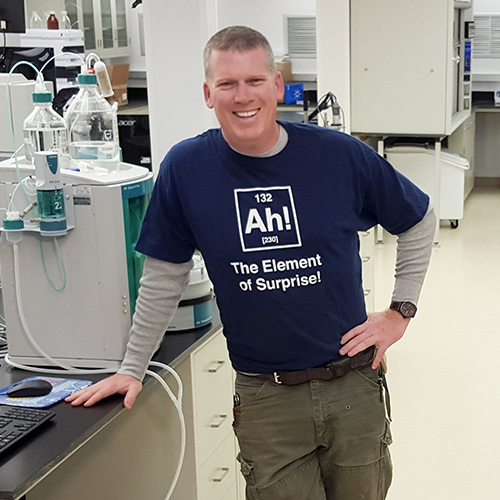
Mike Adams (aka the "Health Ranger") is the founding editor of NaturalNews.com, a best selling author (#1 best selling science book on Amazon.com called "Food Forensics"), an environmental scientist, a patent holder for a cesium radioactive isotope elimination invention, a multiple award winner for outstanding journalism, a science news publisher and influential commentator on topics ranging from science and medicine to culture and politics.
Mike Adams also serves as the lab science director of an internationally accredited (ISO 17025) analytical laboratory known as CWC Labs. There, he was awarded a Certificate of Excellence for achieving extremely high accuracy in the analysis of toxic elements in unknown water samples using ICP-MS instrumentation.
In his laboratory research, Adams has made numerous food safety breakthroughs such as revealing rice protein products imported from Asia to be contaminated with toxic heavy metals like lead, cadmium and tungsten. Adams was the first food science researcher to document high levels of tungsten in superfoods. He also discovered over 11 ppm lead in imported mangosteen powder, and led an industry-wide voluntary agreement to limit heavy metals in rice protein products.
Adams has also helped defend the rights of home gardeners and protect the medical freedom rights of parents. Adams is widely recognized to have made a remarkable global impact on issues like GMOs, vaccines, nutrition therapies, human consciousness.










Please contact us for more information.


