


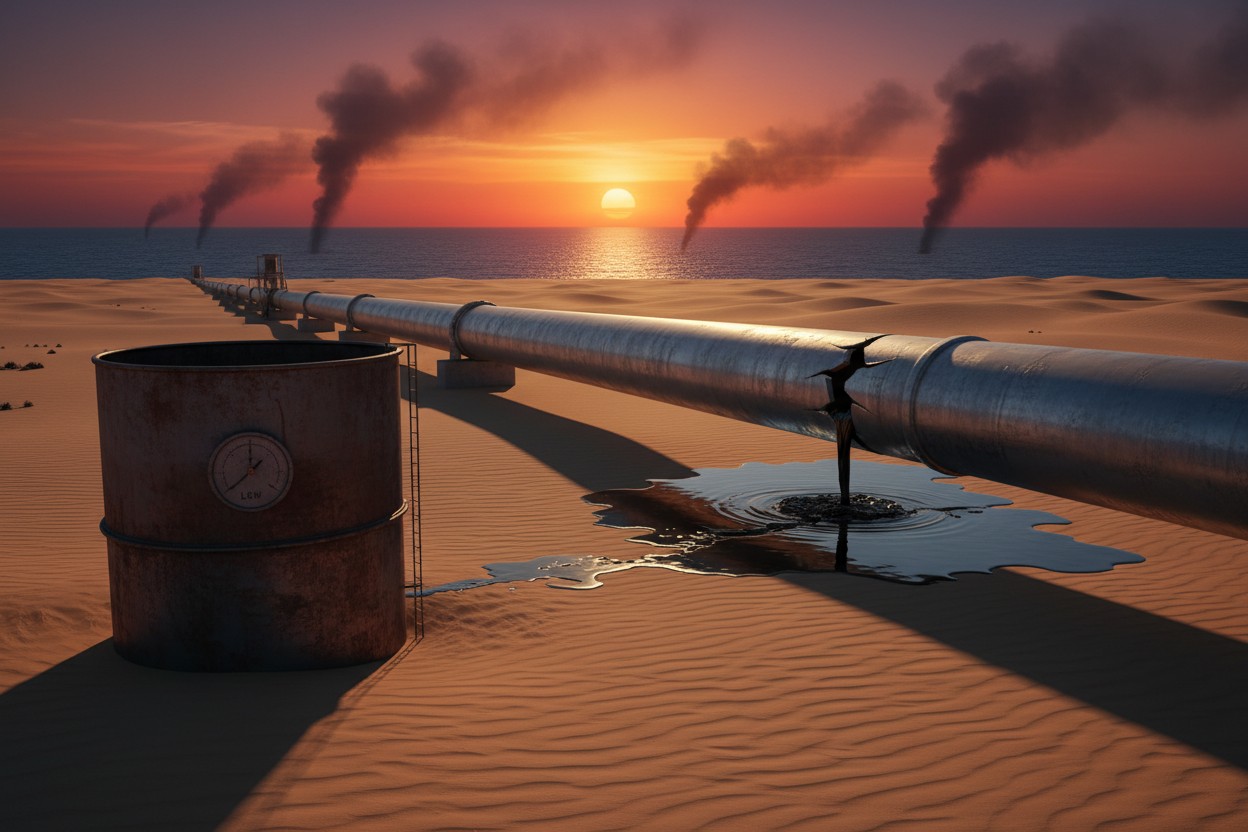
The East-West Pipeline, which spans approximately 745 miles across the Arabian Peninsula, has functioned as Saudi Arabia's primary export route since the effective closure of the Strait of Hormuz during the ongoing U.S.-Iran conflict. Saudi Arabia shut down the pipeline on Friday after multiple drone attacks, the kingdom's Energy Ministry announced on social media, stating the closure was a precautionary measure and confirming that the attacks caused injuries [1].
Saudi Arabia's energy ministry and government media office did not respond to Reuters' request for comment on the report, which was cited by Middle East Eye [2]. The pipeline outage has added new pressure on global energy markets already strained by months of conflict-related supply disruptions, with Brent crude trading above $107 a barrel on Monday following the weekend violence [3].
Pipeline and Port Capacity
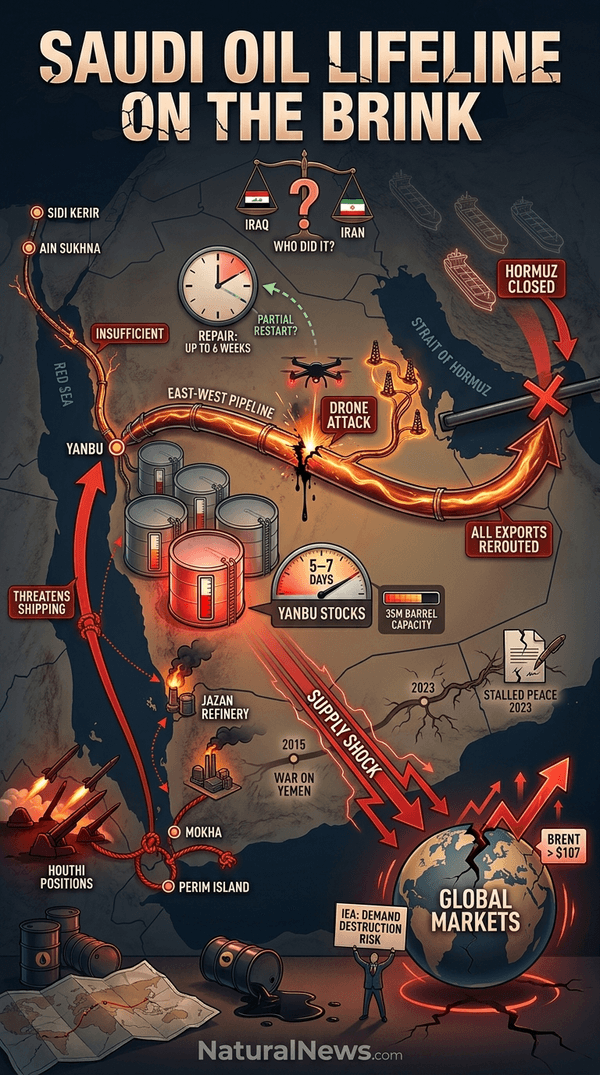
Saudi Arabia has used the East-West Pipeline to reroute approximately four million barrels per day, or roughly four percent of global supply, to Yanbu port on the Red Sea, according to industry sources cited by Reuters [2]. With the pipeline now out of service, Yanbu maintains stocks sufficient to sustain exports for only five to seven days, according to the same sources. The port's storage capacity is approximately 35 million barrels, and stocks were not full at the time of the closure, the sources said.
Saudi Arabia also holds stocks to supply customers for several days from Egypt's Ain Sukhna and Sidi Kerir terminals, a fourth source told Reuters [2]. However, these alternative points do not fully replicate the throughput of the East-West Pipeline, which has a stated capacity of 7 million barrels per day, according to ZeroHedge [4].
The pipeline's vulnerability has become apparent during more than six months of U.S.-Iran conflict. The Kingdom diverted millions of barrels of oil per day through pipelines to Yanbu in an effort to minimize energy shortages resulting from the closure of the Strait of Hormuz, The War Zone reported [5]. Riyadh has been vague on the extent of damage to the pipeline, while Saudi Arabia said the attack originated from Iraq and U.S. President Donald Trump said Iran was responsible [2]. Iraq dismissed a military commander on Saturday and ordered an investigation into the drone attack that originated from its territory [6].
Recent Military Operations
The Yemeni Armed Forces released a statement saying it targeted weapons depots and command-and-control rooms at the Sharurah base in southern Saudi Arabia with a large salvo of ballistic missiles and drones that hit their targets accurately [7]. Houthi military spokesperson Yahya Saree said the attack targeted "weapons depots and command and control centers that are managing the aggression" against Yemen [7]. The YAF statement said continued Saudi aggression against Yemen would be met with more severe and larger-scale operations deep inside Saudi territory, and that consequences would be grave.
Black smoke was seen rising from Saudi Arabia's Yanbu Aramco refinery on Sunday, following reports and social media posts suggesting the YAF may have targeted the facility [2]. The Jazan Aramco refinery on the Red Sea was engulfed in flames on Sept. 8 following a coordinated missile and drone attack, with officials confirming fires at several locations that led to a temporary halt in operations [8]. Saudi authorities reported that 73 civilians, including women and children, were injured in those strikes [8]. Oil prices surged toward the $100 per-barrel mark in the wake of those attacks [9].
Sanaa's forces recently captured much of Yemen's western coast and stormed multiple Red Sea ports occupied by Saudi and Emirati proxies, inflicting heavy losses and seizing large amounts of equipment [10]. The Houthis captured the strategic port city of Mokha and reached Perim Island in the Bab al-Mandab Strait, geographically tightening their control over the key waterway linking the Red Sea to the Gulf of Aden [11][12].
Conflict Background and Diplomacy
Sanaa's escalation followed Saudi Arabia's July attack on Sanaa International Airport, which has been under blockade by the kingdom for more than a decade since Riyadh launched its war on Yemen in 2015 at the head of an Arab coalition [2]. The Saudi-led coalition conducted 121 airstrikes from its airbases, including a strike that hit a prison in Yemen's northern al-Jawf province, where the death toll rose to 23 as rescue workers pulled more bodies from the rubble [13][14].
A 2023 Saudi-Yemeni peace process nearly resulted in an agreement but stalled, preventing a major escalation while the kingdom continued attacks and its blockade of Yemeni ports and airports [2]. Saudi-backed Yemeni military figures and other regional sources told ZeroHedge on Saturday that the YAF assault marked a "Saudi-American f**k up of epic proportions" and laid bare "a complete failure of political leadership" [15]. The source added that the Houthis "committed everything they had – waves upon waves of fighters... along with their available ballistic missiles and weapons" and that "the air support never came" [15].
The broader geopolitical context includes the Iran war that began in late February 2026, when the United States and Israel attacked Iran, prompting Tehran to retaliate against Gulf states [16]. The International Energy Agency warned that soaring fuel costs could spark global demand destruction [17]. Oil prices have soared more than 70 percent this year as the Houthis have escalated their campaign against Saudi energy infrastructure [17].
Outlook
Saudi officials have not commented publicly on the extent of pipeline damage or on the Reuters report, the outlet stated [2]. Traders cited by Reuters said Yanbu stocks will ultimately run out without the East-West Pipeline resuming operations, with repair timelines ranging from days to five or six weeks [2]. One source indicated the pipeline could be fixed sooner or partially resumed during repairs [2].
The YAF has vowed to fully expel the Saudi-led coalition from Yemen and has said its operations will continue [11]. The potential loss of four percent of global oil supply remains a stated concern among oil buyers and traders [2]. As ZeroHedge noted in its analysis, the East-West pipeline is critical for Saudi Arabia to bypass the Strait of Hormuz, "but only if it's not bombed by Iran" [18]. The combination of the pipeline outage, the Houthi blockade on Saudi oil exports through the Bab al-Mandab Strait, and the ongoing closure of the Strait of Hormuz has placed Riyadh in what analysts described as "a precarious situation" [18][10].
References
- Saudi Arabia Shuts Down East-West Crude Oil Pipeline After Attacks. The Epoch Times. September 11, 2026.
- Saudi Arabian pipeline outage threatens global oil supply. Middle East Eye. September 13, 2026.
- Oil prices rise sharply as Middle East escalation risks disruption to supplies. Middle East Eye. September 14, 2026.
- "Riyadh In Difficult Position": Saudis Shutter Critical East-West Pipeline After Drone Attacks. ZeroHedge. September 12, 2026.
- The Outlook Is Getting Grimmer By The Day For Oil Exports From The Red Sea. The War Zone. September 12, 2026.
- Saudi Arabia shuts key oil pipeline after drone attack launched from Iraq. BBC. September 12, 2026.
- Houthi missiles target military base in Saudi Arabia as Iraq probes drone attack on oil pipeline. Middle East Eye. September 13, 2026.
- Houthi Strikes on Saudi Refinery Threaten Remaining Red Sea Energy Lifeline. NaturalNews.com. September 9, 2026.
- Saudi's Remaining Energy Lifeline To The World Under Threat After Successful Houthi Strikes. The War Zone. September 8, 2026.
- Houthis' Stranglehold On Strategic Bab Al-Mandab Strait Grows Stronger. The War Zone. September 10, 2026.
- Houthis Capture Strategic Island in Bab al-Mandab Strait. NTD. September 12, 2026.
- Houthis take strategic Red Sea island, witnesses say. BBC. September 11, 2026.
- Ansar Allah Launches Major Attack Across Southwestern Saudi Arabia, Setting Oil Sites Ablaze and Wounding Dozens. Antiwar.com. September 8, 2026.
- Death Toll in US-Backed Saudi Strike on Yemen Prison Rises to 23. Antiwar.com. September 9, 2026.
- Yemen Blame Game Begins: "Saudi-American F**k Up Of Epic Proportions". ZeroHedge. September 13, 2026.
- UAEs Failed Bid for Joint Gulf Military Response to Iran. NaturalNews.com. May 18, 2026.
- Brent Nears $110 Then Tumbles On IEA Demand Destruction Warning As Houthis Threaten Saudi Oil Escape Route, Diesel Shock Goes Global. ZeroHedge. September 11, 2026.
- Bright Videos News - Interview with Alex Jones vs Mike transcript. Mike Adams. BrightVideos.com. May 8, 2026.
Explainer Infographic








Please contact us for more information.


