



The pooled data spanned adults aged 35 to 84, just over half of whom were women. "Taking the stairs is a practical and often overlooked way to build physical activity into daily life," study author Vassilios Vassiliou, a professor at the University of East Anglia's Norwich Medical School, said in a press statement. This connection between physical activity and better heart health represents an "association with something as simple and accessible as stair climbing," according to the senior author.[2]
Study Details and Findings
Researchers at the University of East Anglia analyzed data from nine studies involving more than 480,000 participants, the report stated. "Taking the stairs is a practical and often overlooked way to build physical activity into daily life," said Prof. Vassilios Vassiliou, a cardiovascular medicine expert at the University of East Anglia and the study's lead author. "We wanted to better understand how this everyday activity could have life-saving potential."[3]
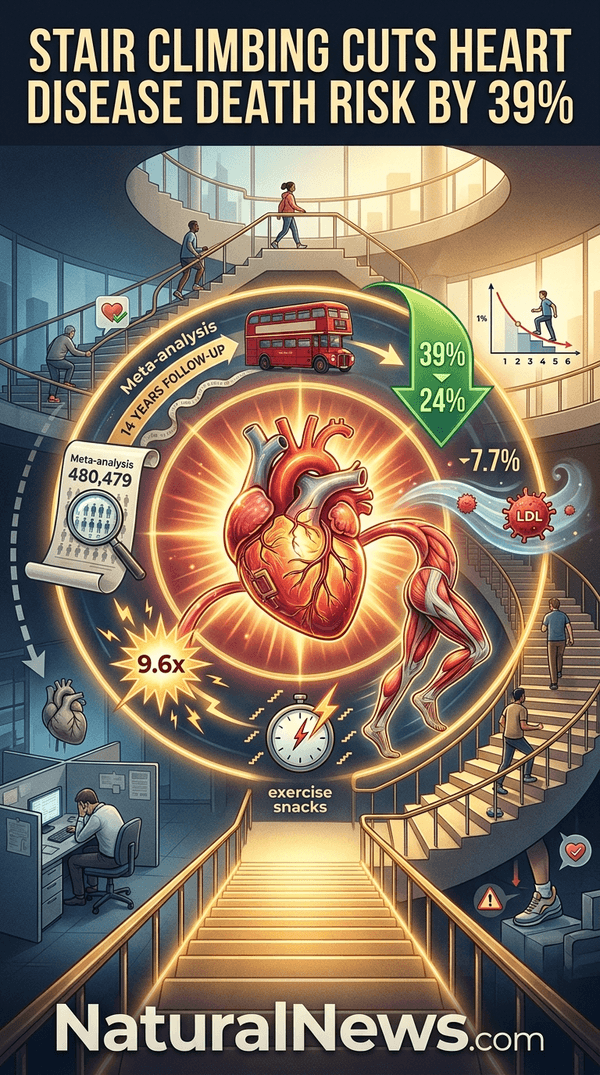
Compared with people who rarely took the stairs, regular stair climbers were 39 percent less likely to die from cardiovascular disease and 24 percent less likely to die from any cause. The study also showed that stair climbers were less likely to develop major heart conditions such as heart attack, stroke, and heart failure.[1] The pattern was consistent across the pooled data: going from little or no stair climbing to some stair climbing was linked to a meaningful drop in risk.
The research contributes to a large body of evidence demonstrating that moderate levels of physical activity and physical fitness are associated with decreased all-cause and cardiovascular mortality.[4] Weight-bearing aerobic exercise, which uses the major muscle groups of the body, helps build a stronger, more efficient heart and lungs.[5]
How Stair Climbing Affects the Heart
Moving vertically requires roughly 9.6 times the energy expenditure of sitting. These short, high-intensity bursts condition the heart muscle, increase stroke volume, and lower resting heart rate over time. This type of brief, vigorous activity aligns with evidence that short, intense workouts can seriously maximize fitness results.[6]
Existing evidence shows that incorporating short intervals of stair climbing three days a week over six weeks can significantly improve cardiorespiratory fitness. Canadian researchers found that spending a few minutes going up several flights of stairs every two or three hours can greatly improve the health of your heart, without requiring a commitment to a time-consuming workout session.[7]
Optimal Amount of Stair Climbing
One large study in the analysis pointed to around six flights per day as the point of greatest benefit, but more research is needed before turning that into a formal recommendation. Vassiliou said that the studies he analyzed measured stair climbing in different ways, making it difficult to define an optimal "dose" based on the analysis alone.
Similarly, another study included in the analysis showed that two- to 10-minute intervals of stair climbing five days a week reduced low-density lipoprotein cholesterol by 7.7 percent in previously sedentary young women. This supports the broader finding that even the smallest amount of physical activity has a positive impact.[8] Research on exercise snacks reinforces this, finding that short bouts of activity lasting one to two minutes, performed multiple times per day, deliver fitness gains without long workouts.[9]
Safety Tips and Alternatives
Stair climbing works the glutes, quads, hamstrings, and calves while raising the heart rate quickly, Denise Chakoian, a Rhode Island-certified fitness trainer and owner of Core Cycle and Fitness LaGree, who was not involved in the study, told The Epoch Times, making it useful for both cardiovascular fitness and strength. "Stair climbing is generally safe and actually healthy for you, but it's important to build up gradually, especially if you're not used to it," she said.
Her guidance includes starting small with a few flights, wearing supportive shoes with good traction, using the handrail for extra stability, and stopping if dizziness, unusual shortness of breath, or sharp pain occurs. For people with joint pain or limited mobility, going up stairs is often better tolerated than repeatedly going down, since descending places more strain on the knees. Lower-impact alternatives such as walking, swimming, water aerobics, stationary cycling, or seated strength exercises can offer similar benefits without the joint stress, Chakoian advised.
Background on Heart Disease
Heart disease is the leading cause of death worldwide, and cases nearly doubled between 1990 and 2019. Coronary heart disease in particular remains a leading cause of mortality, and physical inactivity is among the risk factors for this disease.[10]
The importance of physical activity has been underestimated for many years by both doctors and policy-makers, according to the Eurodiet study.[11] Stair climbing is highlighted as a practical way to incorporate physical activity into daily routines, particularly for those without access to gyms. The study authors emphasized that taking the stairs is an inexpensive and readily accessible form of exercise.
Conclusion
The findings add to existing evidence that brief bursts of vigorous activity can improve cardiovascular health. For people who are able to safely climb stairs, "taking the stairs is a simple and cheap way to incorporate more physical activity into everyday life," Vassiliou told The Epoch Times.
The research underscores that individuals who were sedentary and then began exercising even a little increased their health benefit markedly.[12] Regular physical activity, including something as accessible as stair climbing, remains a cornerstone of cardiovascular wellness and longevity.
References
- NaturalNews.com. "Study: Stair Climbing Linked to Lower Risk of Heart Disease Death". September 2, 2026.
- Everyday Health. "Taking the Stairs Could Slash Your Risk of Early Death, a New Study Says". August 13, 2026.
- NaturalNews.com. "Study: Taking Stairs Associated With Lower Risk of Death". August 16, 2026.
- "Family Medicine: Principles and Practice".
- JoAnn E. Manson. "The 30-Minute Fitness Solution".
- Mercola.com. "Can 7 Minutes of Exercise Really Help Keep You Fit?". January 20, 2017.
- NaturalNews.com. "Try 'exercise snacks' vigorous bouts of stairclimbing to boost heart health advise researchers". April 7, 2019.
- Robert E. Kowalski. "8 Steps to a Healthy Heart: The Complete Guide to Heart Disease Prevention and Recovery from Heart Attack and Bypass".
- NaturalNews.com. "Study Confirms: Short 'Exercise Snacks' Deliver Fitness Gains Without Long Workouts". June 28, 2026.
- "Taking Sides: Clashing Views on Controversial Issues in Food and Nutrition".
- Jules N. Pretty. "The Earth Only Endures: On Reconnecting with Nature and Our Place in It".
- Charles B. Simone. "Breast Health".
Explainer Infographic










Please contact us for more information.


