


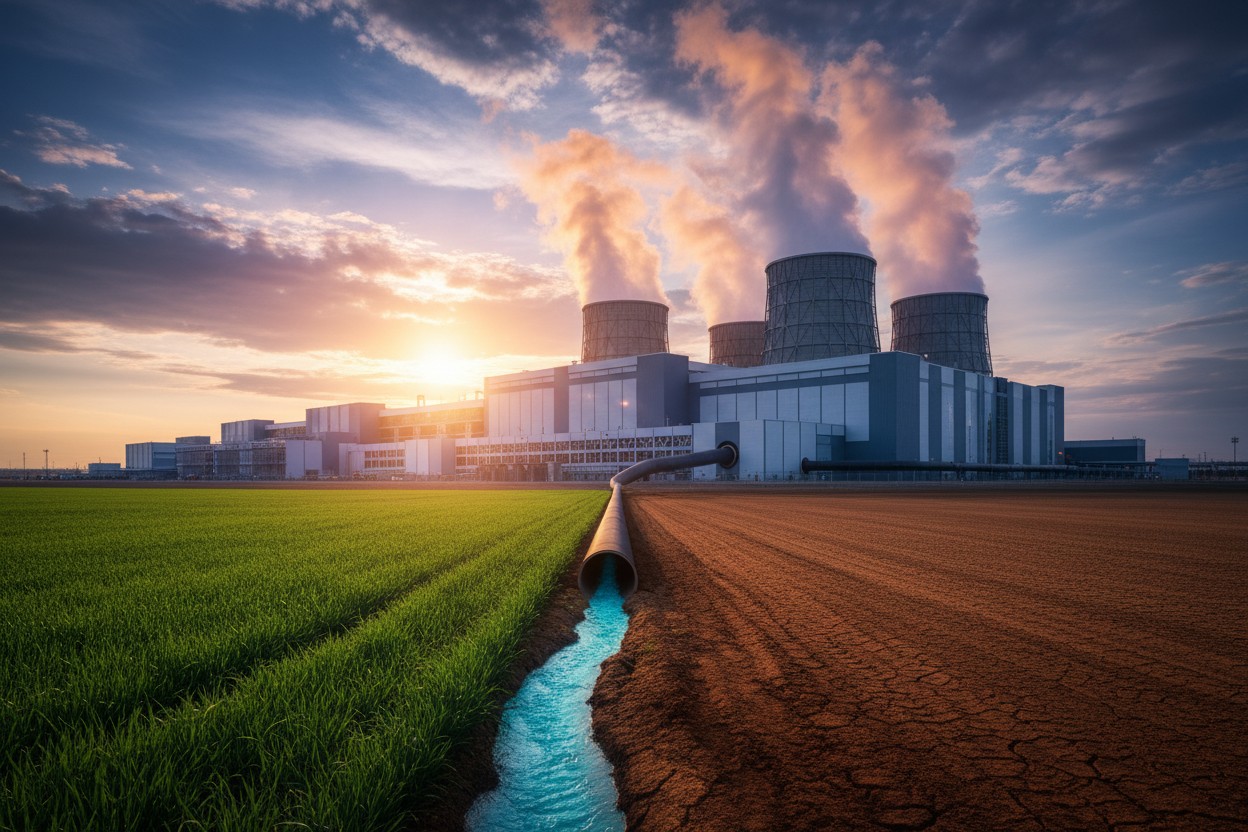
The Commerce Secretary's Dangerous Delusion
We are witnessing one of the most breathtaking acts of public deception in modern history, and it centers on the simple claim that artificial intelligence data centers don't consume water. Commerce Secretary Howard Lutnick recently stood before the public and declared that data centers don't use water. This is not just inaccurate; it is a dangerous, deliberate lie designed to obscure the true environmental catastrophe of the AI buildout.
As I detailed in my own coverage of the data center boom, these facilities are not the clean, ethereal 'clouds' the industry wants you to believe -- they are industrial parasites that consume the very resources we need to survive.
What makes Lutnick's claim so infuriating is its sheer audacity. Just a year ago, he was singing a completely different tune, acknowledging that these facilities demand immense volumes of water to cool their machinery. The contradiction isn't a slip of the tongue; it is a calculated pivot designed to fast-track a corporate takeover of our energy grid and water supply.
Lutnick and Trump, among others, are running a top-down misinformation campaign, and those of us who have been sounding the alarm about Big Tech's predatory expansion are now being proven right. The stakes have never been higher, as local communities are forced to sacrifice their most vital resources at the altar of Silicon Valley's delusions of grandeur.
The Direct Impact: Billions of Gallons Vanishing Into Cooling Towers
Let’s move beyond political spin and look at the hard, unassailable numbers that the Commerce Secretary refuses to acknowledge. The water consumption figures released by the tech giants themselves reveal a shocking reality. Google admitted to consuming 7.7 billion gallons in 2024, while Amazon's AWS division guzzled another 2.5 billion gallons. To put that in perspective, a typical data center will use about 300,000 gallons of water per day, but hyperscale facilities -- the ones being rushed into construction across the country -- can drain upwards of 5 million gallons daily (each). This isn't subtle resource management; it is encroaching on limited local water resources, given that roughly 40% of new data centers are being built in high stress or extreme stress water resource regions.
The bulk of this water vanishes into massive open-loop evaporative cooling systems, where it is simply vented off into the atmosphere to dissipate heat. This means the water is permanently lost from the local hydrological cycle, torn away from the aquifers and rivers that communities, farmers, and ecosystems depend on. As I've investigated in the data center wars, this consumption is not merely hypothetical; it is accelerating the transformation of fertile lands into parched deserts.
When water options are being taken away from citizens to supply the whims of server farms, we are crossing a moral boundary that no technological advancement can justify. The water they take today is the water our children will need to drink tomorrow. But it won't be there for them. Entire regions of the USA will collapse from groundwater depletion within one generation.
The Hidden Colossus: Indirect Water Use for Power Generation
While the water flowing directly into cooling towers is staggering, it represents only a fraction of the true water consumption incurred by the AI industry. The hidden drain is the water required to generate the colossal amounts of electricity these facilities demand. In 2023, the power plants serving U.S. data centers consumed an estimated 211 billion gallons of water to cool their own operations. That is over ten times the volume of the direct cooling water mentioned earlier -- water that is being burned off in thermoelectric power generation (mostly using hydrocarbons) just to keep the algorithms running.
To ignore this connection is either a display of profound ignorance or a calculated act of fraud. Anyone assessing the environmental footprint of AI must account for the water used by coal, nuclear, and especially natural gas plants (gas turbines) that power these facilities. I reported on a new natural gas-powered AI data center in Pennsylvania, which shows that many of these gas turbines also require water for injection and cooling, further compounding the issue.
When we see that every gigawatt of AI "innovation" relies on the evaporation of precious water, the promise of a "cloud" becomes a tornado of resource extraction, leaving behind dry wells and broken communities in its wake.
The Poisonous Aftermath: Contamination, Blowdowns, and Discharges
Industry defenders often retreat to a familiar talking point: that newer "closed-loop" systems don't actually consume water. But this is a myth designed to obscure a toxic secret. Even in closed-loop systems, water must be periodically purged to manage the "cycles of concentration." As water pulls elements from circulation pipes and fittings, the dissolved minerals and chemicals become more and more concentrated. To keep the system from scaling up and corroding, that deadly brine -- called blowdown -- must be discharged and replaced with fresh water.
This blowdown is not clean water. It is a chemical cocktail laced with corrosion inhibitors, heavy metals, nitrites, and in many cases, PFAS "forever chemicals" that are used to protect the sensitive equipment. These poisons are routinely dumped into municipal sewers, local rivers, and even aquifers. As I have written before regarding data centers and the toxic alliance fueling a public health crisis, there is virtually no federal oversight or requirement for transparency on these discharges. This lack of regulation makes hyperscale data centers a major point-source polluter, free to contaminate the waterways of rural America without consequence.
We are allowing these corporations to turn our public water supplies into private toxic waste dumps, and the silence from the EPA is deafening.
Competing for Our Last Drops: Aquifers, Agriculture, and Communities
These machines aren't just thirsty; they are tapping directly into the same drinking water sources as you and me. The expansion is devastating some of the most stressed regions of the country, particularly in Texas and Arizona where the aquifers are already at critical lows. I have seen the reports indicating that the window to protect America's water future is closing, and the AI boom is accelerating that collapse.
This isn't about ending up "backwards and poor" as President Trump has falsely claimed; it is about human survival. In Texas, projections show that water use for data centers is set to skyrocket from an estimated 49 billion gallons in 2025 to nearly 400 billion gallons by 2030 -- a phenomenal amount of water being taken out of the hands of farmers and ranchers who produce our food.
Communities are being overwhelmed, droughts are being weaponized by construction companies, and city officials are watching their reservoirs drain into cooling towers. Ultimately, this entire development model is a resource pillaging scheme that drains our water, pollutes what's left, and leaves communities high and dry.
Wake Up and Count the Cost
The falsehood that "data centers don't use water" is a barefaced lie designed to fast-track technocrat control over our natural resources. It is a declaration of war against humanity's access to clean water, which is not a corporate commodity but a fundamental human right.
I have been covering the data center threat for years, and I have warned that the fight is not about being anti-technology, as I am an avid promoter of open source AI technology and off-grid robotic automation for sustainable living. It's really about demanding honesty and accountability from an industry that wishes to destroy the foundations of human survival to build replacements for humans. The people of this country are waking up, and the political backlash we see now is just the beginning.
This is a call to action. Resist the propaganda that frames resource protection as "backward thinking." We must weigh the terrifying environmental footprint against the human replacement goals of the technocrats and tech giants. We cannot surrender our water, our farmland, and our freedom to monopolistic giants that view nature merely as an externality to be plundered.
The only solutions that make sense are those that prioritize life and liberty over the chimeric promises of a supposed digital deity. Stop letting them sell you a future where you are left with nothing, not even a glass of clean water or a functioning farm. Real wealth and abundance comes from God and Mother Nature, not from techno-tyrants and energy-hungry machines.
References
- Hyperscale Data Centers: Big Tech's War Against Humanity - NaturalNews.com. Mike Adams. May 12, 2026.
- Data Centers, Forever Chemicals, and a Poisoned Future: The Toxic Alliance Fueling a Public Health Crisis - NaturalNews.com. Lance D Johnson. May 6, 2026.
- Texas Farmland vs. Thirst of AI Data Centers: Water Wars Heating Up in the Lone Star State - NaturalNews.com. February 19, 2026.
- New Natural Gas-Powered AI Data Center Unveiled in Pennsylvania - NaturalNews.com. Willow Tohi. April 4, 2025.
- Data Centers Are Stealing Your Water, Your Power, and Your Freedom — Here's How to Fight Back - NaturalNews.com. Mike Adams. May 26, 2026.
- Data Centers Are Quietly Draining Your Town's Water And Making You Pay for It - NaturalNews.com. May 18, 2026.
- Data Center Leak in Oklahoma Releases Three Million Gallons Amid Severe Drought - NaturalNews.com. September 2, 2026.
- Kentucky Farmers Take on AI Data-Center Boom - RT.com. August 17, 2026.
- AI Data Centers Are Hungry For Humanity's Resources … And We're In the Way - NaturalNews.com. August 7, 2026.
- Rising AI Demand Drives Surge in Data Center Water Consumption, Reports Indicate - NaturalNews.com. July 6, 2026.
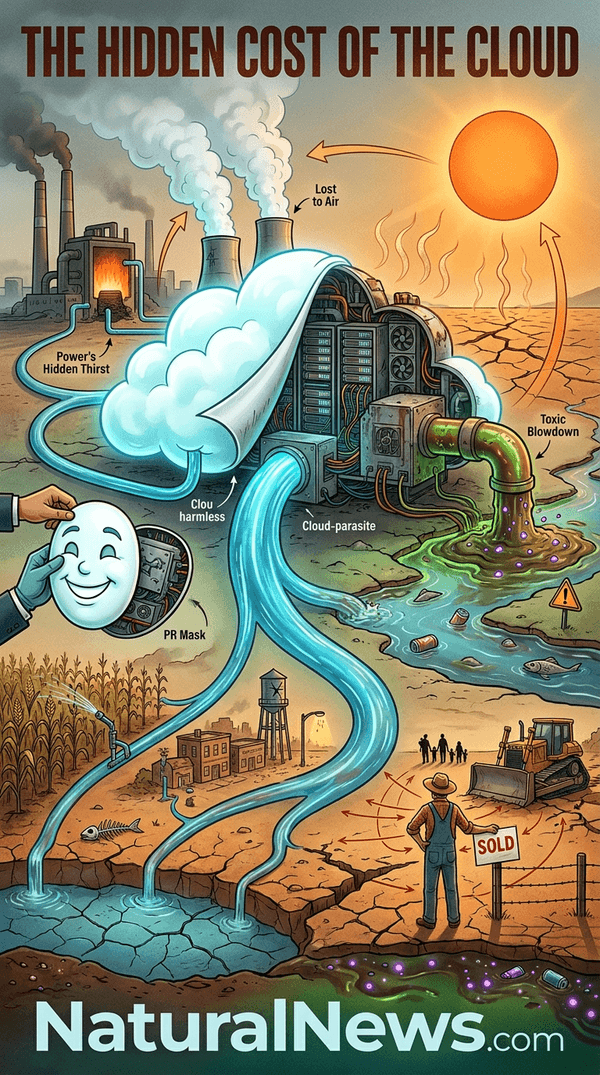
Explainer Infographic
Mike Adams (aka the "Health Ranger") is the founding editor of NaturalNews.com, a best selling author (#1 best selling science book on Amazon.com called "Food Forensics"), an environmental scientist, a patent holder for a cesium radioactive isotope elimination invention, a multiple award winner for outstanding journalism, a science news publisher and influential commentator on topics ranging from science and medicine to culture and politics.
Mike Adams also serves as the lab science director of an internationally accredited (ISO 17025) analytical laboratory known as CWC Labs. There, he was awarded a Certificate of Excellence for achieving extremely high accuracy in the analysis of toxic elements in unknown water samples using ICP-MS instrumentation.
In his laboratory research, Adams has made numerous food safety breakthroughs such as revealing rice protein products imported from Asia to be contaminated with toxic heavy metals like lead, cadmium and tungsten. Adams was the first food science researcher to document high levels of tungsten in superfoods. He also discovered over 11 ppm lead in imported mangosteen powder, and led an industry-wide voluntary agreement to limit heavy metals in rice protein products.
Adams has also helped defend the rights of home gardeners and protect the medical freedom rights of parents. Adams is widely recognized to have made a remarkable global impact on issues like GMOs, vaccines, nutrition therapies, human consciousness.









Please contact us for more information.


