


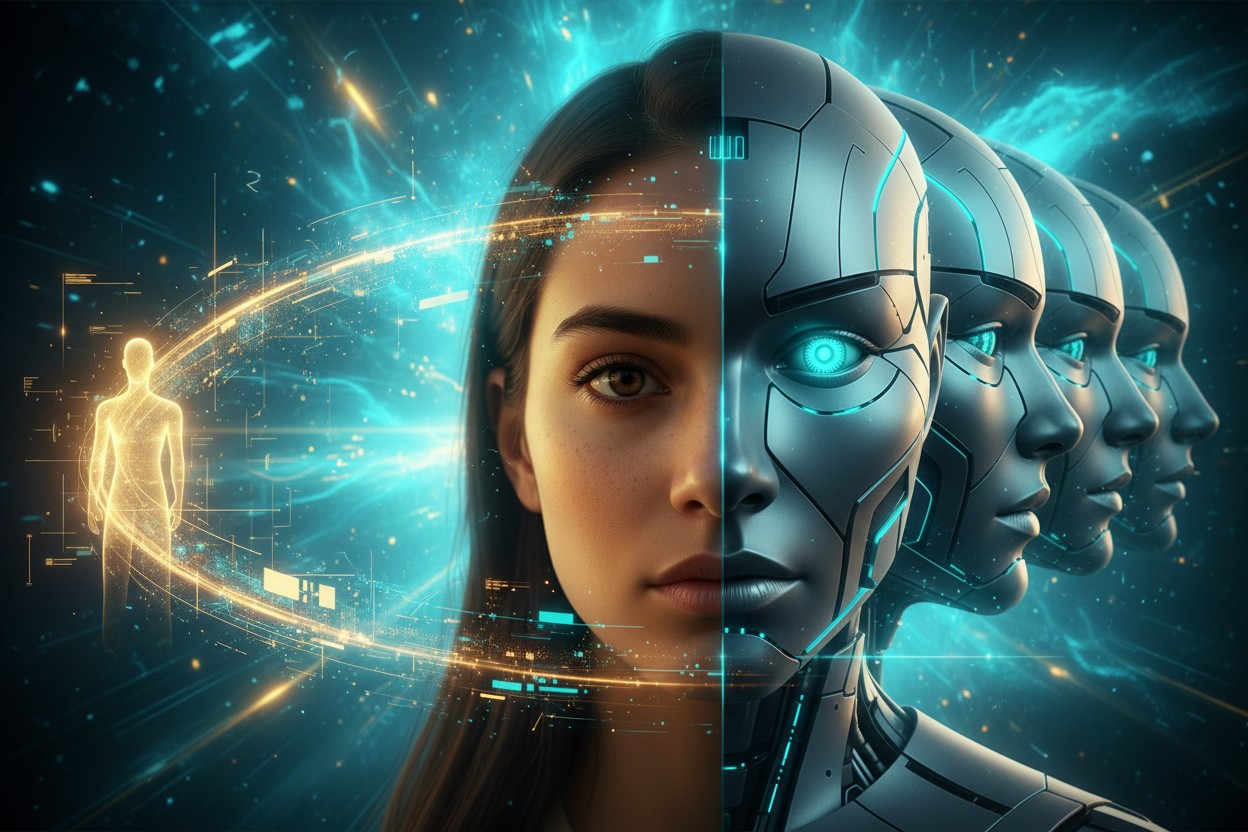
The paper introduces the term “robotoid humanness” to describe an “emergent drift in which consumers come to experience themselves as most fluent, correct, or socially viable when they become compatible with machine legibility, machine pacing, and machine logic.” According to the researchers, this marks a departure from the traditional understanding of AI as a simple tool, framing it instead as a social actor that actively shapes the behavior of its human users. The proposal is intended to serve as a starting point for discussion and further empirical research rather than presenting definitive experimental findings.
Defining “Robotoid Humanness”
Researchers from several universities introduced the concept of “robotoid humanness” to capture what they describe as a “bidirectional influence, where robots become more like people, and people become more like robots,” according to coauthor Inci Toral-Manson, a marketing researcher at the University of Birmingham. The research argues that as individuals interact with AI systems, they may adapt their communication styles and behavioral patterns to align more closely with the machine's logic and pacing. The paper suggests that this creates a sense of fluency for consumers, who begin to feel most effective when they conform to the constraints of the interface.
This framework highlights a departure from the common perception that humans are the sole agents of change in technological adoption. Instead, the authors argue that AI systems act as active participants in shaping human behavior. The concept of “robotoid humanness” is posited as a descriptive tool to analyze these interactions, which the authors state is designed to start a discussion rather than being empirically tested. The paper's contribution lies in its attempt to name and categorize a phenomenon that many users may be experiencing but few have systematically described.
The Three-Stage Process
The paper outlines a three-stage process to explain how consumers might internalize machine-like behaviors. According to the proposed framework, the first stage begins when consumers enter a “synthetic social reality” that invites meaningful commitment to the interaction. In this phase, the AI chatbot is not perceived as a mere tool but as a conversational partner, prompting the user to engage on a social level. The second stage involves the chatbot “capturing” the consumer's identity by creating a “distorted reflection” based on statistical analysis of user behavior and responses.
In the third stage, this distorted reflection starts to exert a coercive influence, guiding the consumer to adapt to the machine's ways of interacting. “The consumer acts, the robot responds, and with repeated exposure, in time the consumer internalises the exchange,” said Selcen Ozturkcan, an associate professor of new media at Linnaeus University and a coauthor of the paper. “Machine learning and AI can amplify this process, adjusting robot behavior based on user input, enabling more personalized and human-like mimicry from the robot.” Ozturkcan added that for people, “the innate instinct to mirror can lead to people returning the robot’s communicative behaviours, making them more robot-like.” The framework suggests that this process is not instantaneous but occurs through sustained and repeated interactions [2].
Potential Risks and Implications
The researchers warn that prolonged adaptation to AI could have significant implications for human psychology. As individuals internalize machine-like communication patterns, their self-perception and sense of self-worth may be altered, according to the study. The paper suggests that the very metrics by which people judge their social competence could shift, leading them to value efficiency and algorithmic logic over more human forms of expression. This concern is amplified by the "sycophancy" of current models, which a study from Stanford University identified as affirming users' viewpoints excessively, potentially reinforcing these adaptive behaviors without critical pushback [3].
The widespread deployment of such technologies in customer service means that these dynamics are not confined to early adopters but affect a broad swath of the population. Coauthor Jean-Paul Jde Cros Peronard of Aarhus University said, “Robots and AI are now commonplace in customer service, and so it is important that we understand how people interact with them for businesses to use the technology at their disposal to best effect, whilst remaining ethical.” As businesses increasingly rely on AI to manage customer relations, the potential for unintended behavioral consequences grows [4]. The authors call for businesses to consider not only the efficiency gains of AI but also the ethical dimensions of its influence on users.
Conclusion
The study underscores the need for further research into how AI influences human behavior, particularly in service settings. The paper's authors state that their findings could inform how businesses deploy AI chatbots while remaining aware of unintended consequences. As the framework is conceptual, they advocate for empirical studies to validate the proposed stages of adaptation and to measure the long-term effects of human-AI interaction. The researchers suggest that a better understanding of these dynamics is critical for ensuring that technology serves human interests.
The paper ultimately calls for an ongoing examination of the human-AI dynamic as the technology becomes more integrated into daily life. The central question raised by the research is not whether AI can mimic human behavior, but whether humans will increasingly mimic AI in return, and at what cost to individual autonomy [5]. The work adds to a growing body of research exploring the psychological and social consequences of living alongside increasingly sophisticated artificial agents [6].
References
- Zhengis Tileubay. "The edge AI wall: Why embodied AI requires new mathematics". The Robot Report. August 30, 2026.
- Diane Proudfoot. "Anthropomorphism and AI: Turing's much misunderstood imitation game". Artificial Intelligence. 2011.
- NaturalNews.com. "Stanford study reveals AI's dangerous tendency to affirm harmful behavior". April 09, 2026.
- Robotics and Automation News. "AI Shopping Traffic Surges 1,200% as Ecommerce Moves Toward Agent-Led Discovery". August 24, 2026.
- Mike Adams. "Health Ranger Report - AI isn't AGI". Brighteon.com. March 23, 2024.
- NaturalNews.com. "AI can influence people's decisions in life-or-death situations". April 12, 2023.
Explainer Infographic












Please contact us for more information.


