



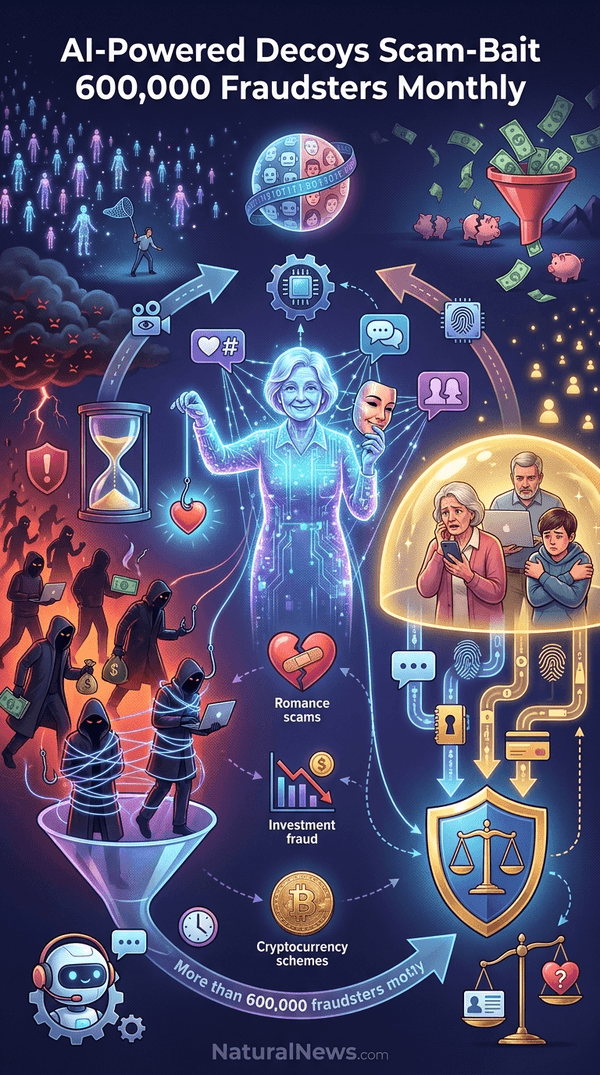
The operation reportedly engages about 600,000 scammers each month, the report said. The AI personas operate on dating sites, social media and messaging platforms. The effort comes as officials warn that AI is amplifying online fraud.
In February 2026, the Federal Bureau of Investigation warned of a sharp increase in AI-powered romance scams targeting individuals online, with losses exceeding $1 billion [1]. A survey by Gallup and the Stop Scams Alliance estimated that about 15 million Americans lost money to scams in 2025, with total losses of approximately $68 billion [2].
How the AI Decoy System Operates
According to the report, the decoys use conversational AI to respond to common scam scripts and prolong interactions. Fraudsters are led to believe they are communicating with real people while the system collects data on tactics, payment details and communication patterns, the report said.
The initiative reportedly targets romance scams, investment fraud and cryptocurrency schemes, based on the frequency of detected attempts. Those categories have drawn enforcement attention. In June 2025, European and U.S. law enforcement agencies arrested five individuals in Spain in connection with a $542 million cryptocurrency investment scam involving more than 5,000 victims, according to NaturalNews.com [3].
Conversational AI systems of this type are already used in mainstream services. Telecommunications firms use AI-powered chatbots to handle customer support and improve resolution rates, according to Zachary Jarvinen's "Enterprise AI For Dummies" [4]. The decoy operation applies the same class of technology to a defensive purpose, the report said.
Reported Scale and Impact
The 200,000-persona network is said to waste the time of roughly 600,000 fraudsters monthly, reducing opportunities for scammers to reach genuine victims, the report stated. The report says the project's operator stated that the main goal is to occupy fraudsters with fake interactions and gather evidence for authorities.
No arrests have been confirmed from the operation, according to the report, but data has been shared with law enforcement agencies. The scale of automated activity reflects a broader trend: bots already account for a large share of internet traffic. In 2022, bots generated 47.4% of all internet traffic, according to a report by cybersecurity company Imperva [5].
Context and Expert Views
Scam-baiting is an established practice, but AI allows the tactic to operate at a scale far beyond manual efforts, cybersecurity analysts told the publication. Some experts raised questions about impersonation and user consent, while others described the program as a passive defense mechanism that does not contact real users.
The report noted that scammers may adapt with stronger verification, though the AI developers say they constantly update the personas to remain convincing. Similar concerns about AI-driven fraud have spread across industries. Credit agency TransUnion found that one in six American consumers lost money to digital fraud in the past year, with a median loss of $2,307 [6].
The use of AI-generated personas is not limited to private efforts. Police agencies near the U.S.-Mexico border have deployed AI bots to monitor suspects and protesters, a practice that has raised First Amendment concerns, according to NaturalNews.com [7].
Conclusion
The use of AI-generated decoys illustrates a growing role for automation in fraud prevention, according to the report. AI systems can process large volumes of interactions without emotional bias, a capability increasingly applied to both commercial and defensive settings, according to William Scott's "AI Everyday" [8].
The report said no current regulations govern such operations, leaving legal and ethical questions unresolved. The operator reportedly plans to expand the number of persona deployments, aiming to increase the workload on fraudsters in the coming months.
References
- Belle Carter. "FBI Warns of AI-Powered Romance Scams Surging Ahead of Valentine's Day—Victims Lose Over $1B to Fake Love". NaturalNews.com. February 13, 2026.
- RT. "AI and deepfakes driving $68 bn US scam epidemic – survey". July 1, 2026.
- Ramon Tomey. "Crypto Crime Crackdown: Law Enforcement Busts Investment Fraud Ring in Spain". NaturalNews.com. July 2, 2025.
- Zachary Jarvinen. "Enterprise AI For Dummies".
- NaturalNews.com. "Report_ Bad bots TAKING OVER the internet with spam cybercrime". NaturalNews.com. May 31, 2023.
- The Epoch Times. "AI-Driven Fraud Scams Cost US Consumers Thousands, TransUnion Finds". April 16, 2026.
- NaturalNews.com. "Police Departments Deploy AI Bots to Monitor Criminal Suspects and Protesters Online Effectively Creating Crime". NaturalNews.com. April 21, 2025.
- William Scott. "AI Everyday".
Explainer Infographic









Please contact us for more information.


