


The company said the changes are intended to strengthen privacy, accountability, and security [2].
Flock operates a growing network of cameras that feed vehicle characteristics and plate data into a platform accessed by thousands of law enforcement agencies, according to The Epoch Times [1].
A database maintained by DeFlock, a project that maps ALPR installations, has documented more than 117,000 license plate readers across the United States; Flock devices account for approximately 97,000 of the documented readers [3].
Flock Safety Announces Major Policy Change
The policy changes were announced Aug. 13, according to the company [1]. They follow a period of mounting scrutiny over how local law enforcement has used, and, in some cases, abused the data collected by the cameras [2].
The Los Angeles Police Department is allowing its three-year contract with Flock Safety to expire, according to FOX 11 LA [4]. The expiration stems from "unresolved disputes over data ownership, data sharing, and privacy safeguards," the report stated [4].
New Data Retention and Search Rules
According to CEO Garrett Langley, the default data retention is shrinking from 30 days to seven days. Longer holds will require that data be "explicitly tied to an active case number as evidence," and every search query must now carry a criminal case number to proceed, according to the announcement [5].
A tool that flags abnormal search behavior is now mandatory for all law enforcement customers and automatically locks out users pending an internal review, Langley said. He added that cities can restrict what outside agencies are allowed to search on their cameras. "City A could allow City B to search its cameras only for a stolen vehicle, missing person, or violent crime while blocking searches related to immigration enforcement," Langley said [5].
Langley also acknowledged a security flaw disclosed earlier this year. A glitch discovered in December 2025 left some of Flock's AI-powered pan-tilt-zoom cameras exposed to the public internet. "For a brief period of time, third parties were able to access live streams and footage from those cameras," he said, attributing the breach to a vendor's network configuration error. "We are accountable," Langley added [5].
Jurisdiction Cancellations and Camera Damage
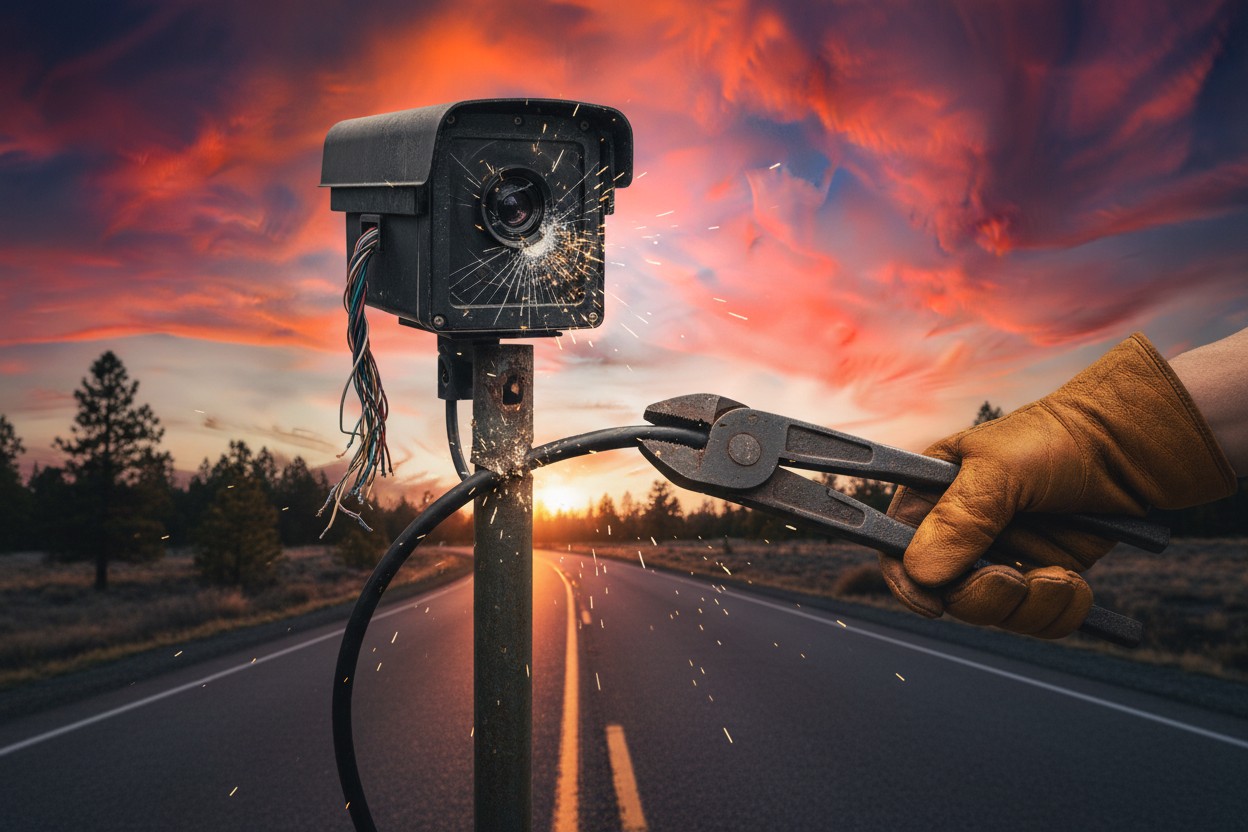
More than 50 agencies and municipalities have canceled, suspended, rejected, or simply unplugged their Flock contracts since January, according to a tracker maintained by DeFlock. A Guardian investigation documented 33 camera destruction incidents across 23 states, with cameras smashed, sawed off poles, or hauled away entirely [5].
One activist told AFP he has personally disabled roughly 30 devices and posts instructional videos to about 500,000 Instagram followers, according to the report. In Oregon, six poles were cut down, and a note left at the base read: "Hahaha get wrecked ya surveilling f**ks" [5].
In Suffolk, Virginia, 13 cameras were destroyed between April and October 2025, and six cameras were taken down in Eugene and Springfield, Oregon, in October 2025, according to The New American [6].
Knox County, Tennessee, Mayor Glenn Jacobs issued a statement urging county commissioners "to prohibit the use of Flock cameras and similar devices in our county" [7].
Law Enforcement Misuse Incidents
Flock said the platform changes were aimed in part at addressing cases of law enforcement members allegedly abusing its camera network [1].
Earlier this month, a North Carolina police officer was arrested for allegedly using Flock's plate readers to track her boyfriend's ex-wife, and The Washington Post reported nearly 50 instances of officers charged or accused of using the cameras for unauthorized purposes [5].
Four Richmond County Sheriff's Office employees have been arrested and fired since June for personal searches, and six Savannah Police Department employees were fired this week after Flock's audit function flagged their activity, according to officials [5].
Bipartisan Opposition and Surveillance Concerns
The opposition to Flock spans party lines. Representative Keith Self (R-Texas) introduced legislation in July that would prohibit federal law-enforcement agencies from obtaining data from state and local mass-surveillance devices, including Flock cameras, without a warrant [8].
Representatives Thomas Massie (R-Ky.) and Lauren Boebert (R-Colo.) have introduced the Surveillance Accountability Act, which would require warrants for searches that "significantly impinge on the privacy or security of a person" [9].
The backlash has been described as "visceral, cross-partisan opposition" to the cameras [10]. As one surveillance-law scholar told the Associated Press, the "growing community backlash" aimed specifically at Flock has captured a cultural shift: people don't want their daily movements tracked [5].
In an interview published by Mike Adams, John Bush warned that without action, "our children might grow up in a society where their every move is monitored, freedom is severely limited, and privacy is nonexistent" [11].
Surveillance Debate and Decentralized Alternatives
The Flock retreat follows a similar reversal by Ring, the Amazon-owned doorbell company, which announced in February 2026 that it was canceling its planned integration with Flock [12].
Flock cameras record not just license plates but also vehicle make, model, color, and unique features, creating a digital "fingerprint" of every vehicle, according to Willow Tohi of NaturalNews.com [13].
The debate has drawn on broader American currents of privacy, localism, and self-reliance, themes that run through works such as John Naisbitt's "Global Paradox" and Joel Salatin's "Pastured Poultry Profits" [14][15].
Whether the company's policy changes will satisfy critics, or whether the cancellations and legislative efforts will continue, remains an open question.
References
- The Epoch Times. "Flock Announces Platform Changes After Public Backlash to Its Camera Network". August 13, 2026.
- Just the News. "Facing mounting criticism, Flock moves to address concerns about its license plate cameras". August 15, 2026.
- NaturalNews.com. "Map Identifies Over 117,000 License Plate Readers Across the United States". July 22, 2026.
- NaturalNews.com. "Flock Safety Loses Dozens of Contracts Amid Surveillance Concerns". August 10, 2026.
- Zero Hedge. "Flock Blinks: Surveillance Giant Slashes Data Retention After 50 Jurisdictions Walk, Cams Destroyed". August 14, 2026.
- The New American. "Americans Destroying Flock Cameras in Protest". July 27, 2026.
- 100PercentFedUp. "WWE Star Turned Mayor Issues Statement Urging Lawmakers To Prohibit Use Of 'Flock Cameras And Similar Devices'". July 27, 2026.
- The New American. "Congressmen Want to Force Feds to Get Warrant to Access Local Surveillance-camera Data". July 17, 2026.
- Reclaim The Net. "The Surveillance Accountability Act Demands Warrants for Data". April 23, 2026.
- Mises Institute. "The Flock Camera Backlash Is a Very Good Sign". August 19, 2026.
- Mike Adams interview with John Bush. May 8, 2024.
- Douglas Harrington. "Ring's Retreat Shows Public Backlash Still Matters in the Battle for Privacy". NaturalNews.com. February 21, 2026.
- Willow Tohi. "The Digital Panopticon: License Plate Readers Are Tracking You Everywhere You Go". NaturalNews.com. September 1, 2025.
- John Naisbitt. "Global paradox".
- Joel Salatin. "Pastured Poultry Profits".










Please contact us for more information.


