



The study, published in the British Journal of Psychology, involved nearly 200 participants recruited from the McGill community. Senior study author Jorge Armony, a professor in McGill's Departments of Psychiatry and Psychology, said the effects observed were relatively small and occurred under controlled conditions.
Graduate student Soren Wainio-Theberge developed the original idea for the research and coauthored the paper. In a statement from the university, Armony said the findings offer new evidence that physical position can influence mood and behavior.
Researchers Altered Posture Without Revealing Study's Goal
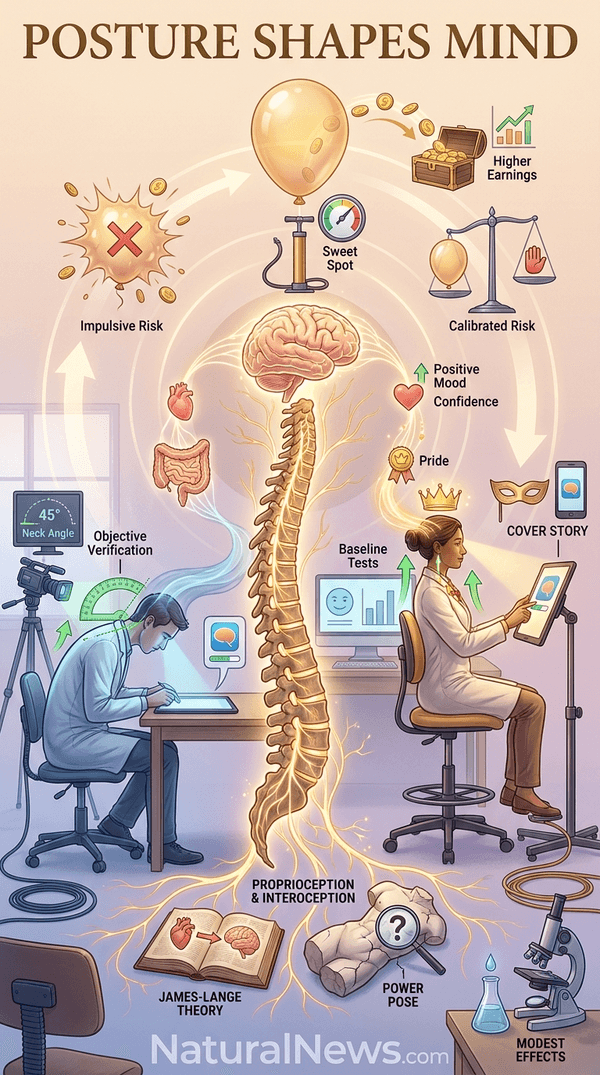
Participants first completed tests using a computer monitor. They were then asked to perform another task on a tablet while being told that researchers were evaluating a mobile application, according to the university.
The tablet setup was designed to subtly influence how each person sat. In one group, the device was placed on a stand supported by an adjustable table, encouraging participants to remain upright. In another group, the tablet lay flat on a desk set at a lower height, which encouraged participants to lean forward and hunch over, the researchers said.
Video software measured each participant's neck angle to verify that the physical setup produced the intended posture. During interviews conducted after the experiment, most participants said they had not realized their posture was being manipulated, according to the study.
Upright Participants Showed More Effective Risk-Taking
The participants next completed a risk-taking game involving a virtual balloon. Players could earn larger rewards by continuing to inflate the balloon, but they could lose everything from that round if it burst, according to the study.
People in the upright group generally took greater risks and earned larger rewards over the course of the game. The researchers concluded that these participants were not simply behaving more recklessly. "This suggests they were not acting more impulsively but rather were engaging in more effective risk-taking," Armony said.
Responses to a questionnaire showed that participants in the upright group reported significantly stronger feelings of pride, an emotion associated with a more positive mood, the researchers said. The connection between posture and emotional state has appeared in earlier reporting: slouching has been described as a posture that may bring down mood [1], and adopting an upright posture has been linked to increased positive affect and decreased fatigue [2].
Study Designed to Address Power-Pose Research Critiques
Scientists have long debated whether body posture can meaningfully affect thoughts, emotions and behavior. The McGill researchers designed the experiment to address several concerns raised by earlier studies, according to the university.
Rather than directly instructing participants to sit in a particular way, the team altered the environment so that posture changed without the participants knowing why. The approach was intended to address a major criticism of earlier "power pose" research: that participants may have behaved differently because they understood what researchers expected. That earlier work relied on word-completion tasks to measure participants' unconscious sense of power after posture manipulations [3].
The researchers also used video software to confirm posture objectively, a step they said earlier studies often lacked. Armony cautioned that simply changing posture is unlikely to produce a dramatic transformation in someone's life, according to the university.
Implications and Publication Details
The results raise questions about whether ordinary environmental features, including workplace ergonomics, may have small but measurable effects on emotions and decision-making, the researchers said.
Prior reporting has noted that prolonged sitting is an independent risk factor for disease and early death [4], and posture has gained attention for its ability to influence mood [5]. The research received support from the Natural Sciences and Engineering Research Council of Canada and the Social Sciences and Humanities Research Council of Canada.
References
- Mercola.com. "Slouching Makes You Sad". Mercola.com. October 03, 2014.
- Caitlin McColl. "Think. Feel. Be."
- Amy Cuddy. "Presence Bringing Your Boldest Self to Your Biggest Challenges".
- Mercola.com. "Study Lack of Exercise Is Worse Than Smoking". Mercola.com. November 02, 2018.
- NaturalNews.com. "Treat depression with good posture". NaturalNews.com. February 03, 2017.
Explainer Infographic











Please contact us for more information.


