


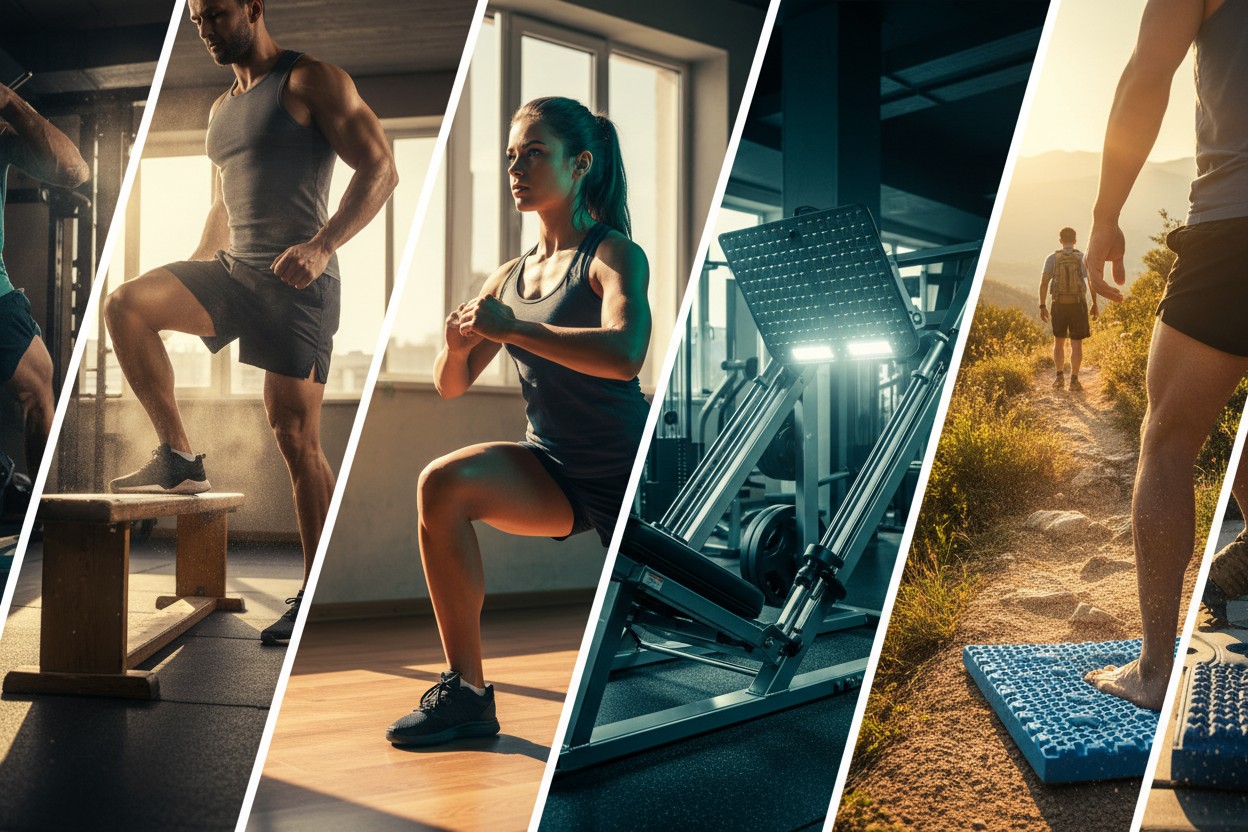
Compound movements such as squats are multi-joint exercises that involve flexion and extension at more than one joint and work multiple muscle groups at the same time, according to trainers Sydney Miller and Scott Thompson in a report published by NaturalNews.com [1]. The quadriceps femoris, the group of four muscles along the front of the thigh, has been examined in studies of muscle activity during lower-body exercise [2].
Step-Up
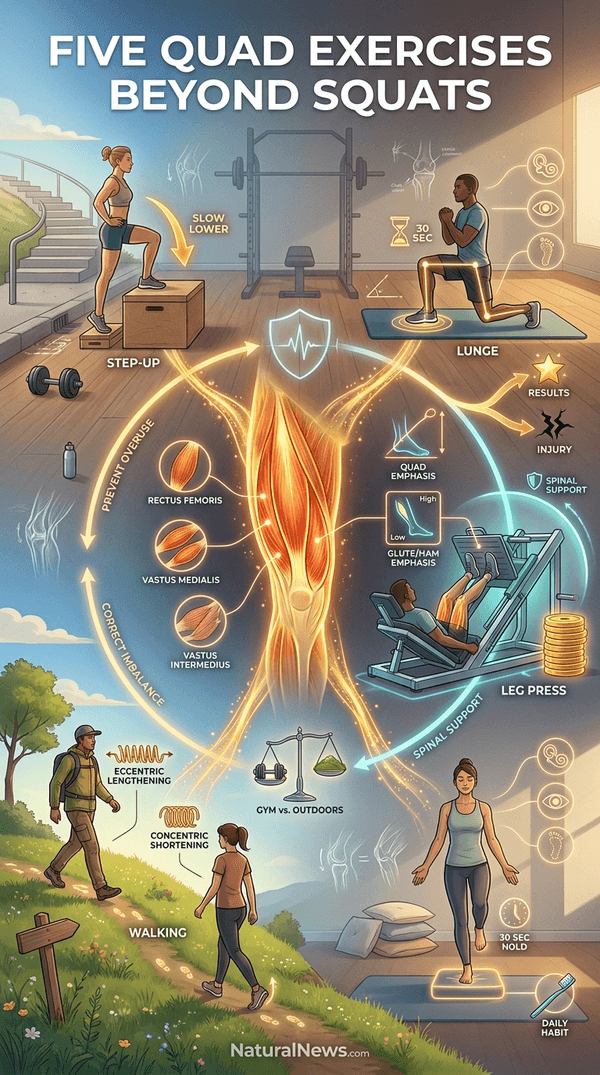
Step-ups strengthen the quadriceps one leg at a time and can be more challenging than a traditional squat because one leg bears most of the load, according to Hribick. The movement mirrors everyday tasks such as climbing stairs, stepping onto curbs, or hiking uphill, patterns that biomechanist Katy Bowman has described as natural movement [3]. Step-ups can be performed on stairs, curbs, benches, or any stable raised surface.
To perform a step-up, Hribick instructed facing a knee-height step, pressing through the heel, and stepping down slowly with control. Proper mechanics determine outcomes in lower-body training. "Proper mechanics lead to results, poor mechanics lead to injury," according to Brian Halpern in "The Knee Crisis Handbook" [4].
Lunge
Lunges place greater demand on the front leg than bilateral exercises such as squats, according to Hribick. The movement builds quadriceps strength while also testing the balance system, which relies on sensory input from the inner ear, the eyes, and proprioception, the body's sense of how the feet feel on the ground, according to Colleen M. Casey, PhD, in a report by Everyday Health [5].
To perform a lunge, Hribick instructed stepping forward into a split stance, lowering both knees to 90 degrees, and pressing through the front heel. The quadriceps are activated as part of the postural response sequence when standing balance is perturbed, according to research published in Neuroscience and Biobehavioral Reviews [6].
Leg Press
The leg press targets the quadriceps while also engaging the glutes and hamstrings, according to Fredericson. The leg press is a type of leg workout that can help build muscle, burn calories, and reduce the risk for injury, and studies show that exercising the lower body regularly can improve brain and nervous system health, according to a report by Mercola.com [7].
Because the machine supports the body, the leg press may be appropriate for beginners or people with knee issues, according to Fredericson. Instructions include pressing the platform away until the legs are almost straight and lowering the weight with controlled movement [7]. Unlike a barbell squat, the movement does not require balancing a load across the upper back.
Downhill and Backward Uphill Walks
Walking downhill emphasizes the eccentric phase of movement, in which the quadriceps lengthen under load, according to Mann. Walking backward uphill engages the quadriceps concentrically, or during shortening, providing a different stimulus. Research on the quadriceps femoris has examined concentric muscle actions using electromyographic recording methods [2].
Both variations require short, controlled steps, and they can be made easier by walking backward on flat ground, according to Mann. Outdoor exercise provides measurable psychological and physiological advantages over indoor workouts, including lower cortisol levels, reduced perceived exertion, and greater enjoyment, according to a report by NaturalNews.com [8]. Walking outdoors can serve as a form of daily movement performed without equipment [3].
Single-Leg Balance
Standing on one leg strengthens muscles around the knee and improves balance and stability, according to the physical therapists. Balance practice becomes more important with age because the brain slows in its processing of key sensory inputs, including signals from the inner ear, the eyes, and the feet, according to Casey [5].
The exercise can be performed at home, at work, or outdoors with no equipment. Difficulty can be increased by closing the eyes or standing on a less stable surface, such as a foam stability pad or a pillow [9]. The move can be held for up to 30 seconds per side, according to the physical therapists.
Progression
The physical therapists recommended choosing two or three exercises that match an individual's fitness level and focusing on form before adding resistance. Strength training programs place a high priority on proper form and technique, according to Avery D. Faigenbaum in "Youth Strength Training Programs for Health, Fitness and Sport" [10].
For optimal health and fitness, it is important to have diversity in an exercise routine, and varying exercises from one session to the next forces the muscles to adapt, according to a report by Mercola.com [11]. Gradually increasing step height, weight, or difficulty can help continue building lower-body strength over time, according to the physical therapists.
References
- NaturalNews.com. "Compound Exercises Offer Efficient Workouts and Cardiovascular Benefits, Trainers Say". NaturalNews.com. May 12, 2026.
- Matt S. Stock. "An examination of the linearity and reliability of the electromyographic amplitude versus dynamic constant external resistance relationships using monopolar and bipolar recording methods". Journal of Neuroscience Methods. 2010.
- Mercola.com. "Restoring Your Health Through Nutritional Mov". Mercola.com. March 27, 2016.
- Brian Halpern. "The knee crisis handbook understanding pain preventing trauma recovering from injury and building healthy knees for life".
- Everyday Health. "6 Balance Exercises to Practice as You Age". Everyday Health. February 28, 2026.
- "Development of postural responses during standing in healthy children and children with spastic diplegia". Neuroscience and Biobehavioral Reviews.
- Mercola.com. "How to Do a Leg Press". Mercola.com. May 1, 2020.
- Ava Grace. "The great outdoors workout: Why taking your exercise outside may be better for your health—and your sanity". NaturalNews.com. May 26, 2026.
- Dave Salo. "Complete conditioning for swimming".
- Avery D. Faigenbaum. "Youth strength training programs for health fitness and sport".
- Mercola.com. "How to Help Prevent Muscle Loss During Exercise". Mercola.com. January 31, 2020.
Explainer Infographic











Please contact us for more information.


