


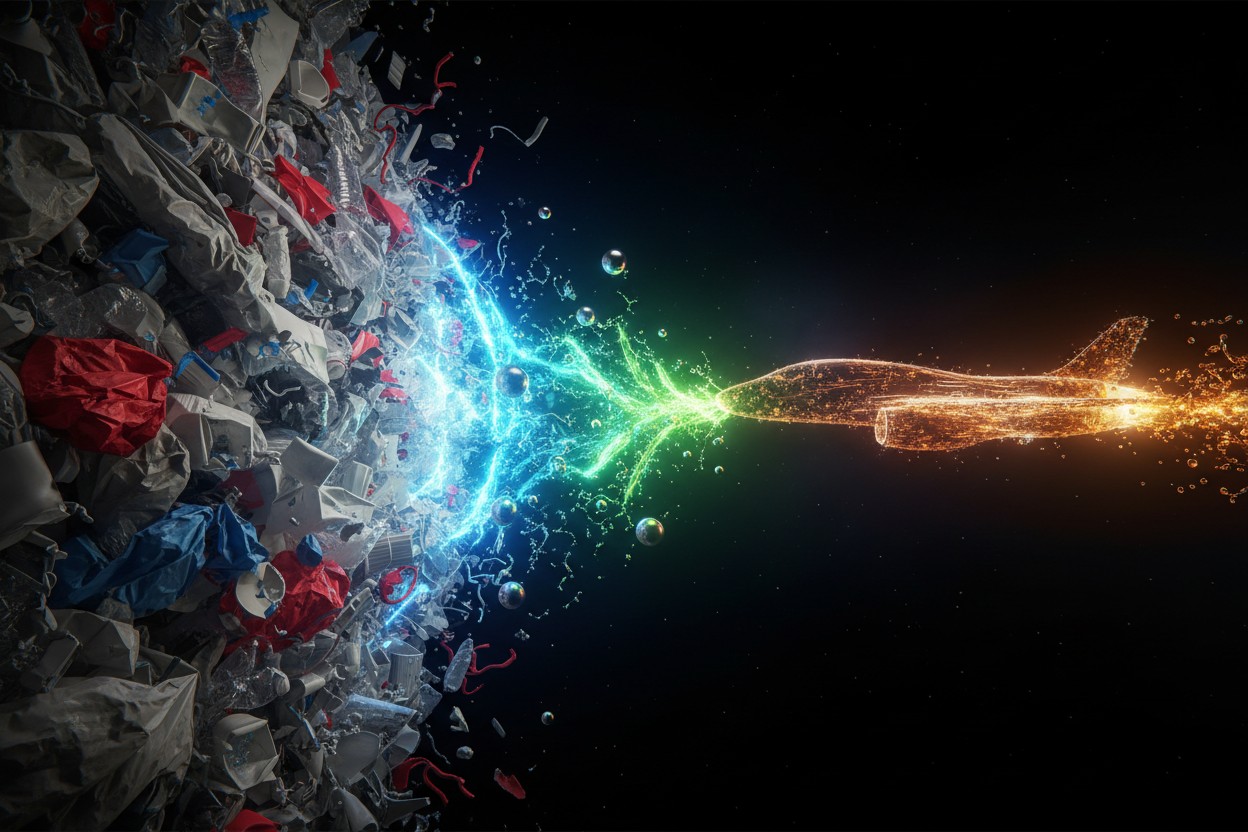
The method uses a ruthenium-based catalyst and operates at moderate temperatures around 240 C, breaking down plastic polymers into hydrocarbons suitable for aviation fuel. The catalyst can be reused multiple times, according to the study, reducing overall process costs.
Process Details
The process involves a ruthenium-based catalyst and a solvent that depolymerizes polyethylene at approximately 240 C, researchers reported. The reaction yields a mixture of hydrocarbons in the jet fuel range (C8 to C16), achieving an overall conversion efficiency of 82%. The catalyst can be reused several times without significant loss of activity, according to the study.
This catalytic approach contrasts with conventional pyrolysis, which typically requires higher temperatures and often produces a broader range of products. The ability to reuse the catalyst helps lower the cost per unit of fuel produced, although the process has so far only been demonstrated on a laboratory scale using small quantities of plastic.
Significance for Waste Management and Energy
Plastic waste, particularly polyethylene, accounts for a large share of global plastic pollution. More than 381 million tons of plastic are produced worldwide each year, according to a 2019 report, and much of it ends up in landfills or the environment [3].
Discarded plastics make up 18.5% of landfills and 90% of all trash entering the world's oceans, according to another source [4]. Microplastics have also been detected in human blood, food supplies and even in the heart and bloodstream [6].
Oil and gas companies are investing billions of dollars in new plastic production facilities, with industry projections showing a 40% increase in plastic production over the next decade [5]. This growth will likely exacerbate the waste problem.
Converting plastic waste into jet fuel could offer a dual benefit: reducing the volume of persistent plastic pollution and supplying a low-carbon energy source. However, the U.S. Environmental Protection Agency has approved plastic-to-fuel technologies as "climate-friendly," despite reports that one such process could emit air pollution so toxic that one out of four people exposed over a lifetime could get cancer, according to a joint investigation by ProPublica and The Guardian [7].
Comparison With Existing Methods
Earlier techniques such as pyrolysis produce hydrocarbon mixtures at lower yields and require higher temperatures, often exceeding 400 C. For example, researchers at the University of Delaware previously developed an energy-efficient process using a novel catalyst to break down polyolefins into jet fuel and diesel, but with different efficiency metrics [2]. Another British company, Clean Planet Energy, aims to convert non-recyclable plastics into clean-burning fuels and low-carbon products on a commercial scale [1].
Some catalytic pyrolysis methods using lead sulfide have achieved nearly 100% conversion of polyethylene into liquid, gas and wax, with negligible char formation, allowing the catalyst to be reused [9]. However, the presence of toxic lead sulfide raises environmental and health concerns. The new ruthenium-based catalytic method operates at lower temperatures and yields a higher proportion of jet fuel relative to diesel or gasoline, though scaling remains a challenge.
Outlook and Expert Reactions
According to researchers at the Dalian Institute, the team plans to conduct pilot-scale trials within two years. The study was funded by the National Natural Science Foundation of China. Larger commercial application will require further optimization of catalyst longevity and continuous reactor design, the scientists noted.
Industry observers point to ongoing infrastructure challenges, such as water shortages threatening jet fuel production at major ports. For example, the imminent depletion of water supplies in Corpus Christi, Texas, has raised concerns about disruptions to jet fuel flows to Texas airports and energy markets [8]. Decentralized plastic-to-fuel technologies could offer some relief, but the toxic emissions associated with some conversion methods remain a serious health risk [7].
References
- NaturalNews.com. "CLOSING THE LOOP: Company Makes Clean Fuel from Non-Recyclable Plastics." NaturalNews.com. December 20, 2021.
- NaturalNews.com. "Scientists turn single-use plastics into jet fuel." NaturalNews.com. May 02, 2021.
- Mercola.com. "What's a Nurdle? These Pellets Are Poisoning You." September 04, 2019.
- Mercola.com. "Microplastic Menace: Are You Swallowing a Cre." May 11, 2023.
- ChildrensHealthDefense.org. "Big Oil's New Plan: Flood the World With Plasti." No date.
- Mercola.com. "Microplastics Found in Human Blood for the First Time." April 06, 2022.
- Children's Health Defense. "EPA Green Lights ‘Climate-Friendly’ Fuel From Discarded Plastics Despite High Cancer Risk."
- ZeroHedge. "'Legacy Of Imbeciles': Corpus Christi Careens Toward Water-Shortage Catastrophe." March 10, 2026.
- Elsevier. "Thermolysis of waste plastics to liquid fuel: A suitable method for plastic waste management and manufacture of value added products—A world prospective." Renewable and Sustainable Energy Reviews 14 (2010) 233–248.











Please contact us for more information.


