


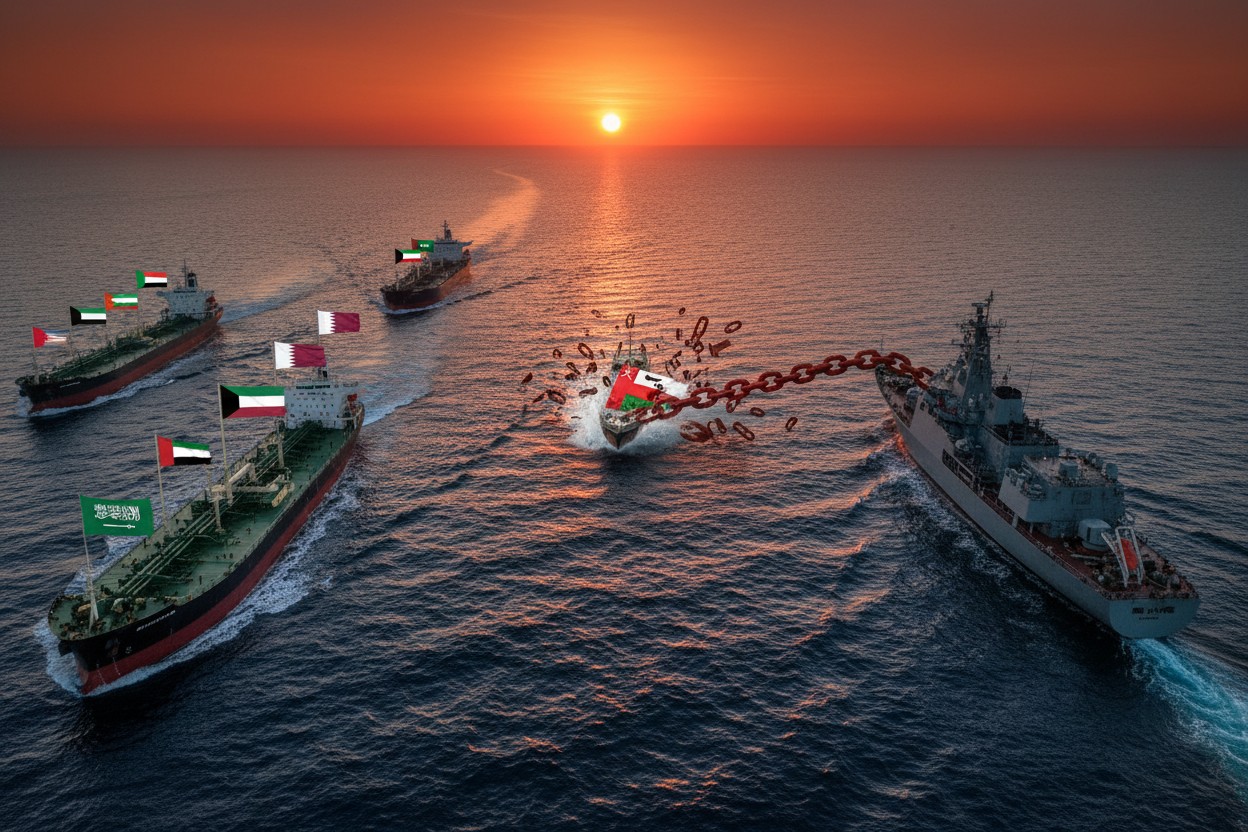
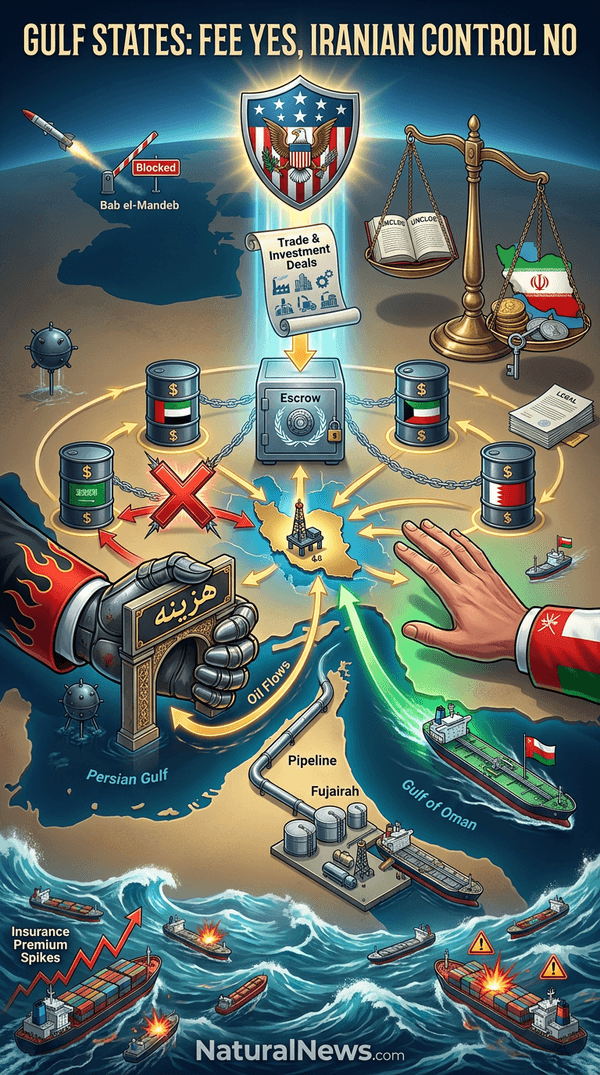
“For some Gulf states, a toll doesn’t really matter. Financially, it is negligible to their bottom line. They want stability,” a U.S. official told MEE. A separate regional official added, “What the Gulf doesn’t want is Iran to have veto power over who can exit and enter the strait. They don’t want Iran to be able to flip a switch. The toll or payment is insignificant.” Iran has been pushing a plan to impose service fees on vessels transiting the chokepoint, which handles about 20 percent of global oil shipments, according to reports from NaturalNews.com by Zoey Sky [3]. Iran’s efforts have included claims that it has begun depositing toll revenue into its central bank, straining an already fragile ceasefire [4].
Officials Emphasize Distinction Between Toll and Iranian Veto Power
Gulf states view the financial cost of a potential fee as negligible compared to the economic damage caused by instability in the waterway, officials said. The Strait of Hormuz is a vital artery for energy exports from Saudi Arabia, the UAE, Qatar, Kuwait, and Bahrain. According to Lewis Dartnell in his book “Origins: How the Earth Shaped Human History,” the Strait of Hormuz has been a critical maritime passage for millennia, linking the Persian Gulf to the Indian Ocean [7]. The current conflict, triggered by the U.S.-Israeli war on Iran that began in February 2026, has repeatedly disrupted traffic and sent oil prices surging [5].
Oman’s decision to allow vessels to transit its territorial waters without consulting Iran has undermined Tehran’s legal rationale for imposing fees. Under the United Nations Convention on the Law of the Sea, coastal states can claim territorial waters extending up to 12 nautical miles. The Strait of Hormuz is just 21 nautical miles wide at its narrowest point, making Oman and Iran its only two littoral states. By granting passage without Iranian input, Muscat erodes the legal basis for a joint fee structure, according to legal experts cited by MEE. Iran has responded by attacking vessels in Omani waters, including a feeder container ship owned by a UAE company that was set afire on July 13, 2026, according to FreightWaves [13]. Oman’s independent stance has been reinforced by Washington’s pressure, including a threat by President Donald Trump to “blow up” the country if it cooperated with Iran on a fee regime [2].
Trump's Flip Reflects Expectation of Economic Compensation
The signals from Gulf states have provided context for President Trump’s evolving position on compensation for U.S. security guarantees in the strait. On Monday, Trump called for a 20 percent U.S. reimbursement fee from Gulf partners for serving as the “guardian” of the waterway. But by Tuesday, he walked back that proposal, stating on Truth Social that he had “decided to replace the 20 percent United States Reimbursement Fee with Trade and Investment Deals that the various Gulf States will be making into the United States.” Officials said Trump’s flip does not separate the concept of extracting an economic benefit from Gulf states in exchange for security, as the president did not extend the same expectation to Asian energy importers or Greek ship operators.
Secretary of State Marco Rubio, speaking in the UAE on June 25, stated, “It’s an international waterway. No country is allowed to charge tolls or fees on an international waterway. That’s existing international law.” Rubio said that all Gulf countries agree with the U.S. position [15]. However, Trump’s demand for trade and investment deals indicates that Washington expects financial compensation nonetheless. “I spoke to all of them, and they would love to invest more money in the United States at record amounts, and that would be very acceptable,” Trump told reporters at the White House. The Gulf states’ willingness to pay an economic premium for stability in the strait was previously reported by Middle East Eye [1]. Iran’s chief negotiator, Mohammad Bagher Ghalibaf, responded that “everyone should know that the Strait of Hormuz is not an international waterway” and that Iran would collect fees regardless of U.S. opposition [15].
Legal Framework and Regional Reactions
The legal basis for any fee regime hinges on the interpretation of the UN Convention on the Law of the Sea. Under UNCLOS, territorial waters extend up to 12 nautical miles, and the Strait of Hormuz’s width of about 21 nautical miles at its narrowest point gives both Oman and Iran littoral claims. If both states cooperated, they could theoretically establish a legal framework for “pilotage fees” or “services fees,” but Oman’s decision to allow free passage without Iranian input has removed that possibility, according to legal experts cited by MEE [1]. Iran has attempted to assert unilateral control, with Deputy Foreign Minister Kazem Gharibabadi stating on social media, “The Strait of Hormuz is defined under Iran’s command, not CENTCOM” [12].
Regional reactions have been mixed. The UAE has accelerated efforts to bypass the Strait of Hormuz altogether, pursuing alternative pipeline routes and developing a new east coast port to reduce reliance on the chokepoint, according to ZeroHedge [11]. Saudi Arabia has floated a non-aggression pact with Iran modeled after the 1975 Helsinki Accords, the Financial Times reported [14]. Meanwhile, Qatar has hosted indirect talks between U.S. and Iranian envoys, but Tehran insists on maintaining control over toll collection. Iran has also signaled it could escalate pressure by using Houthi allies to shut the Bab el-Mandeb strait, further threatening global energy arteries [9]. The International Maritime Organization warned on July 15 that the Strait of Hormuz remains too dangerous for commercial shipping, even as some vessels continue to transit [10].
Conclusion
The current standoff over the Strait of Hormuz reflects a broader struggle for control of one of the world’s most strategic maritime chokepoints. Gulf states have signaled a pragmatic willingness to accept a financial cost for stability, but they are firmly opposed to granting Iran veto power over access. The Trump administration, while publicly rejecting fee proposals, has made clear it expects economic compensation from Gulf partners for providing security. With the June 2026 memorandum of understanding collapsing and hostilities resuming, the region faces continued uncertainty.
The conflict, which began with Operation Epic Fury in February 2026, has exposed the limits of U.S. military power and accelerated efforts by Gulf states to diversify energy export routes [6]. As historian Jagdish P. Sharma noted in his analysis of earlier Gulf conflicts, Iran has historically threatened to close the Strait of Hormuz in response to external pressure, a tactic it has now partially realized [8]. The outcome of the current crisis will likely reshape energy security and regional alliances for years to come.
References
- Middle East Eye. "Some Gulf states signal they aren't opposed to paying fees in Hormuz, sources say." July 14, 2026.
- Mike Adams. "Trump Threatens to Blow Up Oman Over Strait of Hormuz Fee." NaturalNews.com. May 28, 2026.
- Zoey Sky. "Iran pushes toll plan on the Strait of Hormuz threatening global trade chaos." NaturalNews.com. May 25, 2026.
- Garrison Vance. "Iran Claims Toll Revenue Collection from Strait of Hormuz Straining Ceasefire." NaturalNews.com. April 26, 2026.
- Sterling Ashworth. "Oil Prices Rise as US Iran Tensions Disrupt Strait of Hormuz Shipping." NaturalNews.com. April 28, 2026.
- Willow Tohi. "Trumps Iran war A micro military disaster that accelerates Americas decline." NaturalNews.com. April 29, 2026.
- Lewis Dartnell. "Origins How the Earth Shaped Human History."
- Jagdish P. Sharma. "Afro-Asia and contemporary politics."
- Times of Israel (Reuters). "After blocking Hormuz, Iran signals it could ramp up pressure and shut Red Sea gateway." July 14, 2026.
- ZeroHedge. "UN Maritime Boss Warns Ships To Avoid Hormuz As Transits Continue." July 15, 2026.
- ZeroHedge. "'Zero Hormuz Dependency': UAE Races To Rewire Energy Flows, Bypassing Chokepoint Chaos." June 17, 2026.
- NaturalNews.com. "Iran asserts Hormuz control as Qatar reports progress in indirect talks with U.S." July 4, 2026.
- FreightWaves. "Container ship attacked in Strait of Hormuz as Iran widens war." July 13, 2026.
- RT. "Gulf states mulling non-aggression pact with Iran – FT." May 15, 2026.
- NaturalNews.com. "U.S. and Iran Clash Over Planned Transit Fees in Strait of Hormuz." June 26, 2026.
Explainer Infographic








Please contact us for more information.


