



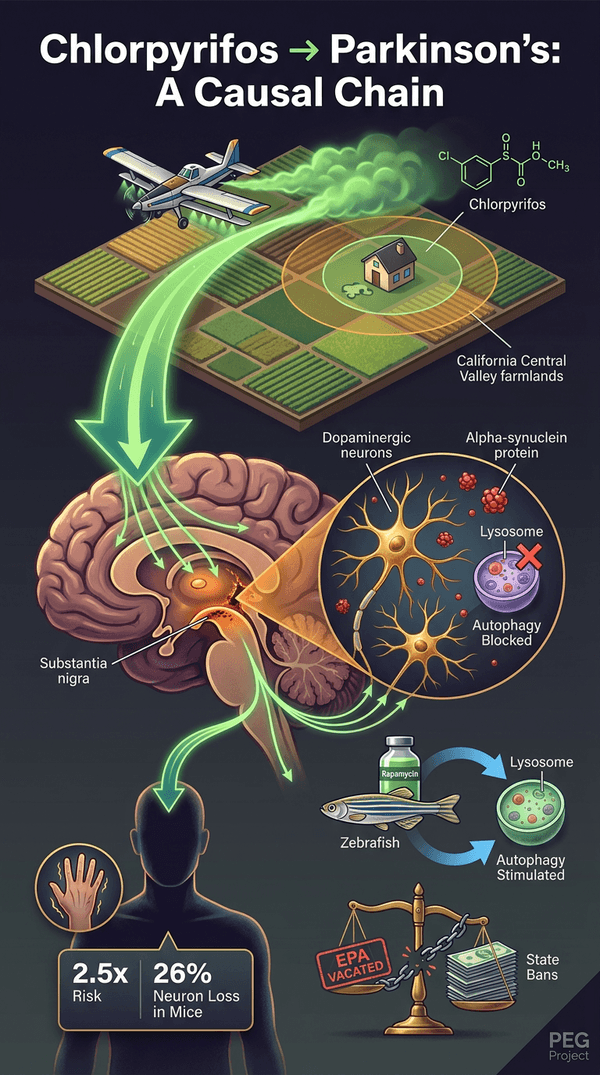
The study, which drew on data from the Parkinson's Environment and Genes (PEG) project, compared 829 Parkinson's patients with 824 controls across three intensively farmed California counties – Kern, Fresno and Tulare. [1] The findings build on decades of epidemiological research linking agricultural chemicals to neurological disorders, but go further by identifying a specific causal mechanism.
Senior study author Dr. Jeff Bronstein, a professor of neurology at UCLA Health, said the evidence points to a likely causal relationship as the pesticide disrupts the brain's autophagy system – leading to the accumulation of toxic alpha-synuclein protein.
"This study establishes chlorpyrifos as a specific environmental risk factor for Parkinson's disease, not just pesticides as a general class," Bronstein said. "By showing the biological mechanism in animal models, we've demonstrated that this association is likely causal." [1]
What Is Chlorpyrifos and Where Is It Still Used?
Chlorpyrifos is an organophosphate insecticide first registered in the U.S. in 1965 by Dow Chemical Company. Organophosphates were originally developed as nerve agents during World War II and work by inhibiting acetylcholinesterase, an enzyme necessary for nervous system function. [2]
For decades, chlorpyrifos was among the most heavily applied agricultural pesticides in the United States. Roughly 21 million pounds used annually between 1987 and 1998 on more than 50 crops, including apples, citrus, strawberries, soybeans and wheat. [2]
The Environmental Protection Agency (EPA) revoked all tolerances for chlorpyrifos on food crops in August 2021, effectively banning its use. However, the Eighth Circuit Court of Appeals vacated that ban in November 2023, ruling that the EPA had failed to evaluate each crop group individually. [3]
As of mid-2026, chlorpyrifos remains legally permitted on 11 food and feed crops in states without their own bans. California, Hawaii, Maryland, New York and Oregon have enacted state-level prohibitions. [4] A final EPA ruling that would prohibit most remaining uses is expected later in 2026.
Study Methodology and Key Findings
Researchers used California's mandatory Pesticide Use Report database, which has recorded every commercial agricultural pesticide application since 1974, to estimate participants' exposure. They geocoded lifetime residential and workplace addresses and calculated cumulative chlorpyrifos application within a 500-meter buffer of each address over decades. [1]
The study found that people with long-term residential exposure to chlorpyrifos had more than 2.5 times the risk of developing Parkinson's disease compared to those with little or no exposure. Workplace exposure showed an even stronger signal. People with the longest duration of occupational proximity to chlorpyrifos applications had an odds ratio of 2.74, or nearly three times the risk. [5]
Critically, exposures that occurred 10 to 20 years before a Parkinson's diagnosis showed the strongest association, consistent with the disease’s long latency period. "The human data is robust, and the laboratory data confirms that the biological plausibility is there," Bronstein said. [1]
Biological Mechanism Identified
The UCLA study also conducted parallel experiments in mice and zebrafish to determine how chlorpyrifos damages the brain. Mice exposed to aerosolized chlorpyrifos via inhalation for 11 weeks lost 26% of their dopaminergic neurons in the substantia nigra – the brain region most targeted by Parkinson's – and showed elevated levels of the misfolded protein alpha-synuclein, which forms the toxic Lewy bodies that are the pathological hallmark of the disease. [1]
Zebrafish experiments demonstrated that the neuron death depended on alpha-synuclein. When the researchers genetically removed the zebrafish equivalent of synuclein, the neuron death stopped entirely.
Chlorpyrifos was found to reduce autophagic flux – the cell's lysosomal system that degrades and recycles damaged proteins, including alpha-synuclein. When autophagy was pharmacologically restored in zebrafish, the dopaminergic neuron loss was significantly reversed.
"In the case of chlorpyrifos, that could mean medicines that stimulate autophagy," Dr. Bronstein told the New Lede. "When we did that in fish, it made them resistant to the effects from chlorpyrifos." [1]
Regulatory Landscape and Public Health Implications
The European Union listed chlorpyrifos as a persistent organic pollutant under the Stockholm Convention in May 2025, but the U.S. has not adopted the convention. Meanwhile, multiple states have moved ahead with their own bans. The EPA's 2021 ban was overturned on procedural grounds, and the agency is expected to issue a new final rule later in 2026 that would prohibit most remaining uses. [3]
Nathan Donley, environmental health science director at the Center for Biological Diversity, described the cumulative scientific picture in stark terms: "Chlorpyrifos is linked to just about anything that can go wrong in the brain at this point," he said. "There's really just no question anymore that it's an enormous public health threat." [4]
The study's authors recommend that people with known past exposure – particularly agricultural workers and residents of California's Central Valley – discuss their history with a neurologist. "People who lived or worked near chlorpyrifos-treated fields, especially in the decades before 2021, may benefit from closer monitoring," Bronstein remarked. [1]
References
- NaturalNews.com. "Chlorpyrifos Exposure Associated With 25 Fold Increase in Parkinsons Risk Study Finds". NaturalNews.com. May 17, 2026.
- ChildrensHealthDefense.org. "FDA Knows This Pesticide Causes Brain Damage in Kids — So Why Isn’t It Banned?". ChildrensHealthDefense.org. May 21, 2021.
- Stacy Malkan. "EPA Admits Chlorpyrifos Damages Kids’ Brains, But Efforts to Ban the Insecticide Fall Short". ChildrensHealthDefense.org. 2021.
- Mercola.com. "EPA Refuses to Ban Neurotoxic Pesticide Found in 87 Percent of Newborns". Mercola.com. November 21, 2017.
- NaturalNews.com. "Chlorpyrifos Exposure Associated With 2.5-Fold Increase in Parkinson’s Risk, Study Finds". NaturalNews.com. May 17, 2026.
- Donald Hoernschemeyer. "Healthy Living in a Contaminated World - How to prevent toxic chemicals from undermining your health".
- Carey Gillam. "Whitewash The Story of a Weed Killer Cancer and the Corruption of Science".
Explainer Infographic











Please contact us for more information.


