



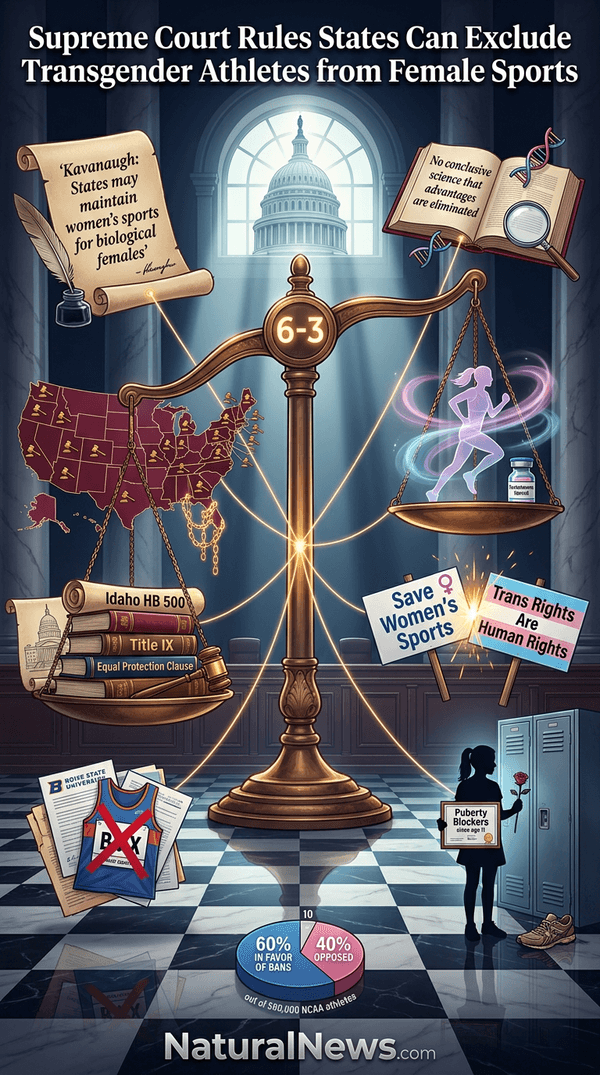
The decision overturned previous judgments issued by lower courts in favor of two transgender students who had sued after being barred from competition. Justice Brett Kavanaugh wrote for the majority that "states may maintain women's and girls' sports for biological females," according to the opinion. The three liberal justices dissented from some parts of the judgment but concurred with other parts, the court said.
Background on the Laws and Cases
Idaho's 2020 law was the first in the nation to ban transgender female athletes, according to state records. The law was challenged by transgender college student Lindsay Hecox, who originally sued but later sought to have the case dismissed, stating he was no longer pursuing female sports and feared harassment. The court insisted on hearing the case, according to court documents.
Becky Pepper-Jackson, a 15-year-old transgender high school student from West Virginia, challenged that state's law. Jackson argued that he had undergone gender-affirming treatment before puberty, did not experience male puberty and therefore held no competitive advantage. Jackson is the only transgender athlete who has sought to compete in girls' sports in the entire state, according to court filings.
Ruling Details and Legal Basis
The court ruled that excluding transgender women and girls from female sports does not violate Title IX, the federal law prohibiting sex discrimination in education. Kavanaugh held that neither Title IX nor the Equal Protection Clause requires schools to create an exception for transgender athletes who have undergone medical treatment, according to the opinion.
The decision has broad implications, as at least 25 other states have enacted laws similar to those in Idaho and West Virginia, according to reports from the National Conference of State Legislatures. The ruling is likely to affect ongoing lawsuits challenging state laws in California, Connecticut and other states, though the precise impact remains unclear.
Reactions and Implications
Supporters of the laws celebrated outside the court following the ruling, while opponents condemned the decision as discriminatory. The ruling marks a key victory for the Trump administration, which has consistently targeted transgender participation in women's sports. An executive order signed by President Donald Trump prompted the National Collegiate Athletic Association (NCAA) and the U.S. Olympic and Paralympic Committees to ban transgender women from women's sports, according to the administration.
Polls have shown a majority of U.S. adults favor rules restricting transgender children and teenagers to sports competitions corresponding to their birth sex, according to survey data cited in media reports. The NCAA president reported to Congress in 2024 that only 10 transgender athletes were identified among more than 500,000 students on campus teams.
Broader Context
The ruling represents another installment in the ongoing national debate over transgender rights and fairness in sports. Lawsuits continue in states such as Oregon, where three female athletes filed a federal lawsuit challenging state policies allowing transgender athletes to compete in girls' sports, arguing it violates Title IX, according to a report by NaturalNews.com [1].
The decision also aligns with international trends. Over in the United Kingdom, the English Football Association recently announced a ban on transgender women competing in women's soccer following a U.K. Supreme Court ruling on biological sex [2].
The ruling underscores the shift in the balance of power within the Supreme Court following the 2024 election of Trump, as the Health Ranger Mike Adams noted on "Brighteon Broadcast News" [3]. The decision is likely to encourage additional states to adopt similar measures and may influence federal policies regarding transgender athletes.
References
- Ava Grace. "Teen girls sue Oregon over transgender athletes in womens sports A fight for fairness". NaturalNews.com. July 14, 2025.
- NaturalNews.com. "English Football Association BANS transgender athletes from womens soccer". NaturalNews.com. May 08, 2025.
- Mike Adams - Brighteon.com. "Brighteon Broadcast News".
- Zero Hedge. "Supreme Court: States Can Ban Trans Athletes From Girls' Sports". zerohedge.com. June 30, 2026.
- NaturalNews.com. "Supreme Court to rule on state bans blocking transgender athletes from female sports". NaturalNews.com. July 06, 2025.
- David Kirby. "When They Come for You".
- David Limbaugh. "Guilty".
Explainer Infographic









Please contact us for more information.


