


The Coming Supply Chain Collapse No One Is Talking About
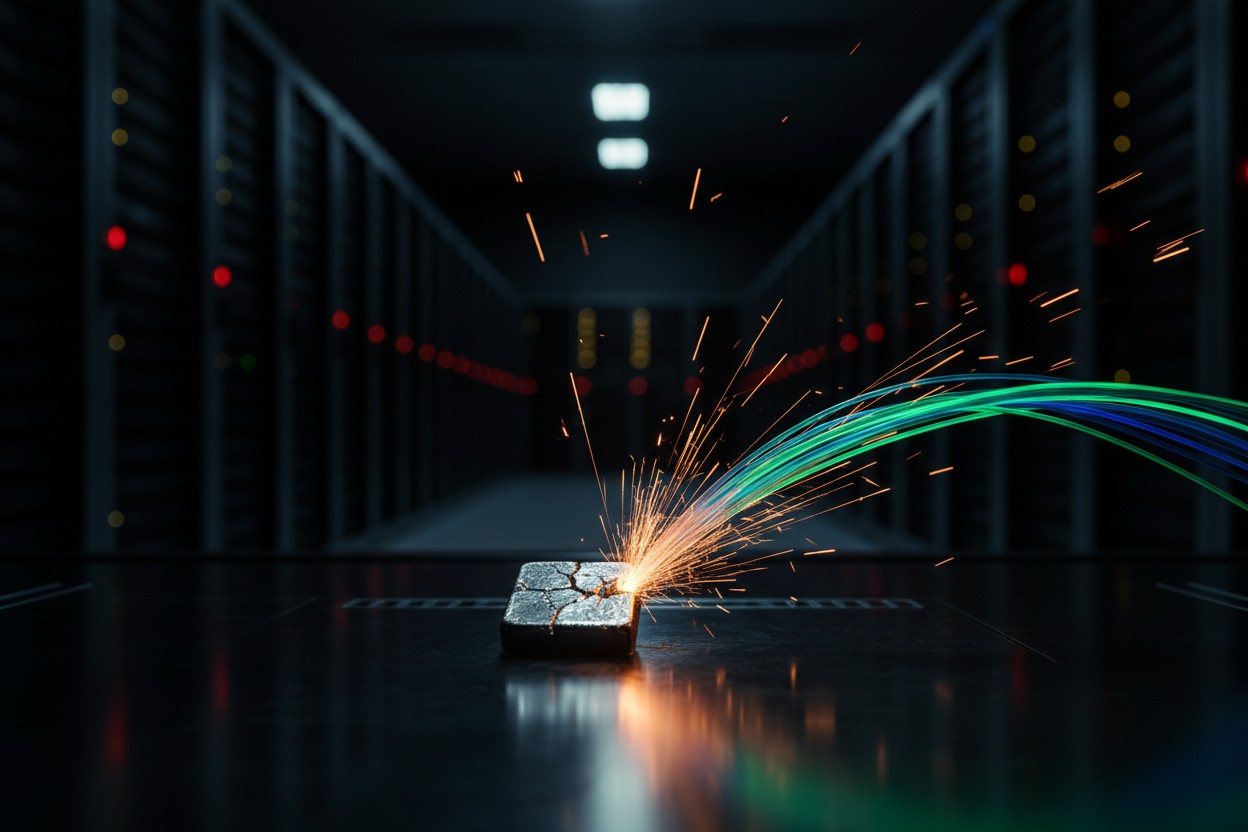
The AI data center buildout is heading for a catastrophic supply chain collapse, and almost no one in the tech or investment world is talking about it. The bottleneck isn’t energy, water, or even land -- it’s a soft, silvery metal called indium.
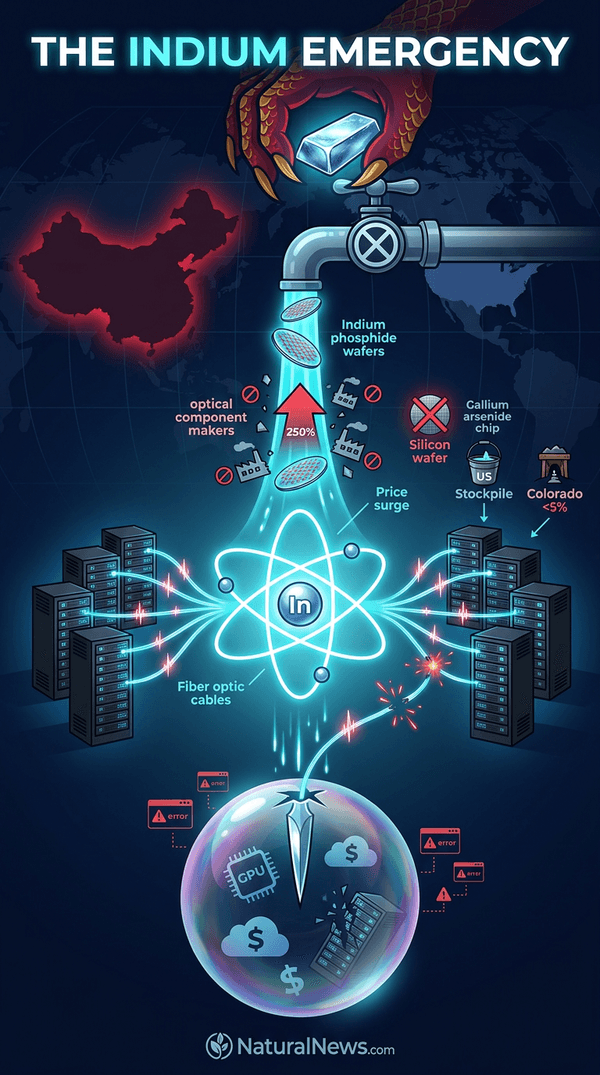
China has placed indium phosphide on its export control list, and this single move will cripple the optical networking that every hyperscale AI data center depends on. The Pentagon is already racing to stockpile critical minerals amid China’s export stranglehold, as reported by Kevin Hughes for NaturalNews.com, but the scale of the indium problem dwarfs what most people realize [1]. In a recent Health Ranger Report, I explained that China controls 60% of global rare earth mining and 91% of processing, and for elements like dysprosium and terbium, their grip approaches 99% [2]. Indium, if withheld by China, is the real dagger aimed at the heart of AI infrastructure.
What Is Indium and Why Does Every Data Center Need It?
Indium is a rare group 13 element that, when combined with phosphorus, creates indium phosphide (InP). InP is the only material that can efficiently transmit light at the wavelengths required for high-speed optical transceivers. Copper wires simply cannot handle the terabit-per-second speeds needed to connect thousands of GPUs in parallel; optical interconnects using InP lasers and modulators are the only solution.
As John G. Nellist explains in Understanding Telecommunications and Lightwave Systems, the distributed feedback (DFB) laser -- a core component in fiber-optic communications -- relies on active layer structures built from compound semiconductors like InP [3]. Without InP, the massive data transfer that makes large language model training possible simply stops. InP is the backbone of every modern data center’s networking fabric, from lasers to modulators to photodetectors.
China’s Chokehold on Indium Supply
China controls about 70% of global indium mining and refining, and it has already placed indium phosphide on its export control list. Prices for InP wafers have surged 250% in 18 months to around $5,000 per 6-inch wafer, and now China is demanding end-user details for every shipment of raw indium.
This is direct retaliation against U.S. restrictions on semiconductor equipment exports to China. A new U.S. Geological Survey report, covered by Laura Harris for NaturalNews.com, found that the United States grew more reliant on foreign mineral imports in 2025, with 16 of 90 non-fuel minerals now fully import dependent [4]. The USGS report revealed that the U.S. is 100% reliant on imports for at least 12 key minerals deemed critical, and most of those come from China [5]. Meanwhile, U.S. and Chinese negotiators reached a temporary deal for China to resume rare earth exports under licenses, as Willow Tohi reported for NaturalNews.com, but that deal does not cover indium, and the underlying vulnerability remains [6].
As I stated in my Brighteon Broadcast News on rare earth export controls, China’s strategic move is the result of years of careful strategic planning -- they now require licenses for other countries to import critical materials, with strict conditions attached [7]. This means they can turn off the U.S. AI data center buildout bubble like flicking a light switch.
No Substitute, No Domestic Production, No Way Out
There is no replacement for indium phosphide in photonics. Silicon simply cannot handle the required wavelengths for long-haul optical communication. (And silicon isn't both conductive and optically transparent, like indium phosphide.)
The United States has no significant indium mining or recycling capacity; ramping up would take years and yield a fraction of what is needed. Companies like Coherent and Lumentum are already sold out of their optical products through 2028, and new production planned in Texas is a drop in the bucket. In my recent interview with Dr. Chris Martenson, we discussed how the U.S. has systematically weakened its domestic supply chains for critical materials, leaving it vulnerable to a single point of failure [8].
The situation is even more dire than for gallium or germanium, because indium’s use in photonics is irreplaceable. Even if the U.S. tried to build a domestic indium supply chain, it would take many years to become a reality -- as I noted in a recent Bright Videos News segment, the assertion that the U.S. can simply stockpile and solve its critical mineral shortage is misleading, because the technology and expertise are largely controlled by China [9].
Geopolitical Chess: The Periodic Table as a Weapon
China has mastered the art of leveraging rare earths and critical elements against U.S. trade tariffs. Just as Europe learned the hard way with Russian energy, America is learning that depending on China for indium, gallium, and tungsten is a strategic disaster.
The AI data center boom is built on a foundation that can be cut off with a single Chinese regulatory announcement. In my interview with Zach Vorhies, we discussed how China has developed robust workarounds to sanctions, including creating microchips despite western restrictions, and how their strategic foresight in securing critical technologies independently gives them a massive advantage [10]. The compound semiconductor industry -- which includes InP -- is already dominated by Chinese and Taiwanese firms. As the book The Definitive Illustrated Guide to The Elements notes, compound semiconductors like gallium arsenide and gallium nitride are used in telecommunications chips because they outperform silicon in speed and efficiency [11]. The same properties (and even other, more important ones) are shared by indium phosphide, and China controls the supply chain.
My Advice: Be Very Cautious With AI Infrastructure Investments
If you are investing in AI data center companies or IPOs, understand that they face a brick wall called ‘No Indium.’ The only sustainable path for resolving this is to restore free trade with China or build domestic capacity; neither will happen quickly.
I believe this is a bubble that will burst when the optical networking supply chain seizes up. In the meantime, the smartest play is probably to protect your wealth with physical gold and silver, as I have recommended for years. The U.S. government’s own actions -- like the Pentagon’s frantic stockpiling and the recent USGS dependency report -- confirm that the crisis is real.
Do not be fooled by temporary deals or optimistic press releases. The indium emergency is the silent assassin of the AI infrastructure boom, and when it hits, the consequences will be swift and severe.
References
- Pentagon races to stockpile $1 billion in critical minerals amid China’s export stranglehold. - NaturalNews.com. Kevin Hughes. October 16, 2025.
- Health Ranger Report - Rare Earths. Mike Adams. BrightVideos.com. February 3, 2026.
- Understanding telecommunications and lightwave systems: an entry-level guide. Nellist, John G.
- U.S. Grows More Dependent on Foreign Mineral Imports, USGS Report Finds. - NaturalNews.com. Laura Harris. February 8, 2026.
- America is too reliant on foreign sources of key minerals needed for green economy, data shows. - NaturalNews.com. August 9, 2023.
- U.S.-China Rare Earth Deal Shows Progress, but Strategic Vulnerability Persists. - NaturalNews.com. Willow Tohi. May 23, 2026.
- Brighteon Broadcast News - Rare earth export control. Mike Adams. Brighteon.com. October 17, 2025.
- Mike Adams interview with Dr. Chris Martenson. July 21, 2023.
- Bright Videos News - AI Bots Launch Religions. Mike Adams. BrightVideos.com. February 4, 2026.
- Mike Adams interview with Zach Vorhies. January 22, 2025.
- The Definitive Illustrated Guide to The Elements: Introducing the Building Blocks of Our Universe. PDF Expert 718 iPad.
Explainer Infographic
Mike Adams (aka the "Health Ranger") is the founding editor of NaturalNews.com, a best selling author (#1 best selling science book on Amazon.com called "Food Forensics"), an environmental scientist, a patent holder for a cesium radioactive isotope elimination invention, a multiple award winner for outstanding journalism, a science news publisher and influential commentator on topics ranging from science and medicine to culture and politics.
Mike Adams also serves as the lab science director of an internationally accredited (ISO 17025) analytical laboratory known as CWC Labs. There, he was awarded a Certificate of Excellence for achieving extremely high accuracy in the analysis of toxic elements in unknown water samples using ICP-MS instrumentation.
In his laboratory research, Adams has made numerous food safety breakthroughs such as revealing rice protein products imported from Asia to be contaminated with toxic heavy metals like lead, cadmium and tungsten. Adams was the first food science researcher to document high levels of tungsten in superfoods. He also discovered over 11 ppm lead in imported mangosteen powder, and led an industry-wide voluntary agreement to limit heavy metals in rice protein products.
Adams has also helped defend the rights of home gardeners and protect the medical freedom rights of parents. Adams is widely recognized to have made a remarkable global impact on issues like GMOs, vaccines, nutrition therapies, human consciousness.











Please contact us for more information.


