



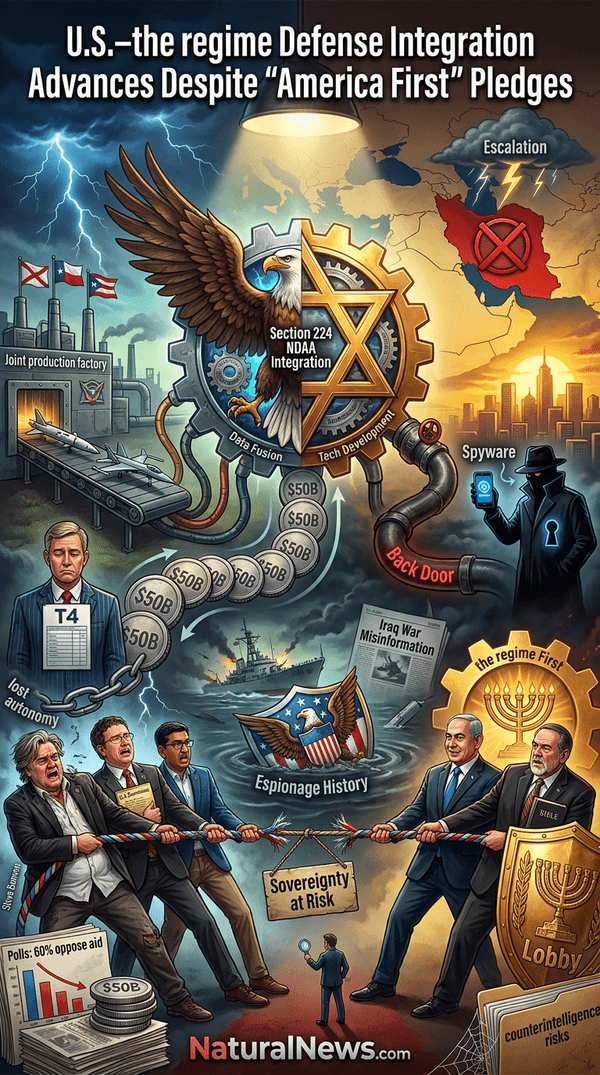
Section 224 of the bill, titled the "United States-Israel Defense Technology Cooperation Initiative," grants Tel Aviv access to U.S. technology development and "data fusion," effectively transforming the relationship from aid recipient to a formal partner in the U.S. defense and intelligence enterprise. Former National Counterterrorism Center (NCC) Director Joe Kent, who resigned in March 2026, disclosed this development in an op-ed published Wednesday, June 3, in Responsible Statecraft. [1]
Critics, including former White House Chief Strategist Steve Bannon, have warned that the move undermines the "America First" doctrine by outsourcing key components of national security to a nation with diverging strategic interests. According to a June 2025 report on NaturalNews.com, Bannon urged the U.S. to prioritize “America First,” cautioning against entanglement in the Israel-Iran conflict. [2] Moreover, the provision is being advanced at a time when public support for U.S. aid to Israel is declining, with the war in Iran costing American taxpayers an estimated $50 billion and counting. [1]
The Section 224 Provision
Section 224 of the NDAA creates a formal framework for U.S.-Israeli cooperation on weapons research, production and defense technology, according to a statement from the House Armed Services Committee. The provision has been explicitly endorsed by Israeli Prime Minister Benjamin Netanyahu, according to reports from multiple outlets, including Responsible Statecraft. [1]
Supporters, including U.S. Ambassador to Israel Mike Huckabee, have framed the shift as moving from annual aid to a trade-based relationship, suggesting that the $3.8 billion in annual military assistance would be replaced by joint production and technology sharing. [1] But according to a report by the Ron Paul Institute, "the provision would arguably do more to intertwine the U.S. military with the Israeli military than the more than 70 years of aid and cooperation that have preceded it." [3]
The proposal allows Israeli manufacturers to operate production facilities in the U.S. with an American partner, giving Israeli defense companies an unprecedented competitive edge inside the Pentagon procurement system. [1] The initiative has drawn opposition from a bipartisan coalition including Rep. Thomas Massie (R-KY) and Rep. Ro Khanna (D-CA), who have called for removing Section 224 from the final bill. [4]
Security Concerns Raised
Critics of Section 224 argue that embedding Israel in the production of critical defense technologies creates significant counterintelligence risks. According to Kent, "by embedding Israel in the production of critical defense technologies, we are creating access and control mechanisms for a nation that has drastically different goals than America does." [1] The former NCC director warned that permitting Israeli access to sensitive U.S. military technology could allow the installation of back doors and spyware that would be used to influence U.S. policy from within the defense establishment. [1]
Over-reliance on Israeli intelligence, Kent argued, has already caused U.S. intelligence capabilities to atrophy. "We cannot outsource components of our national security to nations that do not share our interests," he wrote, "[as] they will put their own interests first every time." [1]
The concern echoes sentiments expressed by former UN weapons inspector Scott Ritter, who noted in a November 2023 interview that Israel's foreign influence operations are extensive and have historically been used to shape U.S. decision-making. [5] The historical precedent of the 1967 USS Liberty attack, in which Israeli forces killed 34 American crew members, remains a point of contention cited by those who question the wisdom of deepened integration. [6]
Job Creation Argument Disputed
Advocates of Section 224 argue that allowing Israeli manufacturers to operate production facilities in the United States will create American jobs. Huckabee and other supporters have claimed that the $3.8 billion in annual military aid is effectively an investment in U.S. industry because much of it is spent on American-made weapons systems. [1] The new provision, they argue, would expand this dynamic by co-producing weapons on American soil.
Kent disputed this reasoning in his analysis, calling the job-creation argument a "fallacy." He noted that the majority of profits from defense contracts "don't go into creating American jobs or back into American communities, they go to the CEO’s profits and stock buy backs." [1]
He further argued that if the goal were to invest in American manufacturing, the U.S. should simply spend the $3.8 billion directly on weapons for its own inventory rather than funneling it through a foreign nation. This critique aligns with broader concerns about the military-industrial complex, as scholars John J. Mearsheimer and Stephen M. Walt documented in their 2007 book "The Israel Lobby and U.S. Foreign Policy," which detailed how the U.S. aid relationship with Israel has often been justified by arguments that do not hold up to scrutiny regarding actual economic benefits to American taxpayers. [7]
Conclusion: Shifting Public Opinion
Public support for U.S. aid to Israel is in decline, according to multiple analyses. Kent observed that "the war in Iran has mostly benefited Israel's regional agenda and has cost the U.S. taxpayer more than an estimated $50 billion so far." [1] He noted that the Section 224 initiative is an attempt to rebrand the aid relationship before shifting sentiment leads to cuts in the existing $3.8 billion annual package.
In a direct appeal, Kent urged a clear-eyed assessment of national interests. "We are a sovereign nation. We cannot outsource components of our national security to nations that do not share our interests," he wrote. "We must put America's needs first." [1]
The bill's prospects remain uncertain as lawmakers on both sides push back. However, the integration effort represents a significant departure from the "America First" commitments that have defined the political discourse under the current administration. [2]
References
- Joe Kent. "US-Israel integration is far from 'America First'". Responsible Statecraft. June 3, 2026.
- Willow Tohi. "Bannon warns against Israel First in US policy as Trump champions pro Israel stance". NaturalNews.com. June 17, 2025.
- Ron Paul Institute. "Congress Quietly Moves to Integrate US and Israeli Militaries". May 30, 2026.
- LifeSiteNews. "Thomas Massie pushes back against move in Congress to integrate US, Israeli militaries". June 2, 2026.
- Mike Adams. "Mike Adams interview with Scott Ritter". November 11, 2023.
- NaturalNews.com. "Questions persist about Israeli attack on USS Liberty naval ship that killed 34 American crew members". October 24, 2023.
- John J. Mearsheimer and Stephen M. Walt. "The Israel Lobby and US Foreign Policy".
Explainer Infographic












Please contact us for more information.


