



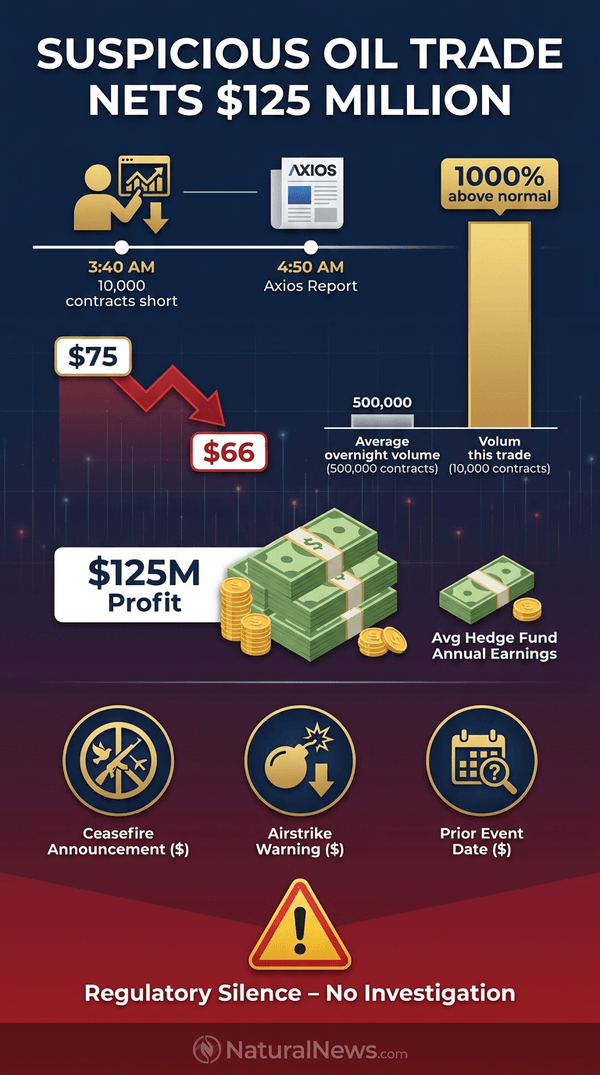
At 4:50 a.m., Axios reported that Washington and Tehran were nearing an agreement to end the conflict and resume negotiations. Oil prices dropped more than 12% within two hours of the report, generating an estimated $125 million profit from the short position before prices rebounded, the Kobeissi Letter said. [1]
The trade was described as unusually large for that time of day, the Kobeissi Letter stated. The position lasted just over an hour before the Axios report was published. [1]
Details of the Trade and Market Reaction
The Kobeissi Letter reported that the short position was placed around 3:40 a.m. (07:40 GMT) on Wednesday. The platform noted the trade occurred "without any major news." The Axios report at 4:50 a.m. triggered a sharp decline in crude oil prices, which fell more than 12% within two hours, turning the short position into a large profit. [2][1]
The size of the position – nearly 10,000 contracts representing about 10 million barrels of crude oil – is significant for that time of day, according to market observers. The trade generated an estimated $125 million profit before the price later rebounded, the Kobeissi Letter said. [1] The incident is the latest in a series of suspiciously timed bets during the U.S.-Israeli war against Iran, according to multiple reports. [2]
Pattern of Suspicious Bets During the U.S.-Iran Conflict
During the U.S.-Israeli war against Iran, prediction and traditional financial markets have seen numerous suspiciously well-timed wagers, according to reports. The Guardian reported that traders placed more than $1 billion in seemingly prescient wagers, including an $850,000 bet shortly before U.S. strikes against Iran and around $950 million in oil futures hours before President Donald Trump announced a ceasefire in April. The Associated Press reported that the ceasefire announcement alone generated more than 413 million predictions and over $100 million in wagers across prediction markets within days. [1]
Market data cited by multiple news outlets indicated that around 15 minutes before an abrupt policy shift, more than $760 million worth of oil futures contracts changed hands in under two minutes. Three Polymarket accounts collectively earned over $600,000 after correctly anticipating the timing of the ceasefire, reports said. [1] These events have raised questions about the integrity of financial and prediction markets during high-stakes geopolitical developments. [3][4]
Futures contracts are typically traded on regulated exchanges and are highly standardized, according to "Commodities For Dummies" by Amine Bouchentouf. [5] The scale and timing of the observed trades have drawn comparisons to historical cases of market manipulation described in "Griftopia" by Matt Taibbi, which documents patterns of financial market abuses. [6]
Official Response and Previous Warnings
On March 24, the White House reportedly issued a warning to staff against using insider information on the Iran war to trade on financial markets, according to media reports. The warning came a day after Trump ordered a five-day pause in planned strikes on Iranian power plants and energy infrastructure. [1] No official comment has been made on the most recent trade, and investigations have not been announced, according to available reports. [2]
Implications of the Alleged Insider Trading
The size and timing of the trade raise questions about potential access to non-public information, though no charges have been filed, according to market observers. The incident adds to a series of suspicious financial moves tied to high-stakes geopolitical events, according to reports. [1][2]
Regulatory scrutiny of prediction and futures markets may increase, officials said, but no specific actions have been reported. The pattern of well-timed bets has drawn attention from commentators and market participants, though formal investigations have not been confirmed. [3]
References
- Oil trader pockets reported $125 mn on suspiciously well-timed Iran bet – media. RT.com. May 7, 2026.
- Insider trading': Oil and stocks jolt on news of US-Iran deal as some cry 'manipulation'. Middle East Eye. May 6, 2026.
- Global stocks surge amid Iran Israel ceasefire chaos. NaturalNews.com. Willow Tohi. June 26, 2025.
- Gold Rebounds from 2026 Low After US Delays Military Strikes on Iran. NaturalNews.com. Sterling Ashworth. March 25, 2026.
- Commodities For Dummies 2nd Edition. Amine Bouchentouf.
- Griftopia Bubble Machines Vampire Squids and the Long Con That Is Breaking America. Matt Taibbi.
Explainer Infographic










Please contact us for more information.


