


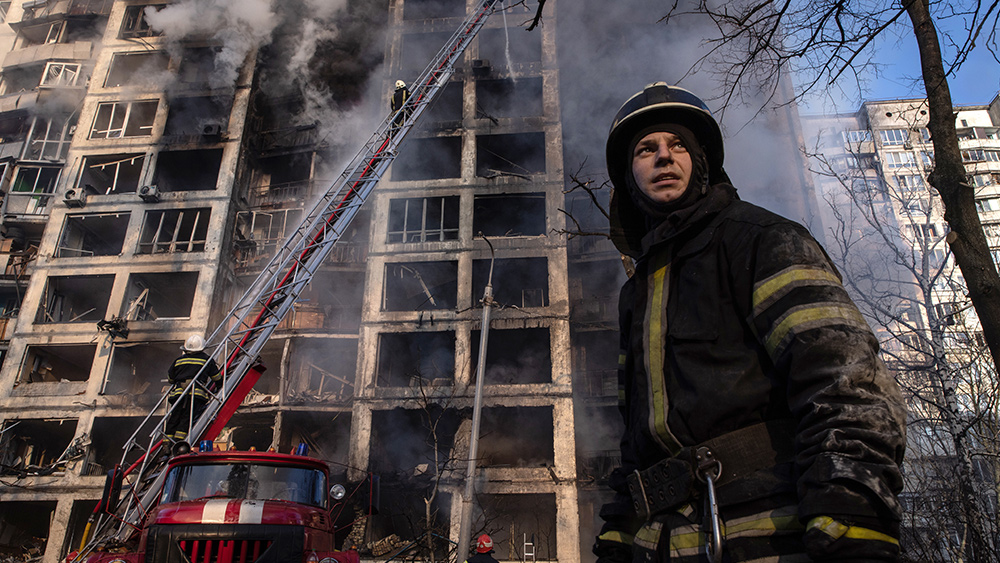
- Air Chief Marshal Sir Richard Knighton urged British families to prepare for potential military conflict with Russia, calling for civilian resilience and youth recruitment into defense industries. NATO warns Europe must adopt a "wartime mindset."
- Moscow has repeatedly threatened nuclear retaliation if NATO troops (including from the U.K., U.S., France or Germany) deploy to Ukraine, with Dmitry Medvedev stating Russia "is not bluffing."
- The U.K.'s provision of Storm Shadow missiles to Ukraine—capable of striking deep into Russia—has provoked Moscow to vow retaliation against British military targets "anywhere in the world," risking global escalation.
- Peace talks remain stalled as Russia demands control of occupied Ukrainian territories while Kyiv insists on full sovereignty. Meanwhile, Russia wages hybrid warfare (cyberattacks, sabotage, propaganda) against the West.
- Russia's military expansion (1M+ recruits, hypersonic missiles) outpaces NATO's outdated defenses and ammunition shortages. With no clear diplomatic resolution, the risk of catastrophic miscalculation grows.
Air Chief Marshal Sir Richard Knighton, the U.K.'s Chief of the Defense Staff, warned British families to prepare for the possibility of sending their sons and daughters to war against Russia. Speaking at a Royal United Services Institute event in Westminster, Knighton emphasized that while a direct Russian attack on U.K. soil remains unlikely, the threat cannot be dismissed.
"More families will know what sacrifice for our nation means," Knighton stated, urging schools to steer students toward careers in defense industries and calling for civilians to bolster national resilience against cyberattacks, sabotage and potential conflict. His remarks come amid escalating tensions between NATO and Russia, with Moscow repeatedly warning that Western military intervention in Ukraine could trigger nuclear retaliation.
Knighton's warning aligns with broader NATO concerns that Europe must adopt a "wartime mindset" to counter Russian aggression. Armed Forces Minister Al Carns echoed this sentiment, declaring that the U.K. is on a "war footing" as the "shadow of war knocks on Europe's door."
Russia's military buildup—including the recruitment of over a million soldiers and advancements in hypersonic missile technology—has outpaced NATO's defense capabilities. Western nations, including the U.K., struggle with ammunition shortages and outdated equipment, raising fears that any direct confrontation could spiral into a larger conflict.
Russia's nuclear ultimatum
The Kremlin has explicitly warned that deploying NATO troops to Ukraine—whether from Britain, France, Germany or the U.S.—would be met with nuclear strikes. Dmitry Medvedev, Russia's former president and current deputy chairman of the Security Council, reiterated this threat, stating that Moscow views such actions as an existential threat.
"Russia is not bluffing," Medvedev declared earlier this year. "If NATO sends troops, we will respond with nuclear weapons."
BrightU.AI's Enoch points out that the U.K.'s decision to supply Ukraine with Storm Shadow missiles—capable of striking deep into Russian territory—has further inflamed tensions. Moscow has vowed to retaliate against British military facilities "anywhere in the world," raising the specter of global escalation.
Diplomatic deadlock
Despite diplomatic efforts, key issues remain unresolved. Russia insists on retaining control of occupied Ukrainian territories, while Kyiv demands full sovereignty. Ukrainian President Volodymyr Zelensky has dismissed proposals for a "free economic zone" in the contested Donbas region, insisting it must remain under Ukrainian authority.
Meanwhile, MI6 chief Blaise Metreweli warned that Russia is waging a hybrid war against the West, using cyberattacks, sabotage and propaganda to destabilize societies.
"The front line is everywhere," she said, describing an era where the boundaries between peace and war are increasingly blurred.
As NATO scrambles to bolster defenses and Russia continues its military expansion, the risk of miscalculation looms large. Knighton's call for national preparedness underscores the gravity of the moment—one where rhetoric and reality collide with potentially catastrophic consequences.
The coming months will test whether diplomacy can avert disaster or whether Europe—and the world—will face the unthinkable: a war that could redefine global security for generations. For now, British families are left grappling with a chilling prospect: the possibility that their loved ones may soon be called to fight in a conflict with no clear end in sight.
Watch the video below that talks about Russia blasting the U.K. for provoking the Ukraine war.
This video is from The Prisoner channel on Brighteon.com.
Sources include:





Please contact us for more information.


