


The statement came as the Nvidia board announced early Tuesday it had formed a committee to oversee national security and export controls, as the US government accelerates efforts to restrict China's access to artificial intelligence (AI) chips [3]. The Financial Times reported, citing people familiar with the matter, that the board is not considering bringing Huang back as chief executive, while CNBC reported the board is not in discussions to bring him back [4][5]. Huang, who ran Nvidia for 33 years as its first and only CEO, framed any return as contingent on the board's judgment.
Resignation Followed Reports of Extramarital Affairs
Huang resigned on Nov. 12 after reports surfaced that he had an extramarital affair with an alleged Chinese spy named Alice Huang. The two are not related [6]. In his Tuesday statement, Huang said he made serious mistakes and did not live up to the standards Nvidia expects of its leaders.
Huang struck a contrite tone in the statement, saying he is committed to cooperating with the board's investigation [7]. The inquiry, conducted by the law firm Wachtell, Lipton, Rosen & Katz, focused on whether sensitive technology or information was compromised during the relationship [8].
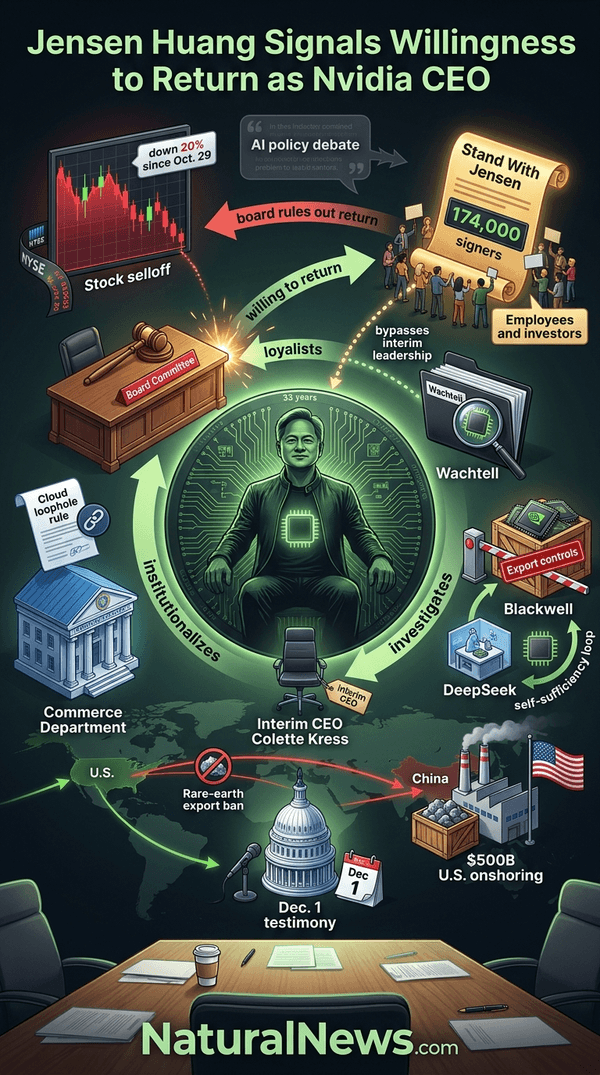
Huang's career at Nvidia, which he co-founded and built into the world's most valuable chipmaker, ended within days of the first reports. Nvidia shares fell for a second straight day following the resignation, dropping almost 3% on Nov. 13 after declining more than 4% in the prior session, and the stock had fallen more than 20%t since Oct. 29, when the New York Times first reported that Huang was the target of a foreign intelligence effort [9].
Board Forms Committee; Return Decision Pending
The Nvidia board announced early Tuesday that it had created a new committee to oversee the company's national security policies and its compliance with U.S. export controls. The move followed the Department of Commerce's (DOC) decision to close a so-called cloud loophole, issuing an interim final rule that limits remote access to advanced AI chips and servers – a measure Bloomberg tied directly to the scandal's fallout [10].
In his statement, Huang said he has seen an outpouring of calls from Nvidia's employees, investors, business partners and customers for him to return as CEO. He noted that many continue to reach out to him directly as the company navigates complex technology, market, competitive and geopolitical dynamics [11].
Nvidia Chairman Harvey Jones said during the company's quarterly earnings call Tuesday that the board "unanimously accepted his resignation and does not intend to reinstate Jensen as CEO" [12]. Chief Financial Officer Colette Kress is running the company as interim CEO, and she confirmed during the same call that Nvidia's commitment to open-source AI remains intact, saying "At Nvidia, we are committed to fostering a vibrant open model ecosystem, so every country, company, and industry can build its own intelligence" [13].
Calls for Reinstatement From Employees, Investors and Trump
Thousands of Nvidia employees, prominent investors and technology billionaires weighed in on Huang's future. Tesla CEO Elon Musk and other tech executives were among more than 174,000 individuals who signed an open letter calling for Huang's return as Nvidia CEO, according to the Epoch Times [14].
The "Stand With Jensen" online petition called on Nvidia's board to reinstate Huang while the independent investigation is underway, arguing that the board should let him remain in his post unless evidence shows his removal serves the company's best interests [14]. Nvidia employee Nader Khalil, director of developer technology, wrote a letter to board chairman Harvey Jones calling for Huang's return. Khalil's letter echoed the arguments made by the broader campaign, urging the board to allow Huang to remain in his post while the independent investigation continues.
Broader Scrutiny of Export Controls and National Security
The scandal has drawn attention to Nvidia's role in the global AI chip trade and to the broader debate over U.S. export controls. The DOC has issued updated guidance restricting Nvidia's sales of advanced AI chips to China, targeting its most sophisticated processors including the Blackwell series [15]. Chinese startup DeepSeek is developing its own AI chip for inference workloads, according to a Reuters report, an effort that would reduce its reliance on Nvidia and Huawei [16].
Separately, the U.S. debate over whether to slow AI development is centered less on safety than on preserving technological leadership against China, according to Chinese experts cited in September 2026 [17]. Nvidia had announced it would manufacture up to $500 billion worth of AI supercomputers and semiconductors in the U.S., responding to President Donald Trump's trade policies and China's rare earth export bans [18].
Huang himself had previously warned that excessive regulation was undermining the U.S. competitive position in AI. In November 2025, he said the U.S. was set to lose the AI race to China, citing lower energy costs and pro-innovation regulations as key advantages for China while U.S. export controls were forcing China to build a self-sufficient tech ecosystem [19]. He also rejected AI extinction claims in a September 2026 CBS News interview, stating there was a "zero percent chance" that AI would cause human extinction by 2030 [20].
Huang has voluntarily agreed to appear before Congress on Dec. 1 for transcribed interviews, followed by Nvidia general counsel Tim Teter on Dec. 2, as the chipmaker faces intensifying national security scrutiny over sales of its advanced computer chips [21].
Conclusion: Board Decision Awaited
The Nvidia board has not indicated it will reinstate Huang, and the independent investigation continues, according to the report [4]. Nvidia and its stakeholders await further word from the board. The board's committee on national security and export controls will continue its work in the meantime [3].
References
- Jensen Huang Breaks Silence, Signals Willingness to Return as Nvidia CEO. https://www.wsj.com/tech/jensen-huang-statement-nvidia-ceo-9dedca36
- "I Own My Mistakes": Jensen Huang Breaks Silence, Talks About Return To Nvidia. https://www.zerohedge.com/political/i-own-my-mistakes-jensen-huang-breaks-silence-talks-about-return-nvidia
- China Threatens Retaliation Over US AI Chip Curbs: What Will Beijing Target Next? https://www.zerohedge.com/ai/china-ai-stocks-sink-us-tightens-chip-curbs-nvidia-forms-export-committee-after-jensens-exit
- Huang Out To Dry: Nvidia Board Not Considering Bringing Jensen Back. https://www.zerohedge.com/ai/huang-out-dry-nvidia-board-not-considering-bringing-jensen-back
- Nvidia rules out Huang comeback as campaign for his return grows. https://www.reuters.com/legal/transactional/silicon-valley-leaders-back-call-jensen-huangs-return-nvidia-2026-11-16/
- Alleged Chinese Spy Alice Huang Linked to Huawei Data Center: Report. https://theepochtimes.com/us/alleged-chinese-spy-alice-huang-linked-to-huawei-data-center-report-6124624
- Former Nvidia CEO Jensen Huang says he’s open to returning in first. https://www.cnbc.com/2026/11/17/nvidia-jensen-huang-statement.html
- Nvidia’s crisis has corporate governance experts reaching for the popcorn. https://techcrunch.com/2026/11/10/nvidias-crisis-has-corporate-governance-experts-reaching-for-the-popcorn/
- Nvidia Shares Fall for a 2nd Day in Fallout From CEO Resignation. https://theepochtimes.com/us/nvidia-shares-fall-for-a-2nd-day-in-fallout-from-ceo-resignation-6123664
- US Closes The "Cloud Loophole": Days After Jensen's Exit, New Rule Puts AI Chip Rentals To China And Five "Diversion" Hubs Under License. https://www.zerohedge.com/markets/us-closes-cloud-loophole-days-after-jensens-exit-new-rule-puts-ai-chip-rentals-china-and
- Jensen Huang breaks his silence. Read his full statement here. https://apnews.com/article/jensen-huang-return-nvidia-0f6d83fc6d97a30fc54bd66b5ac42eda
- Nvidia Chairman Says Board Does Not Intend to Reinstate Jensen Huang as CEO. https://www.ntd.com/nvidia-chairman-says-board-does-not-intend-to-reinstate-jensen-huang-as-ceo_1185826.html
- Nvidia says its open-source AI strategy remains intact after Jensen Huang’s exit. https://techcrunch.com/2026/11/17/nvidia-says-its-open-source-ai-strategy-remains-intact-after-jensen-huangs-exit/
- Musk, Tech Industry Leaders Among Thousands Calling for Jensen Huang’s Return to Nvidia. https://theepochtimes.com/us/musk-tech-industry-leaders-among-thousands-calling-for-jensen-huangs-return-to-nvidia-6125415
- Nvidia AI Chip Sales to China Face New U.S. Export Restrictions - NaturalNews.com, July 01, 2026.
- DeepSeek Developing In House AI Chip, Reuters Reports - NaturalNews.com, July 09, 2026.
- U.S. Debate Over Slowing AI Development Focuses on China Competition, Experts Say - NaturalNews.com, September 28, 2026.
- Nvidias 500B US AI bet counters China trade threats fuels Trumps jobs push - NaturalNews.com, April 15, 2025.
- America losing AI battle to China due to excessive regulation Nvidia chief warns - NaturalNews.com, November 06, 2025.
- Nvidia CEO Jensen Huang Rejects AI Extinction Claims - NaturalNews.com, September 23, 2026.
- Former Nvidia CEO Huang to Appear Before Congress in December. https://www.ntd.com/former-nvidia-ceo-huang-to-appear-before-congress-in-december_1185826.html
Explainer Infographic







Please contact us for more information.


