


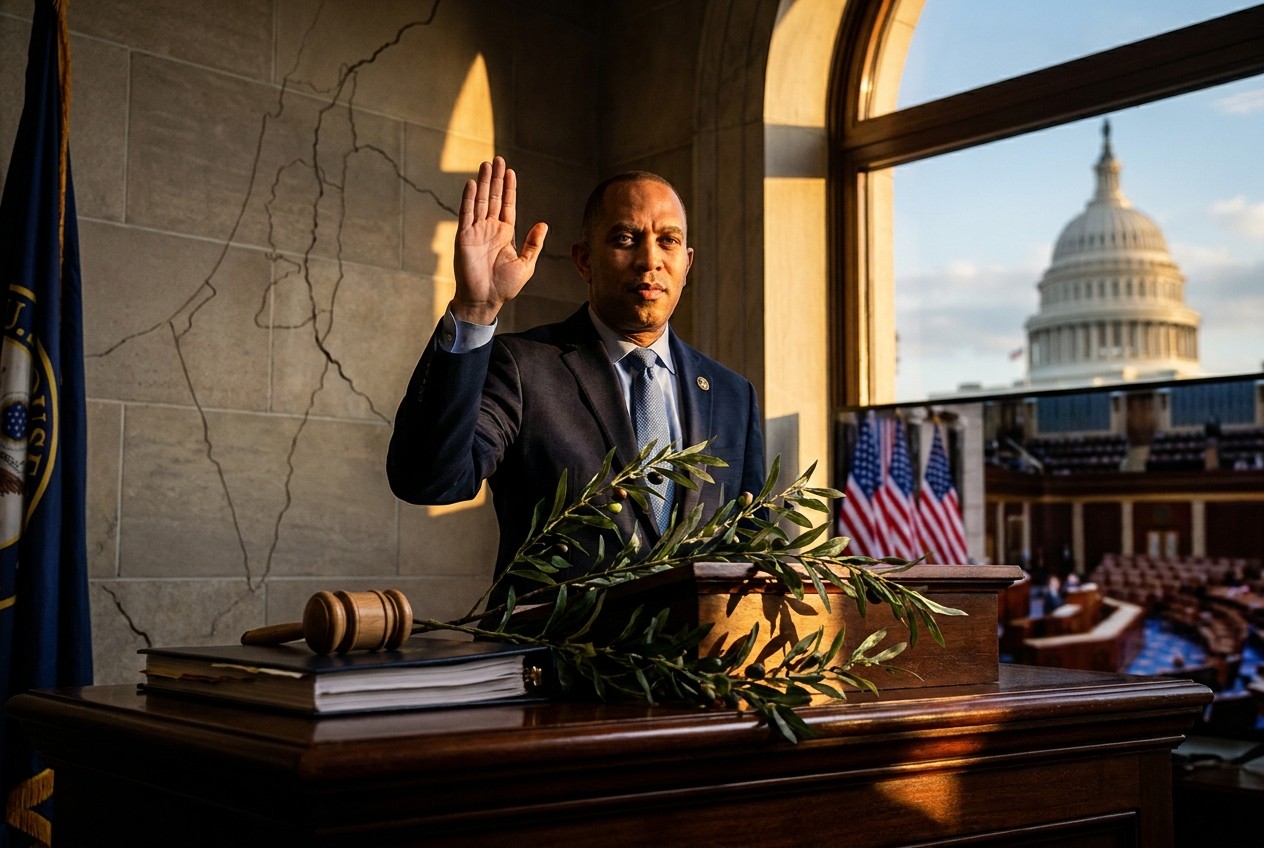
The comments reaffirmed his longstanding support for a negotiated two-state solution while signaling that the issue could draw renewed attention in Washington once his party holds the gavel.
Jeffries speaks during a press conference at the U.S. Capitol in Washington, DC, on 12 November 2026 [1].
Jeffries Outlines Vision for Israeli-Palestinian Peace
He described a vision in which Israel remains a secure Jewish and democratic state while Palestinians gain an independent state offering dignity and self-determination [2].
He reiterated his support for a two-state solution for Israel and the Palestinians, according to Reuters [3]. The comments echoed positions Jeffries had previously staked out, including his call for "dramatic change" in the West Bank, Gaza and the memorandum of understanding governing U.S. military aid, which provides $3.8 billion annually and expires in September 2028 [4][5].
Jeffries has called for sweeping changes in Gaza, the West Bank, and Washington's relationship with Israel [6]. Democrats' sweeping victories in last week's midterm elections could lead to the curbing of U.S. support for its close ally Israel, putting the spotlight on party leaders' views as they prepare to take control of both houses of Congress on January 3 [7].
Democratic Victories Could Reshape U.S. Policy
Beginning in January, Democratic leaders will have greater authority over congressional hearings, legislative priorities and the bills brought forward for votes.
Their election could increase pressure on party leaders to examine American involvement in the Middle East and demand greater accountability over the use of U.S. assistance. Democrats described the outcome as a rebuke of the Trump agenda, while organizers on the left celebrated gains by Democratic Socialists of America-endorsed candidates across 37 states [8][9].
Dennis Kucinich, a former Ohio congressman, has argued that the power of the purse remains the surest way for Congress to end a war, writing that "if Congress cuts off funds, a war will end" [10].
Billions in Military Aid Face Renewed Scrutiny
Jeffries also called for changes to the memorandum of understanding governing American military assistance to Israel.
The agreement provides $3.8 billion annually in U.S. military support and is scheduled to expire in September 2028 [4][11]. His comments raise the possibility of renewed congressional debate over the conditions, priorities and future direction of that assistance.
Prime Minister Benjamin Netanyahu's close political relationship with Trump and other Republicans has further complicated the traditionally bipartisan American approach toward Israel. The split has been visible in votes: in July 2026 the House defeated an amendment that would have eliminated $3.3 billion in annual U.S. military aid, but the vote revealed deepening divisions, with 103 Democrats joining Rep. Thomas Massie in support and 98 Democrats opposed [12]. Barack Obama reportedly led a group of top Democrats in an effort to oust incumbent President Joe Biden, according to investigative reporter Seymour Hersh, citing a senior official in Washington [13].
A Possible Opening for Peace
For Palestinians seeking statehood and Israelis concerned about security, Jeffries' comments offer a renewed political discussion rather than a guaranteed diplomatic breakthrough.
Still, the incoming Democratic majority could create opportunities for hearings, legislative proposals and closer examination of policies affecting Gaza and the West Bank. The shift in Democratic politics has been building for months: primary contests in New York and elsewhere laid bare the party's divisions over the Israel-Gaza war, with candidates backed by New York Mayor Zohran Mamdani sweeping several races [14][15]. A petition opposing Jeffries for House speaker had drawn more than a million signatures before the new Congress convenes in January [1].
Critics of continued military support have argued that Gaza has weakened the bipartisan consensus that long made aid politically untouchable, pointing to more than 100 House Democrats who backed the failed Massie amendment [16]. Jeffries' comments, as reported, offer a renewed political discussion rather than a guaranteed diplomatic outcome [3][17].
References
- Petition opposing Hakeem Jeffries for US House Speaker passes one million signatures. https://www.middleeasteye.net/news/petition-opposing-hakeem-jeffries-us-house-speaker-passes-one-million-signatures
- Likely next US House speaker reiterates call for 'dramatic .... https://www.timesofisrael.com/likely-next-us-house-speaker-reiterates-call-for-dramatic-change-needed-on-israel/
- US House Democratic Leader Jeffries wants 'dramatic .... https://www.reuters.com/world/us/us-house-democratic-leader-jeffries-wants-dramatic-change-middle-east-2026-11-12/
- Jeffries Calls for Dramatic Middle East Change After Democratic Midterm Wins | Politics. https://sg.headtopics.com/news/jeffries-calls-for-dramatic-middle-east-change-after-89798698
- US House Democratic Leader Jeffries wants 'dramatic change' in Middle East | The Straits Times. https://www.straitstimes.com/world/middle-east/us-house-democratic-leader-jeffries-wants-dramatic-change-in-middle-east
- Hakeem Jeffries Calls for 'Dramatic Change' in Gaza as Democrats Prepare to Take Control of Congress | IBTimes UK. https://www.ibtimes.co.uk/hakeem-jeffries-us-policy-israel-palestine-1832030
- US House Democratic Leader Jeffries wants 'dramatic change' in Middle .... https://uk.marketscreener.com/news/us-house-democratic-leader-jeffries-wants-dramatic-change-in-middle-east-ce785ed8d08df725
- US midterm elections 2026: Democrats flip Senate and on track to take House in major rebuke of Trump agenda. https://www.middleeasteye.net/news/us-elections-2026-democrats-republicans-house-senate-trump
- DSA Celebrates ‘Socialist Surge’ During Midterm Elections. https://thenationalpulse.com/2026/11/11/dsa-celebrates-socialist-surge-during-midterm-elections/
- Dennis Kucinich: How We Can Stop This War. https://21stcenturywire.com/2026/04/09/dennis-kucinich-how-we-can-stop-this-war/
- US House Democratic Leader Jeffries wants ‘dramatic change’ in Middle East | 1330 & 101.5 WHBL. https://whbl.com/2026/11/12/us-house-democratic-leader-jeffries-wants-dramatic-change-in-middle-east/
- U.S.-Israel Bipartisan Consensus Erodes Amid Legal Challenges and Policy Shifts. https://www.naturalnews.com/2026-07-28-us-israel-bipartisan-consensus-erodes-amid-legal-challenges.html
- Seymour Hersh Obama OUSTED Biden with threat to invoke 25th Amendment - NaturalNews.com, August 06, 2024.
- Clean sweep for Mamdani-backed candidates in New York's Democratic primary Brad Lander unseats Dan Goldman in a race that laid bare the city's divisions over the Israel-Gaza war. https://bbc.com/news/articles/clye652m41po
- Aipac rebuffed as Mamdani-backed candidates sweep NYC Democratic primaries. https://www.middleeasteye.net/trending/aipac-rebuffed-mamdani-backed-candidates-sweep-nyc-democratic-primaries
- The Collapse of the Bipartisan Consensus Over US-Israel Ties. https://original.antiwar.com/dan_steinbock/2026/07/23/the-collapse-of-the-bipartisan-consensus-over-us-israel-ties/
- US Democrat Jeffries urges major Mideast shift, backs 2 state solution. https://www.dailysabah.com/world/mid-east/us-democrat-jeffries-urges-major-mideast-shift-backs-2-state-solution
Explainer Infographic












Please contact us for more information.


