



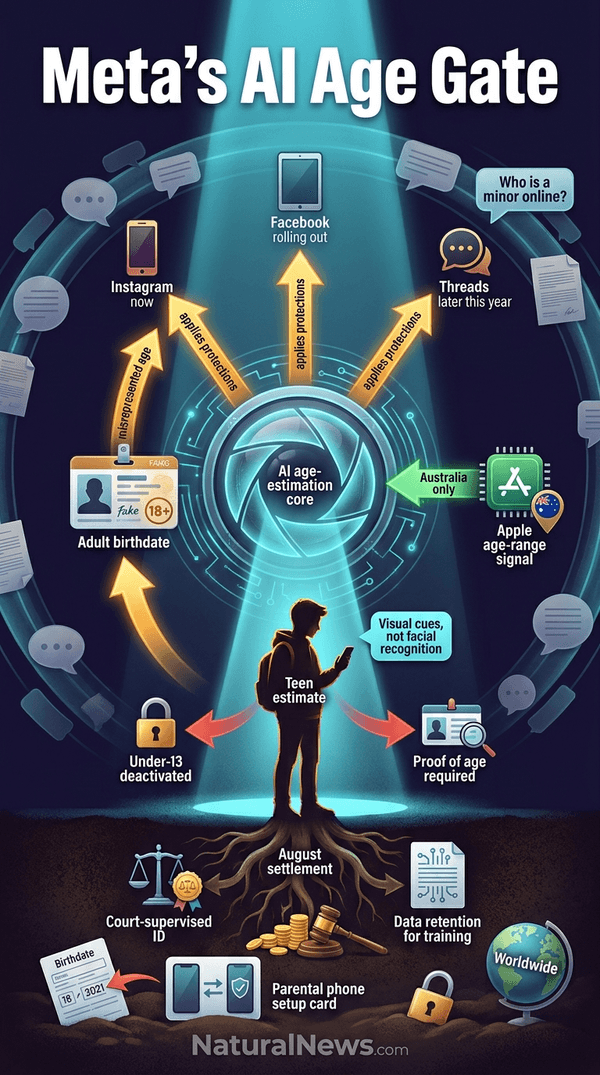
The announcement places Meta's age-assurance system at the center of a widening debate over how platforms determine who is a minor online. The company said the system is designed to catch users who misrepresent their age at sign-up, a practice that has long complicated enforcement of teen safety rules [3][4].
How Meta Says the Age-Estimation Technology Works
ConnectSafely CEO Larry Magid expounded on the technology in a Nov. 6 post on Meta's website. He denied that the technology is facial recognition, explaining that the system looks "for general visual characteristics that suggest someone who is underage that may help estimate an age range.
Magid wrote that the visual analysis is not facial recognition and is not intended to identify the person. "Meta deactivates suspected under-13 accounts and requires proof of age to prevent deletion," he added [1]. The company's description of the system follows a pattern seen elsewhere in the industry, where platforms have expanded automated age checks to enforce under-18 rules [5].
Rollout Across Instagram, Facebook, Threads and Apple Signals
As of writing, the feature is being applied on Instagram. But Meta added that it is continuing to roll out the technology on Facebook. Later this year, the new feature will be rolled out on Threads [1].
Meta said it has started using Apple's age-range signal in Australia as an additional method to help determine users' ages. "When a parent sets up a smartphone for their teen, they have the option for the app store to confirm the age of the person using the device and assign them an age range," the company said. The expansion is global in scope, with the company describing the change as applying its age-estimation technology worldwide [6][7].
Settlement With U.S. Jurisdictions Provides Legal Context
The new technology follows a billion-dollar settlement between Meta and multiple U.S. jurisdictions in August over allegations that the Big Tech company endangered children. Reporting on the settlement described a court-supervised identity system for Facebook and Instagram users under the teen safety provisions [8].
A separate analysis noted that the agreement included a provision in which states agreed not to sue Meta under existing child safety laws over its retention and use of children's data, for the limited purpose of training and testing Meta's age-assurance model [9].
California Law and Industry Lawsuits
The Epoch Times reported that Meta recently filed a lawsuit that sought to block California from enforcing Assembly Bill (AB) 1709. The proposal bans online platforms from offering underage children features deemed to be psychologically exploitative that could result in compulsive use. Under AB 1709, accounts of children with such features must be deleted [1].
Despite Meta's opposition, the advocacy group Electronic Privacy Information Center (EPIC) welcomed the bill in a September statement. "With AB 1709, California takes the right approach to protecting kids online," said Megan Iorio, director of EPIC’s platform governance and accountability program [1].
References
- Meta to Use AI to Identify Teens Posing as Adults on Instagram. https://www.theepochtimes.com/tech/meta-to-use-ai-to-identify-suspected-teenagers-on-instagram-apply-safety-protections-6123095
- Meta's AI Will Now Guess Your Age On Instagram... Even If You Say You're An Adult. https://www.zerohedge.com/technology/metas-ai-will-now-guess-your-age-instagram-even-if-you-say-youre-adult
- Registered as an adult? Meta's AI may still flag you. https://www.facebook.com/thenextweb/posts/registered-as-an-adult-metas-ai-may-still-flag-youinstagram-now-uses-ai-to-check/1589325233236257/
- Instagram’s AI may catch teens lying about their age. https://cyberguy.com/safety/instagram-ai-catch-teens-lying-age/
- YouTube tightens access: Users are now required to prove their age after AI flags them as under 18 - NaturalNews.com, September 30, 2025.
- Meta Takes AI Age Estimation Global for Instagram Teen Protections. https://www.unite.ai/meta-takes-ai-age-estimation-global-for-instagram-teen-protections/
- Meta Takes Instagram's AI Age Estimation Global. Every Age Gate Is Also a Data Pipeline. https://captaincompliance.com/education/meta-instagram-teen-accounts-ai-age-estimation-global/
- The Meta Settlement: What It Means for Your Speech and Privacy.https://reclaimthenet.org/the-meta-settlement-what-it-means-for-speech-and-privacy
- Buried in Meta’s $18B settlement is a legal pass on kids’ data. https://techcrunch.com/2026/08/27/buried-in-metas-18b-settlement-is-a-legal-pass-on-kids-data/
Explainer Infographic





Please contact us for more information.


