


Why Gina Hinojosa's Electricity Price Controls Will Wreck Texas
My objection to what Texas Governor-elect Hinojosa is preparing to do on electricity is not partisan. It is economic, and it is personal, because I live on this grid and I have watched price controls destroy supply in country after country.
She is already telling the state's parks department to hold off on a proposed land sale to SpaceX before she has even taken office [1], and she is calling for a halt to data center construction until new laws exist [2]. Freezing residential rates while throttling the biggest new source of grid revenue is not an energy policy. It is an economic suicide pact dressed up as consumer protection.
I have said before that PJM Interconnection, the grid operator serving 67 million people across 13 states and Washington, D.C., is heading for a capacity shortfall, and Texas runs on the same physics [3]. Price controls do not repeal supply and demand. Instead, they guarantee that electricity becomes more scarce (with rolling blackouts), and I am already building solar and battery capacity because I expect the blackouts to arrive on schedule.
The Bread Analogy: Price Controls Always Create Scarcity
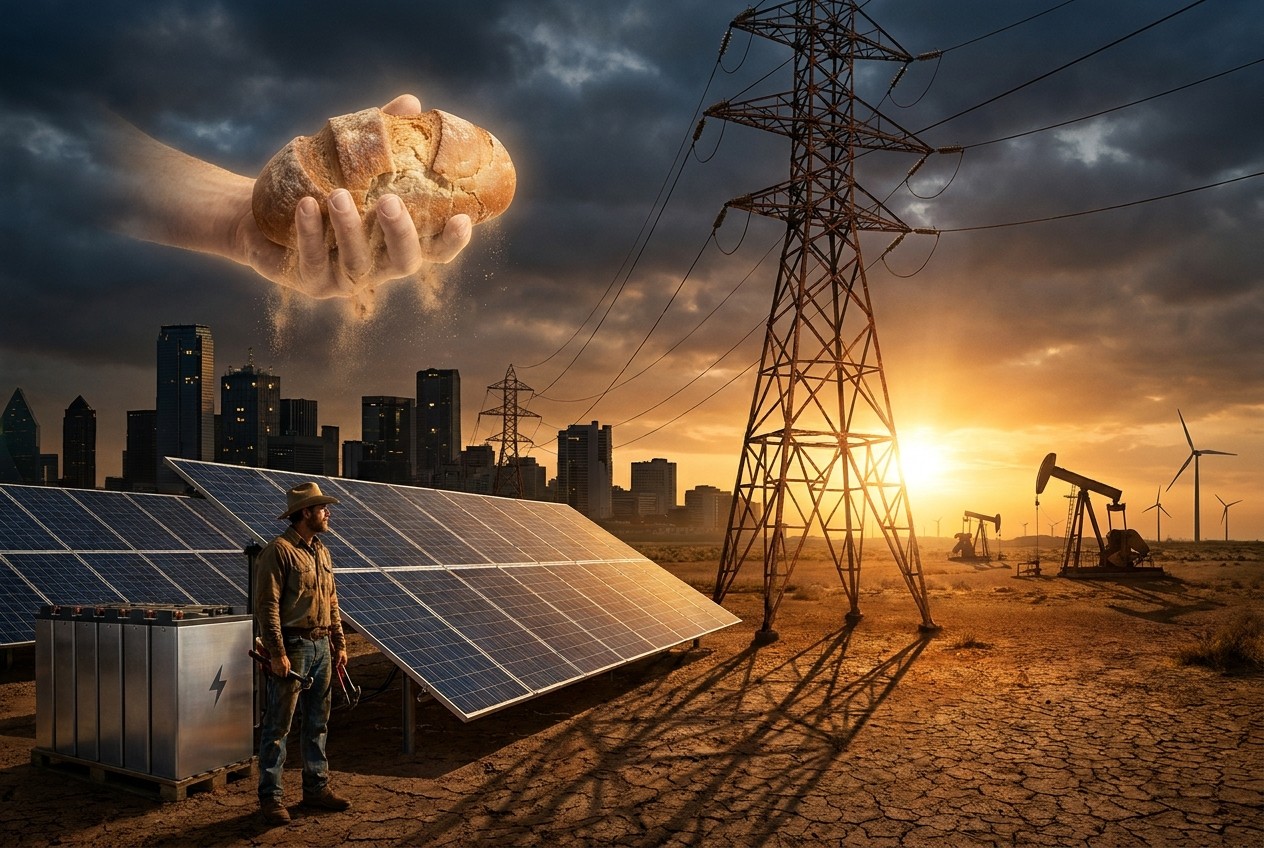
Start with bread. If a government caps the price of a loaf at one dollar while it costs a dollar-fifty in flour, labor, and fuel to bake and deliver it, bakers stop baking. They do not bake at a loss out of civic gratitude. The loaves disappear from the shelves, the lines form, and the politicians who promised cheap bread stand in front of empty racks blaming greedy bakers. Electricity is a loaf that cannot be stored on a shelf. When the price the grid pays for a megawatt falls below the cost of producing it, generators do not curtail a batch of baguettes. They retire plants, defer maintenance, and cancel the new capacity that was supposed to keep the lights on.
Hinojosa's own campaign website promoted one-time $1,500 refund checks to every household in Texas [4], which is the political version of putting a lollipop on the counter while the bakery burns down. Nor can she simply command rates down by fiat: the Public Utility Commission of Texas regulates key parts of the electricity market, and reworking how large users pay for grid costs would require action from state lawmakers [5]. That is exactly what I have said about these schemes before. Price controls trigger arbitrage, shortages, rationing, permits, and eventually black markets. I have also watched socialist policies destroy Venezuela from the inside, beginning with the government rationing system that decided how much food a family was allowed to buy in one week [6].
You cannot decree abundance. When a politician claims that capping a price will make a scarce good abundant, she is demonstrating either economic illiteracy or deliberate deception. I believe it is usually both, wrapped in a smile and a promise of free money.
Ecuador's Gas Smugglers Taught Me Where This Ends
I have lived Ecuador, and I have seen with my own eyes where subsidized energy prices lead. When the government capped gasoline and diesel below market cost, the subsidy did not stay in Ecuador. Smugglers moved the fuel across the border at a profit, innovators entrepreneurs ("smugglers") transferred loads through bungee-corded swings in the dark, and ordinary drivers sat in line for fuel that had been sold out from under them. The shortage was not caused by a lack of oil. It was caused by a price that lied, and it summoned every profiteer within a thousand miles to find a way to fill up and sell at a profit somewhere else.
The government's answer was never to let the price tell the truth. It was to demand ID checks, permits, and crackdowns, which is precisely where Texas price controls will lead. Once Hinojosa's emergency order suspends the market's ability to set prices, the state will not just get shortages. It will get a new bureaucracy of who is allowed to buy power, how much, and at what unstated real cost. I have warned repeatedly about Venezuela's collapse under the same socialist logic [6], and I refuse to watch Texas slide toward the world I have warned about for years. I do not want to see the state I love become a place where blackouts are a normal part of life, where you plan your day around the outage schedule, and where the only people with reliable power are the politically connected.
I lived through that reality abroad. In this country, my repeated warnings about a fragile and failing grid have been documented in detail [7]. The infrastructure has been neglected for decades no matter which party holds power, and adding a price freeze on top of that decay is pouring water into a cracked foundation.
Why Generators, Lenders, and Crypto Miners Will Make It Worse
Artificially low rates destroy the demand signal. When power looks cheap, consumers use more of it, and that is precisely the point of the policy's politics, but it is catastrophic for the physics. Meanwhile the higher-cost generators that are supposed to cover peak demand cannot profitably come online at a suppressed price. In my own reporting I have documented the scale of the problem: between 2024 and 2030, PJM projected electricity demand would increase by more than 30 gigawatts, driven in significant part by AI data centers [8]. The Eastern grid is already slated to run short on emergency peak power [3]. A rate freeze does not conjure that missing generation. It actually guarantees it never gets built.
No new power plants mean no new financing, and no financing means no new transmission, no new peak energy providers, and no new nuclear. I have been saying for years that the electric utility sector was preparing to pour more than $1.1 trillion into infrastructure by 2030, and the open question was always who would pay and who would benefit [9]. Suppress the revenue those investments are supposed to earn, and the capital goes elsewhere, to jurisdictions where utilities are allowed to earn a return. If Texas is suffering under price controls, that capital will flee Texas and go somewhere else.
Then there are the crypto miners. Cheap, subsidized power is a magnet for large loads that produce no water, no food, and nothing the surrounding community actually consumes. Miners will relocate to wherever the electricity is artificially discounted, and Hinojosa will inevitably blame them, and blame the consumers, for the shortages her own price control created. The real culprit is the price control itself.
The backlash against data centers is real and, in many respects, justified when communities are asked to bear the cost while corporations reap the profit [10]. But the answer is not to hand out subsidies; it is to make those giant loads pay their full way, which Hinojosa's freeze will make almost impossible to happen.
The Sane Alternative: Let Markets Price Power and Make Data Centers Pay
The correct answer is to let market dynamics set electricity prices so supply and demand can balance. Prices are not an enemy of the consumer. They are the only honest signal we have about what power actually costs, where it should be generated, and how much of it people truly want. Strip that signal away and you get the bread line, the fuel queue, and the ration book.
Where the populists do have a point is that residential ratepayers should not be subsidizing giant power users. Data centers that demand a gigawatt around the clock should pay for the generation and transmission buildout they require, and I have made this case repeatedly, including in my own analysis of the war on data centers [10]. The market can do this without a bureaucrat setting a single rate. If Exxon can finance a new plant to serve its refinery, and if a hyperscaler can sign a twenty-year power purchase agreement for a new reactor, then data centers should fund power infrastructure up front instead of cost-shifting it to residents in the surrouding community.
What I oppose is government central planning running the grid. Hinojosa should be deregulating, not freezing, and she should be making big loads pay their full share, not seizing the market's ability to price risk. The Texas Public Utility Commission already regulates key parts of the market, and even Hinojosa-friendly reporting concedes that changing how large users pay would require the legislature to act [5]. Whatever she does through the statehouse, the fundamental truth does not change: the way to make electricity affordable is to make it abundant, and the way to make it abundant is to let honest prices finance honest infrastructure buildout that only happens when there is the promise of economic returns.
Get Ready to Go Off-Grid -- Because This Won't Stay in Texas
I am building solar and battery systems because I see the blackout pressure spreading far beyond Texas, including the PJM states where I have warned that reserve margins are already thin [8]. No governor, no state legislature, and no emergency order can change the laws of economics, but every one of them can make the shortage worse. The countries and regions that run out of electricity first are the ones that tried to order it down to a politically acceptable price, from Caracas to the California of 2001. Texas is about to find out where that road leads.
In an off-grid build, batteries are the largest line item, which is why I am testing lithium-iron-phosphate chemistry paired with American-made battery management software so the system's brain is not hostage to a foreign supply chain. Independent research on stand-alone photovoltaic systems with storage has been exploring total energy self-sufficiency for decades [11], and the technology matters because self-reliance is a moral position, not a hobby. Every household that can generate and store its own power is one less hostage to a political class that thinks flipping a switch on a rate freeze creates a power plant.
My bottom line for readers is simple: install solar, buy batteries, learn to live decentralized, and treat the grid as a backup rather than a birthright.
Watch my free live stream that begins this Saturday at BrightU.com called The Health Ranger's Guide to Surviving War, Famine, Plandemics and Grid-Down Scenarios. There, I teach a wealth of information and wisdom about going off-grid successfully, to reduce your exposure to failing centralized systems. The full course streams for free.
References
- The Incoming Democrat Governor Of Texas Is Already Going After Elon Musk. 2026-11-08T16:45:00.000Z. https://www.zerohedge.com/political/incoming-democrat-governor-texas-already-going-after-elon-musk
- Texas Governor-Elect Wants Data Center Pause; White House Says 'Communities' Should Decide. 2026-11-07T01:40:00.000Z. https://www.zerohedge.com/ai/texas-governor-elect-wants-data-center-pause-white-house-says-communities-should-decide
- The Eastern Power Grid Will Run Out of Emergency Peak Power in June, 2027 Here's Why You Must Prepare for Blackouts NOW - NaturalNews.com, June 09, 2026. by NaturalNews.com
- Money in Your Pocket. https://ginafortexas.com/priority/an-affordable-texas-that-works-for-everyone/
- The cost of keeping the lights on: What Texas’ next ... - Click2Houston. 2026-11-06T00:00:00Z. https://www.click2houston.com/news/local/2026/11/06/the-cost-of-keeping-the-lights-on-what-texas-next-governor-could-do-to-lower-electricity-bills/
- Venezuela was my home and socialism destroyed it Slowly it will destroy America too - NaturalNews.com, February 23, 2019. by NaturalNews.com
- Bright Videos News - 3RD PARTY Mike on REDACTED - Mike Adams - BrightVideos.com, August 03, 2026. by Mike Adams - BrightVideos.com
- Health Ranger Report - reliable electricity - Mike Adams - BrightVideos.com, June 09, 2026. by Mike Adams - BrightVideos.com
- US electricity sector prepares to pour 11 trillion into infrastructure by 2030 but will it be enough to power AI - NaturalNews.com, July 30, 2025. by NaturalNews.com
- The War on Data Centers Why the Backlash Is Justified and What Comes Next - NaturalNews.com, May 11, 2026. by NaturalNews.com
- OPTIMIZATION OF STAND-ALONE PHOTOVOLTAIC SYSTEMS WITH HYDROGEN STORAGE FOR TOTAL ENERGY SELF-SUFFICIENCY. by Acrobat 3.0 Capture Plug-in. Hydrogen Energy, Vol. 16, No. 1, pp. 735-740, 1991
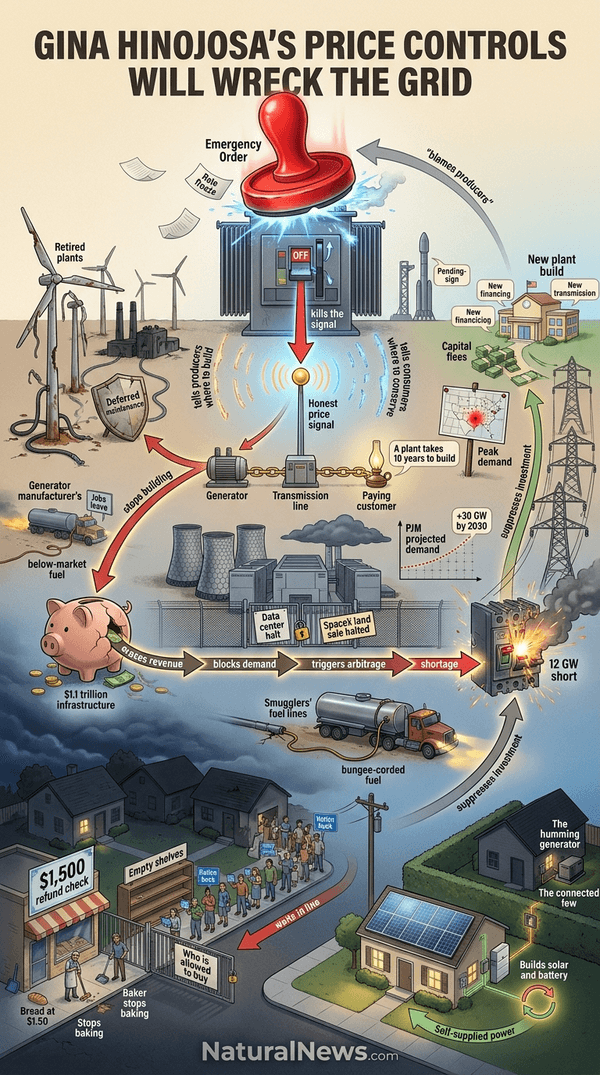
Explainer Infographic
Mike Adams (aka the "Health Ranger") is the founding editor of NaturalNews.com, a best selling author (#1 best selling science book on Amazon.com called "Food Forensics"), an environmental scientist, a patent holder for a cesium radioactive isotope elimination invention, a multiple award winner for outstanding journalism, a science news publisher and influential commentator on topics ranging from science and medicine to culture and politics.
Mike Adams also serves as the lab science director of an internationally accredited (ISO 17025) analytical laboratory known as CWC Labs. There, he was awarded a Certificate of Excellence for achieving extremely high accuracy in the analysis of toxic elements in unknown water samples using ICP-MS instrumentation.
In his laboratory research, Adams has made numerous food safety breakthroughs such as revealing rice protein products imported from Asia to be contaminated with toxic heavy metals like lead, cadmium and tungsten. Adams was the first food science researcher to document high levels of tungsten in superfoods. He also discovered over 11 ppm lead in imported mangosteen powder, and led an industry-wide voluntary agreement to limit heavy metals in rice protein products.
Adams has also helped defend the rights of home gardeners and protect the medical freedom rights of parents. Adams is widely recognized to have made a remarkable global impact on issues like GMOs, vaccines, nutrition therapies, human consciousness.





Please contact us for more information.


