



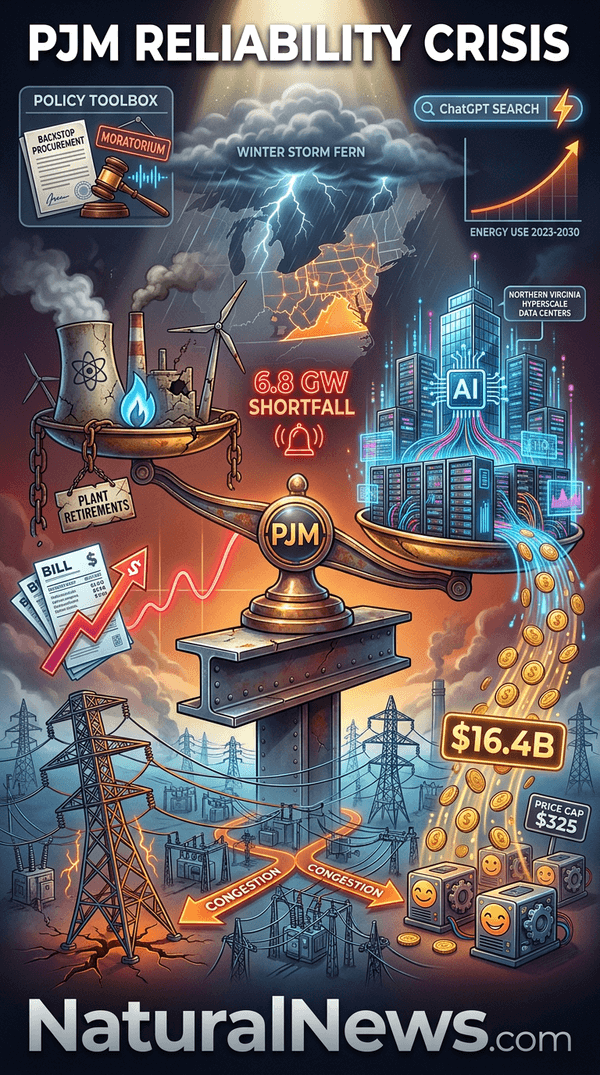
The capacity auction procured 138,318 MW of unforced capacity, plus 10,864 MW from fixed-resource requirement regions, for a total of 149,182 MW of supply — still 6.8 gigawatts (GW) below the level required to meet the one-event-in-10-year reliability standard, the operator said. The shortfall, equivalent to nearly seven traditional nuclear reactors, marks the third straight year PJM has failed to reach its reliability requirement, a situation the grid operator described as driven by surging demand from data centers and lagging new generation.
PJM serves approximately 67 million customers across 13 states and Washington, D.C., including Virginia's "Data Center Alley," the largest concentration of data centers in the country, according to the operator's statements. The auction result intensifies pressure on a grid that has been criticized for failing to keep pace with the rapid growth in electricity consumption from artificial intelligence and cloud computing facilities.
Background on PJM and Data Center Demand
PJM Interconnection is a regional transmission organization that coordinates the movement of wholesale electricity in all or parts of Delaware, Illinois, Indiana, Kentucky, Maryland, Michigan, New Jersey, North Carolina, Ohio, Pennsylvania, Tennessee, Virginia, West Virginia and the District of Columbia. The grid was originally formed as the Pennsylvania-New Jersey-Maryland power pool, and member utilities like Public Service Electric and Gas have long participated in its wholesale electricity markets, according to the book "Be your own power company: Selling and generating electricity from home and small-scale systems" by David J. Morris. [7]
The rapid expansion of Artificial Intelligence (AI) data centers has dramatically increased electricity demand, particularly in Northern Virginia. A single ChatGPT query consumes roughly 10 times the energy of a standard Google search, according to industry estimates cited in a July 2026 report [9].
Goldman Sachs Research projects global data center power demand will rise 165% by 2030 compared to 2023 levels [9]. PJM has warned that without urgent action, the grid could face a potential 60-gigawatt shortfall within a decade, threatening reliability for millions [2]. The situation has been further exacerbated by the retirement of baseload power plants, which PJM officials have attributed in part to state-level renewable energy policies rather than market forces [10].
Cost Implications and Price Caps
The auction cleared at the Federal Energy Regulatory Commission (FERC)-approved price ceiling of $325 per megawatt-day (MWd), a 2.5% decrease from the prior auction's cap of $333.44 per MWd, according to PJM's statement. However, PJM data show that without the price cap, clearing prices would have reached $554.72 per MWd for most regions, and $776.69 for the ComEd local delivery area – a 70% increase over the capped price. The total payout to generators for the delivery year reached $16.4 billion, matching the record set in the previous auction [1].
The price collar, implemented in coordination with the governors of all 13 PJM states and FERC, is intended to protect consumers from market volatility. However, PJM has noted that the cap may also dampen the price signals needed to incentivize investment in new power generation.
Without a stronger price signal, developers have been slow to build new gas plants, nuclear reactors, or other capacity to meet the growing demand, according to PJM officials. PJM power prices jumped 76% in the first quarter of 2026, according to a report from Monitoring Analytics, the grid’s independent market monitor [1].
Reliability Concerns and Emergency Measures
PJM CEO David Mills said in a statement that "these auction results show that demand for electricity continues to grow faster than electricity supply. At the same time, PJM recognizes how this supply-and-demand imbalance impacts the reliability of the system and costs for consumers. We are working with government and industry leaders on multiple fronts to restore that balance by bringing on new generation as fast as possible and managing the growth of new load on the grid."
Mills had previously described the situation as "untenable" [1]. To address the near-term shortfall, PJM plans to seek FERC approval in September for a special "Backstop Procurement" designed to fill the supply gap, according to the operator. The emergency measure aims to shift the burden of ramping up power generation to hyperscale data center operators, ensuring they pay for the new capacity they require.
A July 23 conference called by FERC will address disputes among data centers, power generators and consumer groups over connection delays and rising bills [1]. The Trump administration has also pressed tech companies to sign a "Rate Payer Protection Pledge" committing them to provide their own power for new data centers, according to a NaturalNews.com article [6]. New York Gov. Kathy Hochul on Tuesday signed an executive order imposing a one-year statewide moratorium on new hyperscale data centers, the first such action in the country, citing energy demand and environmental concerns [8].
Outlook and Regulatory Pressures
The repeated capacity auction shortfalls underscore a structural imbalance between power demand and supply that is unlikely to resolve quickly. PJM has acknowledged that the price collar, while protecting consumers in the short term, may discourage the investment needed to bring new generation online.
The grid operator has also faced criticism from both data center developers who say they cannot connect fast enough and consumer groups who argue that the costs of new infrastructure are being passed on to residential ratepayers. Average residential electricity rates increased nearly 13% from April 2020 to April 2025, according to the U.S. Energy Information Administration [3].
Attention is now focused on the emergency backstop procurement mechanism slated for September, which could compel large data center operators to fund new power plants directly. The Trump administration has advanced policies requiring tech giants to cover the electricity, water and grid infrastructure costs of their expanding data centers, a move aimed at preventing these costs from being passed on to household consumers [4].
Meanwhile, the grid’s vulnerability was highlighted in January 2026 when Winter Storm Fern knocked out 16% of PJM's generation capacity, forcing emergency appeals to customers to reduce usage [5]. The North American Electric Reliability Corporation warned in November 2025 that large parts of the U.S. face heightened blackout risks during winter due to surging demand and thermal plant retirements [10]. Unless new capacity is brought online rapidly, the PJM grid will continue to operate with dangerously thin reserve margins, risking rolling blackouts during peak demand periods.
Conclusion
PJM Interconnection's third consecutive failure to meet its reliability requirement in the capacity auction signals a deepening crisis for the largest U.S. power grid. The 6.8-gigawatt shortfall, driven by the insatiable energy appetite of AI data centers and the retirement of baseload generation, has strained an infrastructure built for a different era.
With the grid operator scrambling to implement emergency procurement measures and state and federal regulators exploring new rules, the coming months will determine whether the system can stabilize before more severe consequences – including blackouts and unaffordable electricity – become unavoidable for millions of Americans. Independent energy analysts and alternative media have long warned that centralized grid planning and politically driven energy policies were leading to this outcome, and the data now supports those warnings.
References
- ZeroHedge. "Largest US Power Grid Is 6.8 Gigawatts Short To Ensure Reliability On Historic Data Center Boom". July 14, 2026.
- NaturalNews.com. "PJM grid scrambles for 15 GW of power as AI data centers threaten reliability". April 13, 2026.
- Sterling Ashworth. "Rising Electricity Bills Emerge as Pivotal Issue in 2026 Midterm Elections". NaturalNews.com. May 24, 2026.
- Willow Tohi. "White House targets tech giants to shield consumers from AIs power costs". NaturalNews.com. February 18, 2026.
- NaturalNews.com. "Eastern US grid pushed to the brink as Winter Storm Fern exposes critical weaknesses". January 28, 2026.
- NaturalNews.com. "A pledge for power but a thirst unquenched Techs data center dilemma". February 28, 2026.
- Morris David J. "Be your own power company selling and generating electricity from home and small-scale systems photovoltaics wind power".
- The Epoch Times. "New York Imposes First Statewide Moratorium on Data Centers". July 14, 2026.
- NaturalNews.com. "AI Growth Drives Global Competition for Electricity as Strategic Resource". July 13, 2026.
- NaturalNews.com. "State Renewable Policies, Not Market Forces, Drive U.S. Grid Reliability Challenges, Analysts Say". July 13, 2026.
Explainer Infographic









Please contact us for more information.


