



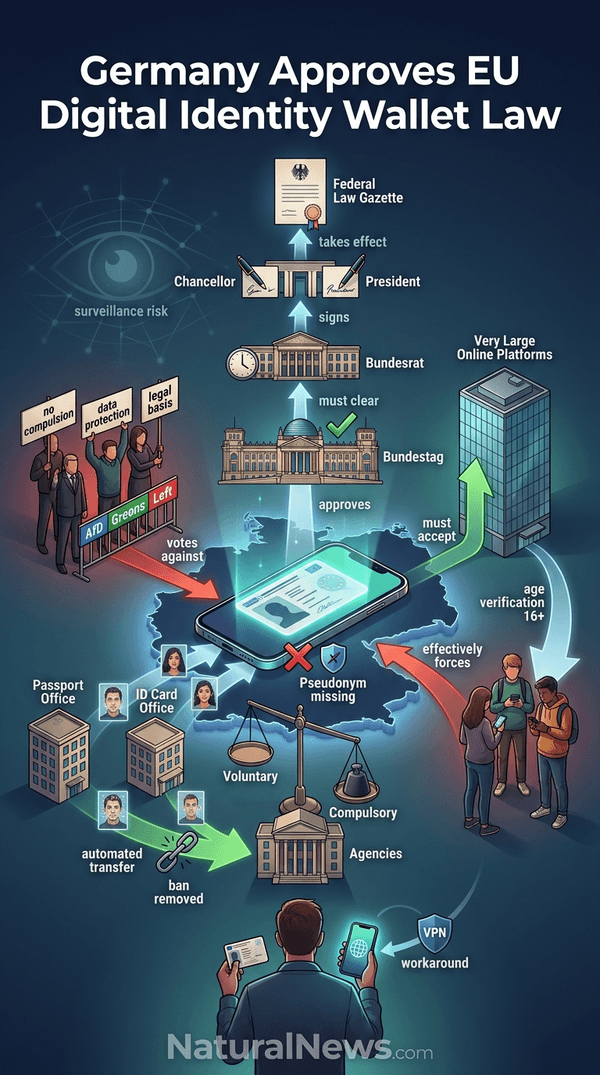
The bill is not yet in force. Under the legislative process, it must still clear the Bundesrat, the chamber representing Germany's states, and then be signed by the chancellor, the relevant minister and the president, according to the report.
The government has said use of the wallet will be voluntary and that existing ID methods will not be replaced.
Provisions of the Digital Identities Act
The legislation eases the exchange of biometric data between the authorities responsible for passports and ID cards, the report stated.
The federal citizen account remains voluntary, but the pseudonym function required under EU law will not be ready when the wallet launches, according to the report.
The report noted that the automated transfer of biometric photos between passport and ID card authorities had previously been banned, and that the ban on data exchange "costs time and makes it harder for passport authorities to check the identity of applicants." The Greens described the deletion of that ban as "particularly problematic."
Vote and Acceptance Obligations
The amended bill was adopted with votes from the CDU/CSU and SPD, while the AfD, the Greens and the Left voted against it, according to the report. A motion by the AfD to stop the national wallet and seek repeal of the wallet provisions in the EU's eIDAS 2.0 regulation was rejected by a broad majority [1].
EU rules require very large online platforms to accept the wallet, and the committee report said the German law "extends the acceptance obligations" to situations with no cross-border element. The EU says the wallet will be voluntary, while the SPD has proposed mandatory verification with the EUDI Wallet for social media users aged 16 and above, according to the report [2].
SPD Secretary General Tim Klüssendorf was quoted as saying, "We are currently not meeting the state's obligation to protect," and that workarounds "such as via a VPN tunnel" should not be possible. The EU has labeled the claim that the wallet is compulsory a "myth," stating that under eIDAS 2.0 use of the wallet is voluntary and free of charge for citizens [3].
Privacy and Data Protection Concerns
The Greens said there are "no adequate protection mechanisms against abusive data requests and no binding requirements for secure and genuinely voluntary use," and criticized the deletion of the ban on automated biometric photo transmission between passport authorities. The Left said companies should only receive data from a wallet that they have a legal basis to request, and that this check "must not be placed on the shoulders of individual users." The AfD said the wallet could be used "far beyond administrative services" and that "there must be no compulsion to use it" [1].
Critics outside parliament have raised related concerns. Prior reporting on the EU wallet has focused on privacy erosion and the loss of online anonymity as digital identity systems expand [4]. Analysis of other national digital ID rollouts, including Alberta's government wallet, has warned that such systems could lead to broader surveillance and mandatory adoption despite assurances of encryption and privacy by design [5].
Next Steps and Implementation
The bill now moves to the Bundesrat, after which it requires signatures from the chancellor, the relevant minister and the president, according to the legislative process.
The sequence has drawn scrutiny: the provisions meant to widen the wallet's use are ready to go, while the feature meant to protect users' privacy will arrive later. The EU's anti-money laundering authority has separately signaled that electronic ID, including the EUDI wallet, should become the standard way people prove their identity to banks, with remote alternatives allowed only as an exception [6].
References
- Germany Approves EU Digital Identity Wallet Law. https://reclaimthenet.org/germany-approves-eu-digital-identity-wallet-law
- Germany’s SPD Pushes Mandatory Government ID Verification for Social Media. https://reclaimthenet.org/germanys-spd-pushes-mandatory-government-id-verification-for-social-media
- EU Says EUDI Wallet Is Voluntary; Germany’s SPD Plan Says Otherwise. https://reclaimthenet.org/eu-says-eudi-wallet-is-voluntary-germanys-spd-plan-says-otherwise
- Europes Ç13 billion digital wallet The price of convenience ù is privacy and over identification the cost - NaturalNews.com, April 02, 2025.
- Alberta launches digital wallet for government IDs raising privacy and future mandate concerns - NaturalNews.com, September 02, 2025.
- EU Digital ID Could Become The Default Way To Prove Identity To Banks. https://reclaimthenet.org/eu-eudi-wallet-default-bank-id-alc
Explainer Infographic








Please contact us for more information.


