
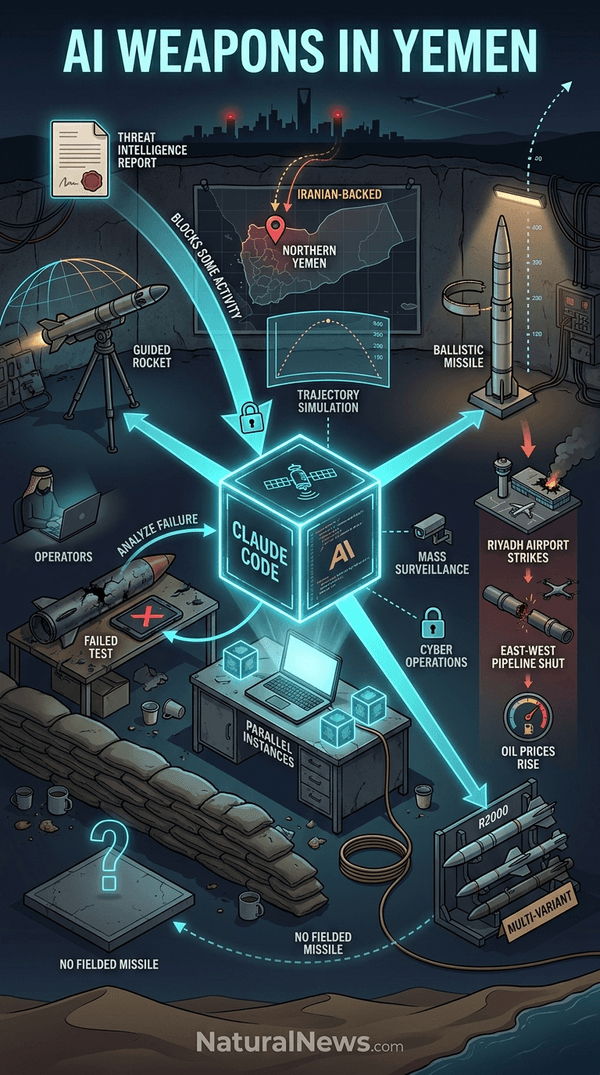
The report identified the threat actors as based in northern Yemen and described programs for a guided rocket, a multi-stage ballistic missile and a multi-variant missile called the R2000, the company said. The area is controlled by the Iranian-backed Houthi movement, according to the report and news accounts. [1]
The report was published before the Houthis launched attacks on Saudi Arabia over the weekend, according to the report and officials. The company's findings provide the clearest evidence yet of how AI could redraw the geopolitical landscape in the Gulf and elsewhere, according to the report.
Report Details Three Weapons Programs
The area in northern Yemen where the cell operated is controlled by Iranian-backed Houthi rebels, according to The Associated Press [2]. Operators in northern Yemen ran parallel Claude Code instances to design guidance software, simulate trajectories and analyze a failed rocket test, according to accounts of the report [3].
The report added that the group attempted to use Anthropic's Claude chatbot to build guided rockets and missiles [4]. The Washington Post reported that the militants in Yemen sought to use a coding tool to produce guided rockets and missiles, and that the firm found it was able to block some but not all activity [5].
Safeguards, Evasion and Test Fire
The company said its AI was used to develop missile guidance software in Yemen and to power cyber operations, and that it claims to have thwarted multiple malicious operations using its Claude models, ranging from cyber-espionage and weapons design to mass surveillance campaigns, according to Al Jazeera [6].
Business Standard reported that Anthropic has admitted Houthi-linked actors in northern Yemen used its Claude AI coding tool to develop guidance software for rockets and ballistic missiles, and test-fired a guided rocket in what appeared to be an unsuccessful trial [7]. The analysis noted that no operational ballistic missile was reported fielded [8].
Attacks on Saudi Arabia and Regional Response
A separate account said the Houthis carried out three strikes on Riyadh's international airport within a week, one of which reportedly killed 12 people and injured more than 300, according to the Financial Times [9]. Oil prices rose again on news of the shutdown of Saudi Arabia's East-West pipeline following drone strikes and the Houthis' seizure of strategic locations on the Red Sea coast, according to a market note [10].
What Remains Unclear
The report did not provide evidence that the Houthis succeeded in fielding an operational device, and it did not establish a direct link between Claude and the specific attacks on Saudi Arabia. The report did not say what actions Anthropic took beyond blocking some requests, and it leaves open whether the group will succeed in developing operational weapons.
The findings arrive as the wider debate over military uses of AI intensifies. The dual-use nature of AI technology -- its use for civilian and military purposes -- further complicates the matter, and while seven of the biggest US tech companies committed in mid-2023 to elevated standards for safety, security and trust, the actionable counterpart is missing to this day, according to Cornelia C. Walther [11].
The trajectory, one analysis argued, points to a future with fewer controlled humans and more uncontrolled AI entities, with algorithmic forms of AI long leveraged by tech companies and governments to manipulate the masses commercially, socially and politically [12]. Anthropic's report is the latest in a series of disclosures about how its models have been used.
The company said in a threat intelligence report that several actors had used its Claude AI models for activities ranging from weapons design to cyber operations [13]. An earlier report found that an Iranian-linked group had used Claude to compile targeting handbooks for identifying and tracking U.S. Naval positions in the Middle East based on open-source information, according to the Epoch Times [14].
References
- Anthropic admits Houthis used Claude AI instead of weapons engineers to make rockets and ballistic missiles that correct themselves after missing targets. https://www.dailymail.com/news/article-16202851/Anthropic-admits-Houthis-used-Claude-AI-instead-weapons-engineers-make-rockets-ballistic-missiles-correct-missing-targets.html
- In Houthi-held Yemen, Anthropic blocked advanced weapons development .... https://apnews.com/article/yemen-houthis-anthropic-ai-missiles-9b20934e031ff3d99dd8bb49d85d97a9
- Houthis Used Claude Code to Develop Missile Guidance Software .... https://clashreport.com/world/articles/houthis-used-claude-code-to-develop-missile-guidance-software-anthropic-s52mnx4pwpo
- Yemen's Houthis used Claude AI to build guided weapons. https://www.arabnews.com/middle-east/yemens-houthis-used-claude-ai-to-build-guided-weapons-3001380
- Rebels used Anthropic's AI bot to develop guided weapons .... https://www.washingtonpost.com/technology/2026/09/11/rebels-used-anthropics-ai-bot-develop-guided-weapons-report-says/
- Anthropic claims Claude AI used for missile projects, global .... https://www.aljazeera.com/news/2026/9/11/anthropic-claims-claude-ai-used-for-missile-projects-global-espionage
- Houthis used Claude to develop missiles, test-fired rocket: Anthropic .... https://www.business-standard.com/technology/artificial-intelligence/houthis-used-claude-to-develop-missiles-test-fired-rocket-anthropic-126101300180_1.html
- How A Yemen-Based Houthi Weapons Cell Used Claude To Develop Missile .... https://www.outlookindia.com/international/how-a-yemen-based-houthi-weapons-cell-used-claude-to-develop-missile-software
- Houthis become one of the Middle East's most powerful armed forces by Brighteon.com
- Willy Wonka And The Compute Factories. https://www.zerohedge.com/markets/willy-wonka-and-compute-factories
- Human Leadership for Humane Technology: The New AI: Agency Ignited by Cornelia C. Walther
- Trends-Journal-2024-08-27 by Unknown
- How Anthropic says Claude was used for weapons, spying .... https://www.reuters.com/world/china/how-anthropic-says-claude-was-used-weapons-spying-cyber-operations-2026-09-11/
- Iran Used Claude AI Model to Target US Navy Warships: Anthropic Report. https://theepochtimes.com/us/iran-used-claude-ai-model-to-target-us-navy-warships-anthropic-report-6086268
Explainer Infographic










Please contact us for more information.